Who may enter
Most Hindu temples in North India, Nepal, Bali and the Tamil temples of Singapore and Malaysia welcome visitors of any faith. Others restrict entry, and the rule is stated plainly at the gate. In Kerala most temples admit Hindus only: the Sree Padmanabhaswamy Temple in Thiruvananthapuram enforces this together with a strict traditional dress code. The Jagannath Temple in Puri is also for Hindus only, and many temples in Tamil Nadu close their inner sanctums to non-Hindus.
Partial access is common. At the Meenakshi Amman Temple in Madurai non-Hindus walk the outer corridors and halls but not the sanctums of Meenakshi and Sundareswarar. At Pashupatinath in Kathmandu only Hindus may enter the courtyard of the main temple, and others look in through the gates or from the terraces across the river; Changu Narayan and Dakshinkali keep non-Hindus outside the inner enclosure too. In Bali the innermost court of a pura is reserved for worshippers, as at Uluwatu.
What to wear
Cover shoulders and knees, and in practice a little more: long trousers or a long skirt, a top with sleeves, nothing tight or see-through. Siddhivinayak in Mumbai and Chamundeshwari in Mysore turn away shorts and sleeveless tops, and Swaminarayan Akshardham in Delhi hands out cover cloths at the gate. The BAPS Hindu Mandir in Abu Dhabi asks for shoulders, chest and knees covered. In the strictest Kerala temples men wear a white mundu and go bare-chested, and women a sari or long skirt; at Gavi Gangadhareshwara in Bengaluru men may be asked to remove their shirts in the sanctum.
Shoes, leather and phones
Shoes come off at the gate or at the foot of the steps, and most large temples run a free or nominal shoe stand. Socks are usually allowed and are a mercy on hot stone; at Karni Mata in Deshnoke, where rats run freely over the floor, they are advisable. Many temples also exclude leather, so leave belts, wallets and leather bags behind, as at Pashupatinath, Eklingji near Udaipur and Somnath.
Security has tightened at the largest temples. At Akshardham in Delhi phones, cameras, bags and food go to a cloakroom before you queue, so photography is impossible inside, and Meenakshi Amman, Kashi Vishwanath in Varanasi and Krishna Janmabhoomi in Mathura have similar rules. Carry as little as possible and expect a body search.
Bali is different
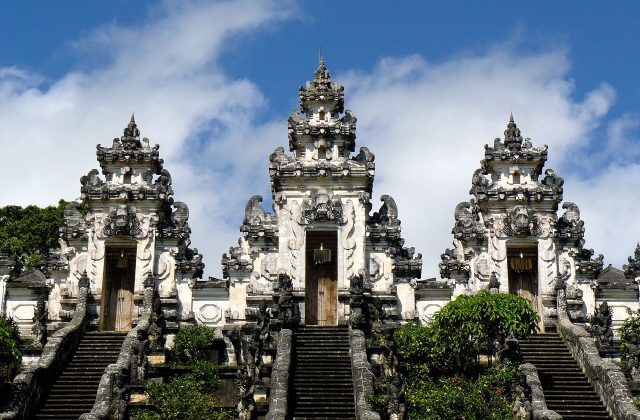
Balinese Hinduism has its own customs. A sarong and a sash tied at the waist are required for everyone, men included, in the temple courts, and they are lent at the entrance at Uluwatu, Tirta Empul, Pura Lempuyang and Besakih. Shoulders should be covered. Menstruating women are traditionally asked not to enter, a rule posted at Tirta Empul and many other puras. Do not climb on shrines or walls, and never step on the small palm-leaf offerings, canang sari, left on the ground.
At Tirta Empul visitors may join the purification in the spring-fed pools, wearing a separate bathing sarong, making a small offering first and following worshippers from spout to spout without splashing or posing. At Besakih decline the unofficial guides near the car park and hire only from the official desk.
Darshan, puja and offerings
Darshan, seeing and being seen by the deity, is the heart of a temple visit, and at busy temples it means a queue. Many large temples sell paid fast-track darshan, as at Meenakshi Amman, Kamakhya in Guwahati and Kashi Vishwanath. If a priest offers you a blessing, a red mark on the forehead or a sweet prasad, accept it with the right hand; he may hope for a small donation, and you are free to give what you choose. Walk round the shrine clockwise, keeping it on your right.
Photography
Many temples ban photography inside, and some ban phones altogether. Kedarnath forbids photos inside, while Galtaji in Jaipur and Karni Mata charge a small camera fee. At Pashupatinath the cremation ghats are open to view, but behave as you would at a funeral: keep a distance from mourners and never photograph a cremation close up. Sadhus who pose for pictures expect a tip.
Common mistakes
The usual errors are wearing leather into a shrine, giving or receiving with the left hand, walking anticlockwise and touching an image or a priest's offering tray. In Bali the mistake is treating a pura as a backdrop: the queue for the photograph in the split gate at Pura Lempuyang can last hours, and the inner courts are not part of the show. Above all, read the sign at the gate and accept a refusal without argument.