Thailand is not Japan
Buddhism spans very different traditions, and the visitor's rules change with them. In the Theravada countries, Thailand, Cambodia, Laos, Sri Lanka and Myanmar, temples are working monasteries with firm expectations about clothing, feet and the Buddha image. In Japan most temples have no dress code, ask you to remove shoes only in certain halls and charge admission at the gate. China, Korea and Vietnam sit between the two, while Tibetan monasteries in Nepal, Ladakh and Tibet add their own conventions of circling and prayer wheels.
What to wear
In Theravada temples cover shoulders and knees, and in the royal temples of Bangkok go further. Wat Phra Kaew in the Grand Palace requires shoulders, knees and ankles covered and turns away shorts, sleeveless tops and ripped trousers; Wat Rong Khun in Chiang Rai enforces its rule strictly too. Sarongs are lent at Doi Suthep and Wat Chalong. In Sri Lanka white or light clothing is preferred, and at the Temple of the Sacred Tooth Relic in Kandy many pilgrims dress entirely in white. In Laos women are expected to wear a long skirt at Wat Si Muang.
In Japan, Kinkaku-ji in Kyoto and Senso-ji in Tokyo ask for nothing beyond removing hats in the halls, and most Chinese temples are similarly relaxed, though modest clothing is always appreciated. In Vietnam pagodas such as Tam Chuc and the Truc Lam Zen Monastery in Da Lat do not allow shorts or short skirts in the main hall. Hats come off indoors across the whole region.
Shoes, feet and Buddha images
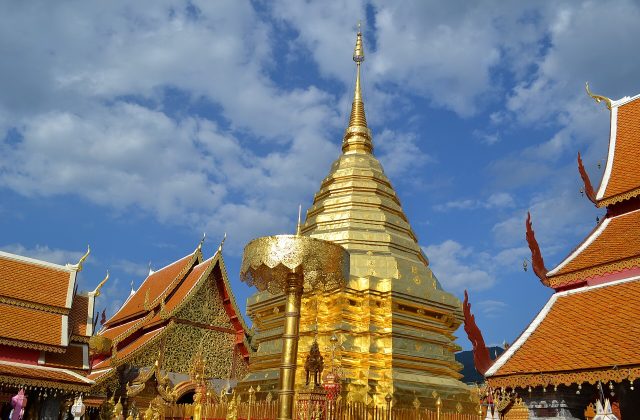
Take shoes off before entering any hall that houses a Buddha image, and often on the terrace around a chedi or stupa, as at Doi Suthep. Leave them where you see other footwear. In Japan the rule follows the floor: shoes come off where wooden boards or tatami begin, as in the abbot's quarters of Nanzen-ji or on the veranda at Ryoan-ji, and bags for carrying them are often provided. Wear socks you are happy to show, as the floors are cold in winter.
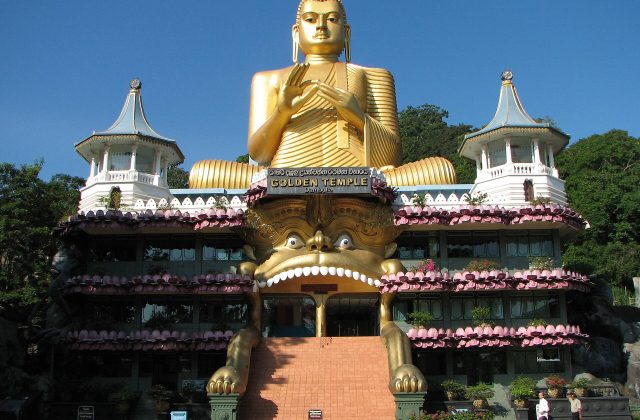
Feet are the lowest part of the body, so never point them at a Buddha image, a monk or an altar; when sitting in a Thai hall, tuck your legs to one side. Never climb on statues and never stand with your back to a Buddha for a photograph. At Dambulla and in Kandy this causes real offence, and in Sri Lanka visible tattoos of the Buddha can cause serious trouble.
Monks and nuns
In Theravada countries women should not touch a monk or hand anything directly to him; place the object on a table or a cloth in front of him instead. Give monks room on paths and in vehicles, and avoid sitting higher than one. Some halls are closed to women: at Wat Sri Suphan in Chiang Mai women may not enter the silver ordination hall and view it from the terrace. Ask before photographing monks. A slight bow with palms together, the wai in Thailand, is always welcome.
Walking clockwise
Circle stupas, chedis and shrines clockwise, keeping them on your right. At Boudhanath and Swayambhunath in Kathmandu pilgrims walk the circuit turning the prayer wheels set into the base, and visitors are expected to follow the same direction. At the Lama Temple in Beijing you also walk clockwise round the prayer wheels. Do not touch or step over offerings of flowers, food or incense left on the ground.
Photography
Rules vary from site to site. Photography is not allowed inside the main hall at Wat Phra Kaew, in the halls of the Lama Temple, inside the chapels of the Potala Palace or inside the halls of Horyuji. At Senso-ji it is fine in the grounds but should be discreet in the main hall. Where it is allowed, avoid flash, do not photograph people at prayer and never pose climbing on an image.
Offerings and donations
Many temples in Thailand, Cambodia and Laos are free and rely on donation boxes, and a note in the box is customary if you have enjoyed the visit. In Japan an admission fee is normal, JPY 500 at Kinkaku-ji and JPY 600 at Ryoan-ji. At Senso-ji you can draw an omikuji fortune slip for a small donation and tie a bad one to the rack to leave the luck behind, while at the great incense burner people waft the smoke over themselves for good health. At the Lama Temple the ticket includes a bundle of incense, which is lit only at the courtyard burners.
Common mistakes
The classic error in Bangkok is to believe a stranger who says the Grand Palace is closed today and offers a tuk-tuk ride somewhere else instead; ignore it. Others are arriving at Wat Phra Kaew in shorts, sitting with feet stretched towards the altar, touching a Buddha image on the head and talking loudly in a meditation hall. In Japan the commonest mistake is walking onto tatami in shoes. When in doubt, watch what local visitors do and follow them.