
Fushimi Inari Taisha
Kyoto, Japan
There is nothing to buy to enter Fushimi Inari: the grounds and the mountain trails are open free of charge at all…
38 tickets & tours
Buddhist Temple · Kyoto · Japan
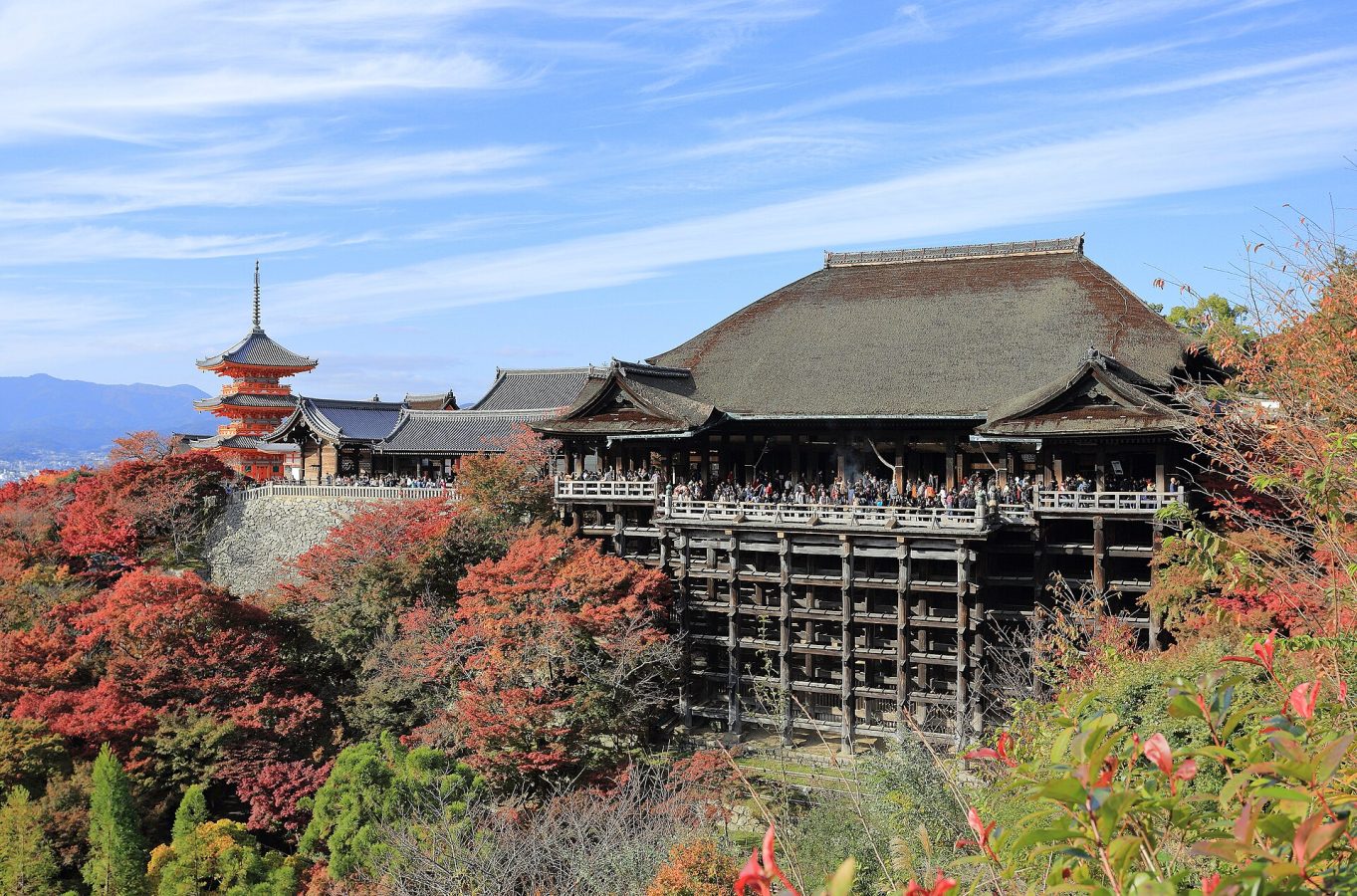
Photo: Martin Falbisoner, CC BY-SA 4.0
Kiyomizu-dera does not sell timed tickets, and there is nothing to book for an independent visit: the grounds are open to all, and you pay a modest fee at the gate to the main hall and its famous wooden stage. A separate small charge applies to the walk through the darkened basement of the Zuigudo hall. The temple is easy to reach by city bus or on foot from Gion, which makes the self-guided visit the default for most travellers. The tours on sale are mostly walking tours of the Higashiyama district that start or finish at the temple and continue down the old lanes to Gion, often with a second stop at the Fushimi Inari shrine in the south of the city.
There are full-day coach tours that also take in the Golden Pavilion and Arashiyama, day trips from Osaka, private walks with a historian, early cycling or hiking routes from Fushimi Inari across the hills, and evening walks through Gion. A big category is kimono rental from the shops on the approach streets, sometimes with a professional photo shoot, and there are tea ceremonies, sake tastings and food walks nearby. For a first visit, a morning walking tour of Higashiyama with a local guide is the sensible choice; otherwise go on your own at opening time.
Live dates and prices from GetYourGuide. Free cancellation on most tickets.
Kiyomizu-dera is one of the oldest temples in Kyoto, founded in 778, before the city became the capital, at a spring on the slopes of Mount Otowa; its name means pure water. It belongs to the Kita-Hosso school of Buddhism and is dedicated to Kannon, the bodhisattva of compassion, whose main image is a hidden statue shown only on rare occasions. Most of the present buildings were rebuilt in 1633 under the third Tokugawa shogun, Iemitsu. The temple is part of the Historic Monuments of Ancient Kyoto World Heritage Site. From the top of the steep Kiyomizu-zaka slope you pass through the vermilion Deva Gate, with the three-storey pagoda beside it, and climb to the main hall. Its great wooden stage juts out over the valley, held up by a lattice of tall pillars joined without nails, and the view takes in the maple trees below and the city beyond.
Further on, the path drops to the Otowa waterfall, where three thin streams fall into a pool; visitors use long-handled cups to drink from one of them for health, success or love, and it is considered greedy to drink from all three. The Jishu shrine above the main hall is dedicated to a god of love and matchmaking. Near the entrance, the Zuigudo hall offers a short walk in complete darkness that symbolises rebirth; it is a strange and moving experience. Be patient on the narrow paths, and do not lean on the railings of the stage. From Kyoto station, take a city bus to Gojo-zaka or Kiyomizu-michi and walk up for about 15 minutes, or walk from Gion through Ninenzaka and Sannenzaka.
The temple opens early in the morning, at around 6 am, and closes in the early evening, with later night openings during the special illuminations in spring, summer and autumn; check the official site for the current hours. The best time is right at opening: by 9 am the approach streets are full of school groups and tour buses, and the stage is crowded until dusk. The temple is at its most beautiful in late March and early April, when the cherry trees bloom around the stage, and in the second half of November, when the maples below turn red;
both are also the busiest times of year. Winter mornings are cold but quiet, and a dusting of snow on the roofs is a rare treat. Summer is hot and humid. Every 12 December the temple's chief priest paints the kanji of the year on a huge board, a ceremony broadcast across Japan. Allow one to one and a half hours, more if you walk the old lanes of Higashiyama afterwards towards Kodai-ji, Yasaka Shrine and Gion.
Yes. GetYourGuide lists 40 tickets and tours for Kiyomizu-dera, with live dates and prices and free cancellation on most of them.
Kiyomizu-dera does not sell timed tickets, and there is nothing to book for an independent visit: the grounds are open to all, and you pay a modest fee at the gate to the main hall and its famous wooden stage.
Allow one to one and a half hours, more if you walk the old lanes of Higashiyama afterwards towards Kodai-ji, Yasaka Shrine and Gion.
The best time is right at opening: by 9 am the approach streets are full of school groups and tour buses, and the stage is crowded until dusk.
Entry to Kiyomizu-dera: Small fee for the main hall area
No dress code; shoes off only for the walk through the dark hall beneath Zuigudo.
Kiyomizu-dera covers 12 ha.
Kiyomizu-dera was established in 778.
Kiyomizu-dera is in Kyoto, Japan. The map on this page shows the exact spot.
How to visit a Buddhist temple: shoes, dress and manners — Shoes, dress, feet, photos and offerings in Buddhist temples, from the wats of Thailand and Sri Lanka to the Zen temples of Japan.
Kyoto, Japan
There is nothing to buy to enter Fushimi Inari: the grounds and the mountain trails are open free of charge at all…
38 tickets & tours
Kyoto, Japan
Kinkaku-ji is simple to visit on your own: you pay at the gate on arrival, and the ticket, a paper talisman printed…
19 tickets & tours
Kyoto, Japan
Ryoan-ji sells its own entry ticket at the gate, and for most visitors that is all that is needed.
3 tickets & tours
Kyoto, Japan
Entry to the courtyard of Heian Jingu is free, and there is nothing to book.
2 tickets & tours
Kyoto, Japan
Kifune Shrine has no admission fee and nothing to reserve.
2 tickets & tours
Kyoto, Japan
Kitano Tenmangu needs no ticket. The gates open to anyone from early morning, there is no admission charge for the main…
2 tickets & tours


