Can non-Muslims go in
Most mosques in this catalogue welcome visitors of any faith outside prayer times, and many of the great ones, from Istanbul to Abu Dhabi and Kuala Lumpur, run visitor entrances, free tours and robe loans for exactly that purpose. A few do not. The Grand Mosque of Mecca, and the city itself, are closed to non-Muslims, as is the central sanctuary of Medina. In Morocco nearly all mosques are for Muslims only: the Koutoubia in Marrakesh, the Al-Qarawiyyin in Fez and the great mosques of Tangier and Chefchaouen are seen from outside or through an open door.
The exceptions are worth knowing. The Hassan II Mosque in Casablanca is the one large Moroccan mosque that non-Muslims can enter, and only on the official guided tour of about an hour. The Great Mosque of Kairouan in Tunisia admits visitors to its courtyard but not to the prayer hall, and on the Temple Mount in Jerusalem non-Muslims may walk the esplanade in short morning and early-afternoon windows but cannot enter the Dome of the Rock or al-Aqsa. Where a restriction exists, it is applied calmly and without exception.
What to wear
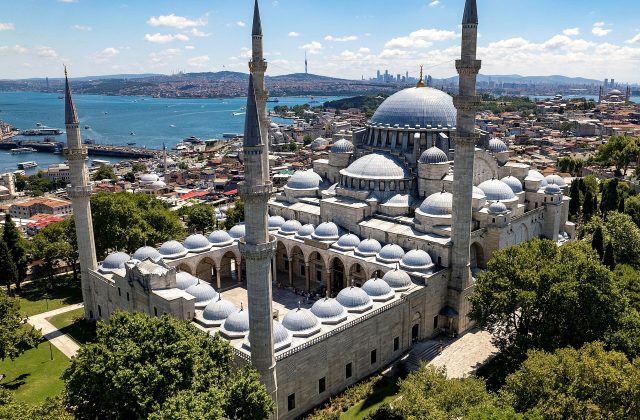
The common standard is simple: arms and legs covered for everyone, and hair covered for women. Men wear long trousers and a shirt with sleeves; women wear a long skirt or loose trousers, a top that covers the arms and a scarf over the hair. Tight or sheer clothing fails the test even when it covers the skin. In Turkey the rule is applied gently, with scarves and wraps lent at the door of the Blue Mosque and the Suleymaniye, and the mosques of Sarajevo, Tirana and Prizren work in much the same way.
The Gulf is stricter and better equipped. At the Sheikh Zayed Grand Mosque in Abu Dhabi long, loose clothing is checked at the entrance; the Sultan Qaboos Grand Mosque in Muscat lends or rents abayas and scarves, and the national mosques of Malaysia lend robes free at the visitor entrance. At Jama Masjid in Delhi robes are handed out at the gates to anyone in shorts or a sleeveless top. Carrying your own light scarf saves a queue for a borrowed one.
Shoes and where to walk
Shoes come off before the carpeted prayer hall, and in many mosques before the courtyard as well. Take them off at the marked threshold, not on the carpet itself. At the Blue Mosque and the Suleymaniye plastic bags are handed out so you carry your shoes with you, and Hassan II provides a bag at the entrance. In Cairo, at Ibn Tulun and Al-Hakim, an attendant keeps shoes or lends cloth covers and expects a small tip. Wear clean socks, as courtyard marble can be hot by midday.
Inside, keep to the area set aside for visitors, often roped off or marked by a carpet runner. Sheikh Zayed follows a marked route and closes worship areas to sightseers, and Hagia Sophia sends foreign visitors with tickets up to the galleries while worshippers use the ground floor.
Prayer times and Fridays
The five daily prayers shape every visit. Their times move with the sun, so check them on the day, and expect tourist mosques to close to visitors for an hour or more around each one. The Blue Mosque closes for about 90 minutes at each prayer and stays closed to tourists on Friday until mid-afternoon; Hagia Sophia follows a similar pattern, and its Friday closure catches many people out. Friday midday is the main congregational prayer everywhere, and at Jama Masjid in Delhi it is the one time not to come.
Ramadan changes the rhythm: days are quieter, visiting hours can shorten and evenings are crowded with worshippers. Sheikh Zayed opens later on Fridays, adjusts its hours in Ramadan and asks visitors to register for a free time slot on its official website. Almost everywhere, the first hour after morning opening is the calmest.
Photography and behaviour
Photographing the architecture is usually allowed and sometimes encouraged, as at Sheikh Zayed and on the Hassan II tour. Never photograph people at prayer, never walk directly in front of someone praying, and keep your voice low. At Jama Masjid in Delhi a camera fee is charged at the gate, phones included. Couples should not hold hands or pose together in the prayer hall, and food, music and drones have no place inside.
Women, children and visitors
Women pray in their own section, behind a screen, in a gallery or at the back of the hall, so some areas may be reserved for men or for women. At Sidi Saiyyed Mosque in Ahmedabad women view the famous stone lattice from outside. Children are welcome if they are kept quiet. Non-Muslim visitors are not expected to perform ablutions or any gesture of prayer, and staff at the large mosques are usually glad to answer questions; the free cultural tours at Sheikh Zayed exist for exactly that.
Common mistakes
The usual errors are small and avoidable: arriving at Friday noon, wearing shorts in the belief that the heat excuses them, stepping onto the carpet in shoes, and photographing a man at prayer because the light was good. Another is assuming that one country's rule holds in the next. A visitor used to walking freely into the Suleymaniye may be surprised by the closed doors of Fez, while one who knows Morocco may not expect to need a booked slot in Abu Dhabi. Check the page for each mosque before you go.