Hagia Sophia
Istanbul, Turkey
Since Hagia Sophia became a mosque again in 2020, the way you visit it has changed.
78 tickets & tours

Entry to the Suleymaniye Mosque costs nothing and needs no ticket, so anything sold online for it is really a guide's time rather than admission. That makes the choice simple: if you are happy to read up beforehand, walk in on your own outside prayer times and spend the money elsewhere. If you want the story of Suleiman, Sinan and the Ottoman complex explained as you stand in it, a guided visit is worth having. The tours that include the mosque fall into a few kinds. Some are short walking tours of the Old City that pair it with the Blue Mosque and the Grand Bazaar, usually covering the ground on foot between the Hippodrome and the Third Hill.
Others are longer half-day or full-day outings that add Topkapi Palace or Hagia Sophia, where the palace ticket is normally paid on top unless the listing says it is included. There are also private walks devoted to the Suleymaniye alone with a local guide, and self-guided audio options that you download and follow at your own pace. Whichever you pick, check whether the route runs on a Friday, when the noon prayer closes the mosque to visitors for much of the middle of the day, and whether hotel pick-up is included or you meet the guide in Sultanahmet.
Live dates and prices from GetYourGuide. Free cancellation on most tickets.
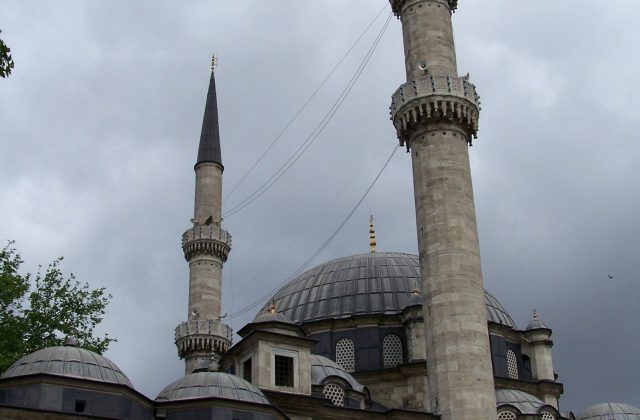
The mosque stands on the Third Hill of the historic peninsula, above the Golden Horn, and its four minarets and stepped cascade of domes are one of the shapes that define the Istanbul skyline. Suleiman the Magnificent commissioned it from his chief architect Mimar Sinan; building began in 1550 and the mosque was inaugurated in 1557. It is the largest Ottoman mosque in the city, and the main dome rises to about 53 m. You enter through a colonnaded forecourt with a fountain at its centre before reaching the prayer hall. Inside, the effect is of light and calm rather than decoration: the walls are largely plain stone, with Iznik tiles kept mostly to the qibla wall around the mihrab, and many windows filling the space with daylight.
Look for the fine stained glass above the mihrab, the carved marble minbar and the way two half domes extend the central dome along the axis of the hall. Do not leave without walking round the back. Behind the qibla wall is a walled cemetery with the octagonal tombs of Suleiman and of his wife Hurrem Sultan, known in Europe as Roxelana. The mosque was the heart of a wider complex of madrasas, a hospital and a public kitchen, and several of those buildings still stand around the outer courtyard, as does the terrace with a wide view over the Golden Horn. Remove your shoes at the entrance and carry them in a plastic bag. Women cover their hair; scarves and wraps are lent at the door. Keep voices low, avoid photographing people at prayer and stay behind the barrier during services. From Sultanahmet it is a 20-minute walk uphill past the Grand Bazaar, or take the tram to Beyazit or Eminonu and walk up.
The mosque is open daily from early morning until after the evening prayer, but it closes to sightseers for roughly half an hour around each of the five daily prayers, and for longer at the Friday noon prayer. Prayer times move with the sun, so check them on the day and aim for the gaps between them. The quietest hour is early morning, before the walking groups climb up from Sultanahmet, or late afternoon, when the light through the windows is softer and the terrace view of the Golden Horn is at its best.
Spring and autumn are the most comfortable seasons for the walk between the hills. During Ramadan the mosque is busy in the evening and visiting hours can be shorter, and on the main religious holidays it is crowded with worshippers. Allow about an hour for the prayer hall, the tombs and the courtyards. The obvious pairing is the Grand Bazaar just downhill, followed by the Spice Bazaar and the Rustem Pasha Mosque near Eminonu, another fine work by Sinan.
Yes. GetYourGuide lists 5 tickets and tours for Suleymaniye Mosque, with live dates and prices and free cancellation on most of them.
That makes the choice simple: if you are happy to read up beforehand, walk in on your own outside prayer times and spend the money elsewhere.
Allow about an hour for the prayer hall, the tombs and the courtyards.
The quietest hour is early morning, before the walking groups climb up from Sultanahmet, or late afternoon, when the light through the windows is softer and the terrace view of the Golden Horn is at its best.
Shoulders and knees covered, women cover their hair; shoes off and carried in a bag inside.
Entry to Suleymaniye Mosque: Free; donations welcome
Suleymaniye Mosque was established in 1550.
Suleymaniye Mosque is in Istanbul, Turkey. The map on this page shows the exact spot.
How to visit a mosque: dress, timing and manners — What to wear, when to go and how to behave in a mosque as a non-Muslim, and which mosques do not admit visitors at all.
Istanbul, Turkey
Since Hagia Sophia became a mosque again in 2020, the way you visit it has changed.
78 tickets & tours
Istanbul, Turkey
Entry to the Sultan Ahmed Mosque is free and there is no ticket to buy, so anything sold online is really a guide, a…
34 tickets & tours
Istanbul, Turkey
The Grand Çamlıca Mosque is a working place of worship and costs nothing to enter.
3 tickets & tours
Istanbul, Turkey
Entry to the Eyup Sultan Mosque and to the tomb of Abu Ayyub al-Ansari is free, and no ticket is needed or sold.
1 ticket or tour
Istanbul, Turkey
There is nothing to book for the Mihrimah Sultan Mosque in Üsküdar, and no ticket for it alone is sold online.
No online ticket
Istanbul, Turkey
No ticket for Neve Shalom is sold through the booking platforms, and you cannot simply walk in.
No online ticket