Meiji Shrine (Meiji Jingu)
Tokyo, Japan
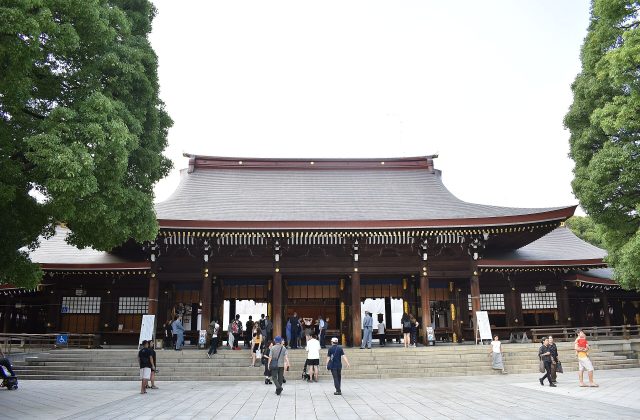
Meiji Jingu is free to enter and there is no ticket to buy for the shrine itself: you simply walk in from Harajuku or…
38 tickets & tours
Shinto Shrine · Tokyo · Japan

Photo: Kakidai Rising Sun Flag of Japan (16 rays) Legal discla, CC BY-SA 4.0
Yasukuni Shrine, in the Kudan district of central Tokyo just north of the Imperial Palace, is free to enter, and the only paid part is the Yushukan, the military history museum next to the main hall, which charges a modest admission at the door. Nothing needs to be booked. Guided visits are few and of two quite different kinds. The first is a historical walking tour that uses the shrine and the museum to talk about Japan's wars, especially the Second World War, the way the dead are commemorated and why the shrine provokes protests in China and Korea. A good guide puts the museum's one-sided account in context, which is the strongest reason to go with one.
The second is a light-hearted stroll through the shrine grounds and quiet nearby streets in the company of a local and their Shiba Inu dog, which is more about a gentle walk than about history. Independent visitors can manage without either. Kudanshita station on the Tozai, Hanzomon and Shinjuku subway lines is a few minutes' walk from the great steel torii at the bottom of the approach, and Ichigaya and Iidabashi stations are within fifteen minutes on foot. English signs are limited in the shrine grounds, but the museum labels are partly translated. If you want to understand why the shrine matters politically, read about it beforehand or take the historical tour.
Live dates and prices from GetYourGuide. Free cancellation on most tickets.
The shrine was founded by the Meiji emperor in 1869 to honour those who had died fighting for the imperial side in the civil war that brought him to power, and it now enshrines the spirits of nearly two and a half million people who died in Japan's wars up to 1945. Among them are more than a thousand convicted war criminals, including fourteen judged guilty of the gravest charges at the Tokyo trials, which is why visits by Japanese politicians draw protests from neighbouring countries. The approach is long and wide, lined with cherry and ginkgo trees and passing under a series of huge torii, the first of them among the tallest in Japan. A bronze statue of Omura Masujiro, founder of the modern Japanese army, stands in the middle of the avenue.
The inner gate, hung with large white curtains bearing the imperial chrysanthemum, leads to the plain, dignified hall of worship in the restrained style of Shinto architecture. Visitors may pray in front of the hall but not enter the inner areas. The Yushukan museum displays weapons, uniforms, personal letters of soldiers and a steam locomotive from the Thai-Burma railway, and its narrative presents Japan's wars in a strongly nationalist light, an interpretation most historians reject. Visit it to understand that point of view rather than as a neutral history. Behind the main hall lies a quiet Japanese garden with a pond. Behave as at any memorial: dress neatly, keep your voice down and do not stage playful photographs. Photography inside the main hall area is not permitted.
The shrine gates open early in the morning and close in the early evening, a little earlier in winter; the Yushukan keeps shorter museum hours. Check the official site before visiting on public holidays. Weekday mornings are quiet. Spring is the most beautiful season: the cherry trees on the approach include the tree Japan's weather agency watches to declare the start of the blossom season in Tokyo, usually in late March, and the grounds fill with picnickers. In mid-July the Mitama Matsuri festival lights the approach with tens of thousands of paper lanterns over four evenings and brings out food stalls and crowds. Be aware of the politically charged dates.
On 15 August, the anniversary of Japan's surrender, the shrine is crowded with veterans' associations, nationalist groups, media and police; it is a striking sight but tense, and visitors who want a calm visit should avoid it. The main spring and autumn festivals, in April and October, also attract official delegations. Allow an hour for the shrine and two for the museum. Combine the visit with the Chidorigafuchi moat, beautiful in cherry season, the Imperial Palace East Gardens and the bookshops of Jimbocho.
Yes. GetYourGuide lists 2 tickets and tours for Yasukuni Shrine, with live dates and prices and free cancellation on most of them.
Allow an hour for the shrine and two for the museum.
Entry to Yasukuni Shrine: Free; Yushukan museum ticket extra
No dress code; behave with restraint at this memorial shrine.
Yasukuni Shrine was established in 1869.
Yasukuni Shrine is in Tokyo, Japan. The map on this page shows the exact spot.
How to visit a Shinto shrine: torii, water and prayer — How to pass the torii, purify at the water basin, pray, take photos and buy charms at a Shinto shrine in Japan.
Tokyo, Japan
Meiji Jingu is free to enter and there is no ticket to buy for the shrine itself: you simply walk in from Harajuku or…
38 tickets & tours
Tokyo, Japan
There is no ticket for Senso-ji: the temple grounds are free and always open, and the main hall can be entered at no…
31 tickets & tours
Tokyo, Japan
Nezu Shrine is free to enter and open to anyone who walks in, so there is no ticket to buy;
7 tickets & tours
Tokyo, Japan
There is nothing to buy for Asakusa Shrine: it stands open and free inside the grounds of Senso-ji, Tokyo's oldest…
6 tickets & tours
Tokyo, Japan
Gotokuji is free to enter and there is nothing to book for the temple itself.
3 tickets & tours
Tokyo, Japan
Hie Shrine charges no entry fee and no ticket for it is sold online.
No online ticket