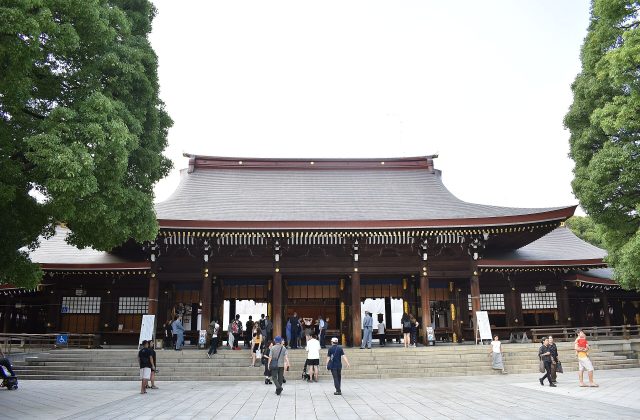
Meiji Shrine (Meiji Jingu)
Tokyo, Japan
Meiji Jingu is free to enter and there is no ticket to buy for the shrine itself: you simply walk in from Harajuku or…
38 tickets & tours
Shinto Shrine · Tokyo · Japan

Photo: Kakidai, CC BY-SA 3.0
There is nothing to buy for Asakusa Shrine: it stands open and free inside the grounds of Senso-ji, Tokyo's oldest Buddhist temple, and almost everyone who visits does so on the way round the larger temple next door. You can see it perfectly well on your own in half an hour. What is offered online are guided walks of the Asakusa district in which the shrine is one stop among many. The most common are two- to three-hour walking tours with a local guide that start at the great Kaminarimon gate, walk up the Nakamise shopping street to Senso-ji and then cut across to the shrine, often with tastings of street snacks or a visit to a craftsman's workshop.
Full-day city tours by coach or public transport fit Asakusa into a circuit that also takes in the Meiji Shrine, the Imperial Palace gardens, Shibuya or the Tokyo Skytree, so the time here is short. A few tours focus on the spiritual side of the area, explaining how Shinto and Buddhist worship sit side by side and how to pray at each. Guides and tastings are generally included, while transport tickets and any optional extras are not. If you are curious about the story behind the shrine and its link to the temple, a guided walk is the easiest way to get it.
Live dates and prices from GetYourGuide. Free cancellation on most tickets.
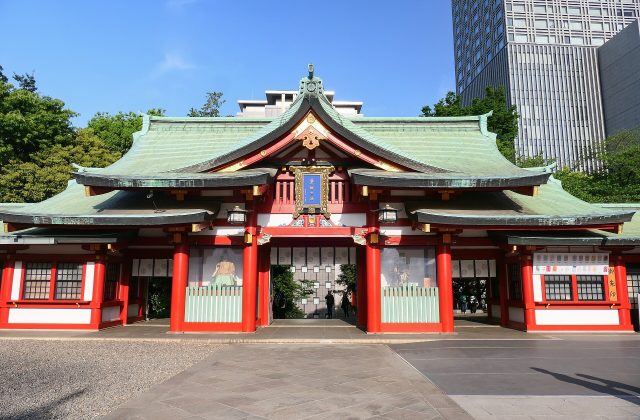
Asakusa Shrine sits just to the right of Senso-ji's main hall, reached under a large stone torii. It honours three men as kami: the fisherman brothers Hinokuma Hamanari and Takenari, who according to legend pulled a small statue of Kannon from the Sumida River in 628, and the local landowner Haji no Nakatomo, who recognised it and enshrined it, founding the temple next door. That is why Tokyoites call the shrine Sanja-sama, the shrine of the three gods. The present buildings were commissioned by the third Tokugawa shogun, Iemitsu, and completed in 1649 in the gongen style, with the worship hall and main sanctuary joined by a connecting chamber.
They escaped the fire raids of March 1945, which destroyed most of Senso-ji, and are listed as an Important Cultural Property. Look at the lacquer, the gilded fittings and the carved and painted panels under the eaves, which are richer than the shrine's modest size suggests. In the precinct you will also find a kagura hall used for sacred dance, the small Hikan Inari shrine with its fox guardians, and a pair of stone guardian lions that couples visit for luck in love. Purify your hands and mouth at the water basin, then throw a coin, bow twice, clap twice and bow once at the worship hall. Photography is fine outside but not of the inner sanctuary. Asakusa station on the Ginza and Asakusa lines and the Tobu line is about five minutes on foot.
The grounds are open at all hours and the shrine office sells charms and seal stamps during the day, roughly from 9 am to 4.30 pm. Asakusa is one of the busiest places in Tokyo, so come early, before about 9 am, when the temple precinct is still quiet, or in the evening, when Senso-ji and its pagoda are lit up and the crowds have thinned. The Sanja Matsuri, held over the third weekend of May, is the shrine's great festival and one of the wildest in Tokyo: around a hundred portable shrines are carried through the streets by bearers, and on the Sunday the three main ones leave from here.
Expect huge crowds and plan accordingly. New Year brings long queues for the first prayers of the year, and late March sees cherry blossom along the Sumida River nearby. Allow 20 to 30 minutes for the shrine and an hour or two with Senso-ji. Combine it with the Nakamise street, a river cruise on the Sumida and the Tokyo Skytree across the water.
Yes. GetYourGuide lists 6 tickets and tours for Asakusa Shrine, with live dates and prices and free cancellation on most of them.
The grounds are open at all hours and the shrine office sells charms and seal stamps during the day, roughly from 9 am to 4.30 pm.
Allow 20 to 30 minutes for the shrine and an hour or two with Senso-ji.
Entry to Asakusa Shrine: Free
No dress code; bow at the torii and keep quiet in front of the worship hall.
Asakusa Shrine was established in 1649.
Asakusa Shrine is in Tokyo, Japan. The map on this page shows the exact spot.
How to visit a Shinto shrine: torii, water and prayer — How to pass the torii, purify at the water basin, pray, take photos and buy charms at a Shinto shrine in Japan.
Tokyo, Japan
Meiji Jingu is free to enter and there is no ticket to buy for the shrine itself: you simply walk in from Harajuku or…
38 tickets & tours
Tokyo, Japan
There is no ticket for Senso-ji: the temple grounds are free and always open, and the main hall can be entered at no…
31 tickets & tours
Tokyo, Japan
Nezu Shrine is free to enter and open to anyone who walks in, so there is no ticket to buy;
7 tickets & tours
Tokyo, Japan
Gotokuji is free to enter and there is nothing to book for the temple itself.
3 tickets & tours
Tokyo, Japan
Yasukuni Shrine, in the Kudan district of central Tokyo just north of the Imperial Palace, is free to enter, and the…
2 tickets & tours
Tokyo, Japan
Hie Shrine charges no entry fee and no ticket for it is sold online.
No online ticket