Temple of Literature (Van Mieu)
1 km away
Most visitors simply buy a ticket at the main gate on Quoc Tu Giam Street and walk in;
11 tickets & tours
Buddhist Temple · Hanoi · Vietnam
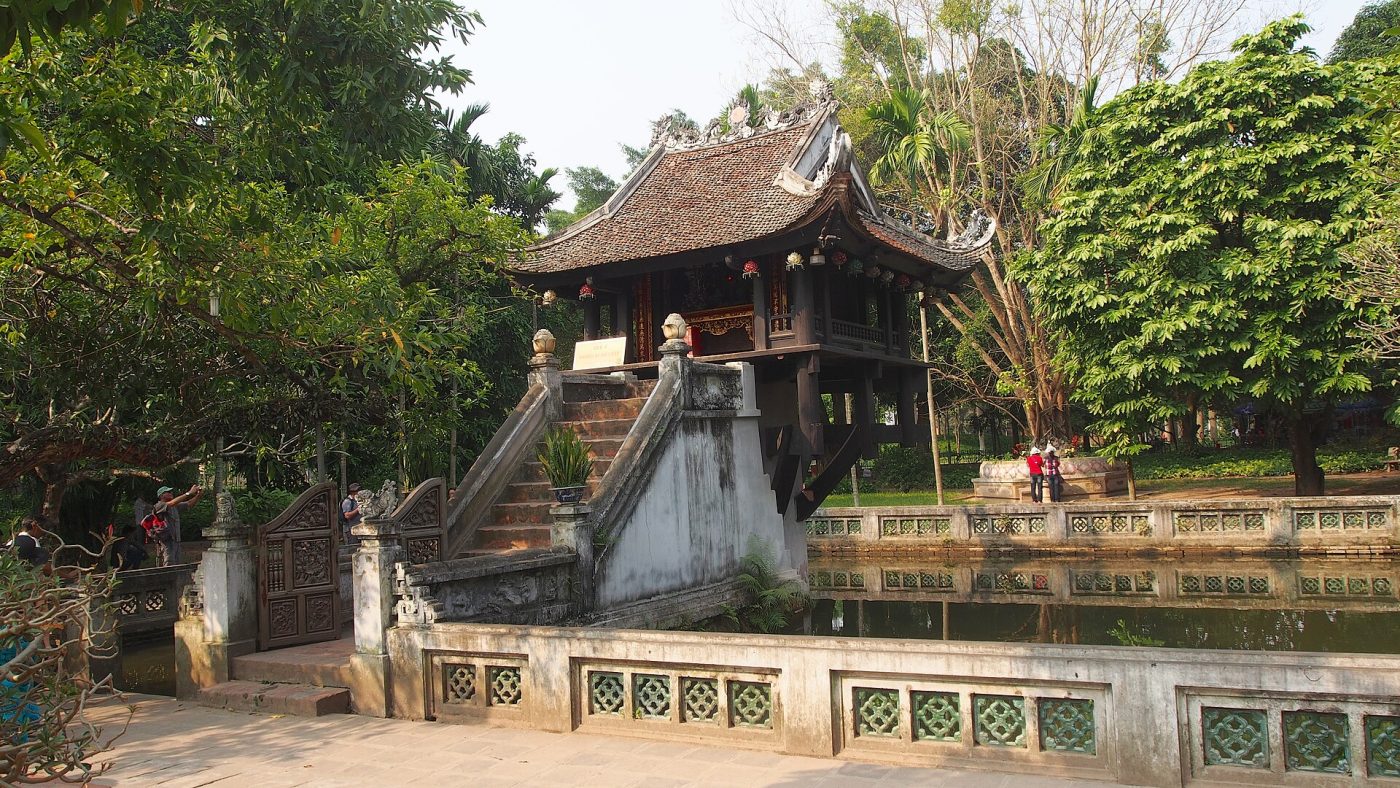
Photo: Clay Gilliland, CC BY-SA 2.0
Entry to the One Pillar Pagoda is free, and no ticket for the pagoda alone is sold online. It stands in a small garden in Ba Dinh district, inside the area around the Ho Chi Minh Mausoleum and next to the Ho Chi Minh Museum, so you simply walk in from the square or the museum side. Security staff control access to the wider complex, but the pagoda itself has no gate booth. Most travellers see it as part of a Hanoi city tour rather than on its own. Half-day and full-day tours of the capital typically group the mausoleum, the Presidential Palace grounds and Ho Chi Minh's stilt house, the One Pillar Pagoda, the Temple of Literature and Hoan Kiem Lake, with an English-speaking guide, hotel pick-up and entry fees included;
lunch, a cyclo ride or a water puppet show are sometimes added at extra cost. Since all the Ba Dinh sites sit within a few minutes' walk of each other, a guide mainly adds context and saves you working out the security routines and opening days. Independent visitors can reach the area by taxi or ride-hailing app in about 10 to 15 minutes from the Old Quarter, or walk in around half an hour past the citadel. The page lists any GetYourGuide tours whose route passes the pagoda.
Live prices from GetYourGuide for tickets and tours that include this temple. Free cancellation on most of them.
The pagoda is one of the most recognisable symbols of Hanoi, and its scale surprises many visitors: it is tiny. A small wooden shrine with a curved tile roof sits on a single stone column rising from a square lotus pond, so that the whole resembles a lotus flower opening above the water. Steps lead up to a narrow gallery, from which you look into the shrine at a gilded statue of the bodhisattva Quan Am, the Vietnamese name for Guanyin, the goddess of mercy. The story behind it goes back to 1049. Emperor Ly Thai Tong, who had no heir, dreamed that the bodhisattva, seated on a lotus, handed him a baby son. Soon afterwards he married a peasant girl who bore him a son, and on the advice of a monk he built a shrine on a pillar in a lotus pond to recreate the vision.
It belonged to a larger temple complex known as Dien Huu, the pagoda of extended blessings, which was enlarged in 1105. Nothing original survives. The shrine was restored several times under the Nguyen dynasty, blown up in 1954 as French forces withdrew from Hanoi, and rebuilt in 1955 on the earlier model. Beside it, the small Dien Huu pagoda has a quiet courtyard with bonsai and a bell tower, which many visitors miss. Dress modestly, take off your hat at the shrine, keep your voice down and leave incense or flowers if you wish. Photographs are allowed, but the narrow staircase gets crowded, so wait your turn.
The pagoda is open every day from early morning until early evening; the wider Ba Dinh complex follows the mausoleum's routine, which opens only in the morning, closes on Mondays and Fridays and shuts for maintenance for several weeks each year, usually in autumn. Come early, between about 7 and 9 am, ideally combined with a morning visit to the mausoleum, before tour buses fill the square.
Late afternoon is quieter too, but check that the access paths are still open. Autumn, from October to early December, is the most pleasant season in Hanoi, followed by spring. The summer months are hot and humid. The first and fifteenth days of each lunar month, Tet and the Buddha's birthday in spring bring many worshippers with offerings. Allow 15 to 20 minutes for the pagoda. Combine it with the mausoleum, the stilt house, the Ho Chi Minh Museum, the Temple of Literature and the Imperial Citadel of Thang Long.
1 km away
Most visitors simply buy a ticket at the main gate on Quoc Tu Giam Street and walk in;
11 tickets & tours
1 km away
Tran Quoc is an active Buddhist pagoda and entry is free;
3 tickets & tours
20 km away
But Thap Pagoda stands in the countryside of Bac Ninh Province, beside the dyke of the Duong river, about 30 km east of…
1 ticket or tour
Yes. GetYourGuide sells tickets and guided tours whose route includes One Pillar Pagoda; live prices are shown on this page.
The pagoda is open every day from early morning until early evening; the wider Ba Dinh complex follows the mausoleum's routine, which opens only in the morning, closes on Mondays and Fridays and shuts for maintenance for several weeks each year, usually in autumn.
Allow 15 to 20 minutes for the pagoda.
Autumn, from October to early December, is the most pleasant season in Hanoi, followed by spring.
Photographs are allowed, but the narrow staircase gets crowded, so wait your turn.
Entry to One Pillar Pagoda: Free
Shoulders and knees covered, as required in the surrounding mausoleum area.
One Pillar Pagoda was established in 1049.
One Pillar Pagoda is in Hanoi, Vietnam. The map on this page shows the exact spot.
How to visit a Buddhist temple: shoes, dress and manners — Shoes, dress, feet, photos and offerings in Buddhist temples, from the wats of Thailand and Sri Lanka to the Zen temples of Japan.
Hanoi, Vietnam
The Perfume Pagoda is not a single building but a pilgrimage route through the limestone hills of Huong Son, about 60…
28 tickets & tours
Hanoi, Vietnam
Most visitors simply buy a ticket at the main gate on Quoc Tu Giam Street and walk in;
11 tickets & tours
Hanoi, Vietnam
Tran Quoc is an active Buddhist pagoda and entry is free;
3 tickets & tours
Hanoi, Vietnam
Tay Phuong Pagoda is an active Buddhist temple and charges no admission in the ordinary way;
1 ticket or tour
Hanoi, Vietnam
No ticket is sold for Bach Ma Temple, and none is needed: the doors open onto the street during the day, entry is free,…
No online ticket
Hanoi, Vietnam
There is nothing to book in advance for Ngoc Son Temple.
No online ticket