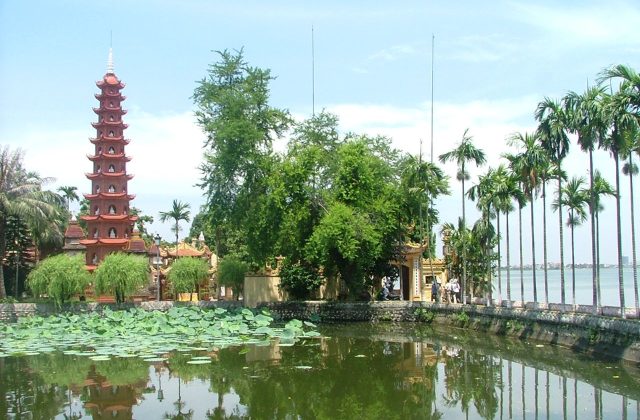
Tran Quoc Pagoda
1 km away
Tran Quoc is an active Buddhist pagoda and entry is free;
3 tickets & tours
Chinese Temple · Hanoi · Vietnam
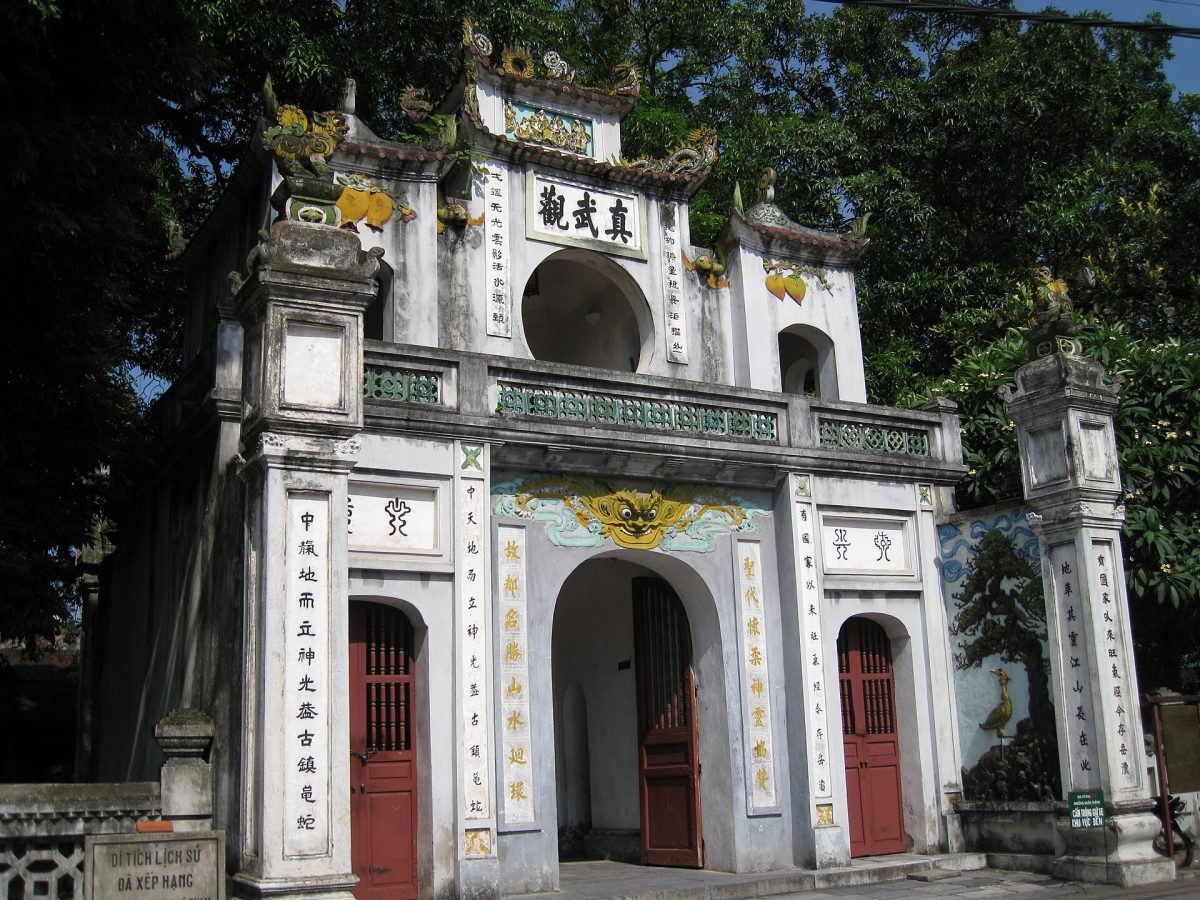
Photo: Nguyễn Thanh Quang, CC BY-SA 3.0
There is no online ticket for Quan Thanh Temple. Foreign visitors pay a small entrance fee at the gate on Quan Thanh street, in Vietnamese dong, and walk in; worshippers bringing offerings enter freely. No guide service is offered on site, and there are no timed slots or queues worth worrying about. The temple stands at the corner of Quan Thanh and Thanh Nien streets, at the southern end of West Lake, about 2 km north-west of Hoan Kiem Lake. From the Old Quarter it is a 20-minute walk or a short ride by taxi, ride-hailing motorbike or cyclo, and it fits naturally into a loop of the Ba Dinh district.
Half-day and full-day city tours of Hanoi often stop here, usually together with the Ho Chi Minh Mausoleum and the One Pillar Pagoda, the Temple of Literature and Tran Quoc Pagoda on its islet in West Lake. Those tours generally include hotel pick-up, an English-speaking guide, transport and entrance fees, sometimes with lunch or a water-puppet show added in the evening. Independent travellers can see the temple perfectly well on their own. If you want the symbolism of the statues and altars explained, a private walking guide booked through your hotel for a morning in Ba Dinh is a better choice than a large-group coach tour, which tends to allow only 15 minutes here.
Live prices from GetYourGuide for tickets and tours that include this temple. Free cancellation on most of them.
Quan Thanh is a Taoist temple, one of the Four Sacred Temples said to have been founded under Emperor Ly Thai To in the early 11th century to guard the new capital, Thang Long, from evil spirits coming from the four directions. It protects the north, and it is dedicated to Tran Vu, the Taoist Lord of the North, whose emblems are the turtle and the snake. The buildings have been rebuilt many times; the present gate and halls largely date from a restoration in 1893. You enter through a three-arched gate into a paved courtyard shaded by an old banyan and other big trees, with incense burners and stone stelae recording past donations and repairs.
The worship hall leads back into the inner sanctuary, and there, in the dim light, sits the reason to come: a seated bronze statue of Tran Vu almost 4 m high, cast in 1677 by craftsmen from the bronze-working village of Ngu Xa. The deity rests one hand on a sword around which a snake coils, while a turtle stands at his feet. It is among the largest bronze statues in Vietnam, and the dark, polished metal is a fine piece of 17th-century casting. Look also for a bronze bell cast at the same time, and for the small statue of the master caster honoured beside the deity. People come to pray throughout the day, so move quietly, do not stand directly in front of anyone kneeling, and avoid flash. Photography is generally tolerated in the courtyard but ask before photographing the altars.
The temple is open every day from early morning to late afternoon, with a short break at lunchtime on some days; check at the gate for current hours. Early morning, from about 8 am, is the quietest time, with soft light in the courtyard and local people lighting incense on their way to work. Hanoi has a real winter: from December to February it is cool, grey and often drizzly, while the summer months from May to September are hot, humid and stormy.
Autumn, from October to November, and spring, from March to April, are the most pleasant seasons for walking around West Lake. The temple is busiest on the first and fifteenth days of each lunar month, when crowds of worshippers bring offerings, and during the days around Tet, the lunar new year in late January or February, when the courtyard fills with incense smoke and families praying for a good year. These are fascinating days to watch, but expect crowds and some closed areas. Allow 30 to 45 minutes. Combine it with Tran Quoc Pagoda, a walk along Truc Bach Lake and the Ho Chi Minh Mausoleum area.
1 km away
Tran Quoc is an active Buddhist pagoda and entry is free;
3 tickets & tours
2 km away
Most visitors simply buy a ticket at the main gate on Quoc Tu Giam Street and walk in;
11 tickets & tours
19 km away
But Thap Pagoda stands in the countryside of Bac Ninh Province, beside the dyke of the Duong river, about 30 km east of…
1 ticket or tour
Yes. GetYourGuide sells tickets and guided tours whose route includes Quan Thanh Temple; live prices are shown on this page.
Entry to Quan Thanh Temple: Small fee at the gate
The temple is open every day from early morning to late afternoon, with a short break at lunchtime on some days; check at the gate for current hours.
Allow 30 to 45 minutes.
Early morning, from about 8 am, is the quietest time, with soft light in the courtyard and local people lighting incense on their way to work.
Shoulders and knees covered; hats off in the shrine halls.
Quan Thanh Temple is in Hanoi, Vietnam. The map on this page shows the exact spot.
How to visit a Chinese temple: incense, gods and manners — How to behave in Taoist, Confucian and folk temples in China, Taiwan, Hong Kong and South-East Asia: incense, thresholds and fortunes.
Hanoi, Vietnam
The Perfume Pagoda is not a single building but a pilgrimage route through the limestone hills of Huong Son, about 60…
28 tickets & tours
Hanoi, Vietnam
Most visitors simply buy a ticket at the main gate on Quoc Tu Giam Street and walk in;
11 tickets & tours
Hanoi, Vietnam
Tran Quoc is an active Buddhist pagoda and entry is free;
3 tickets & tours
Hanoi, Vietnam
Tay Phuong Pagoda is an active Buddhist temple and charges no admission in the ordinary way;
1 ticket or tour
Hanoi, Vietnam
No ticket is sold for Bach Ma Temple, and none is needed: the doors open onto the street during the day, entry is free,…
No online ticket
Hanoi, Vietnam
There is nothing to book in advance for Ngoc Son Temple.
No online ticket