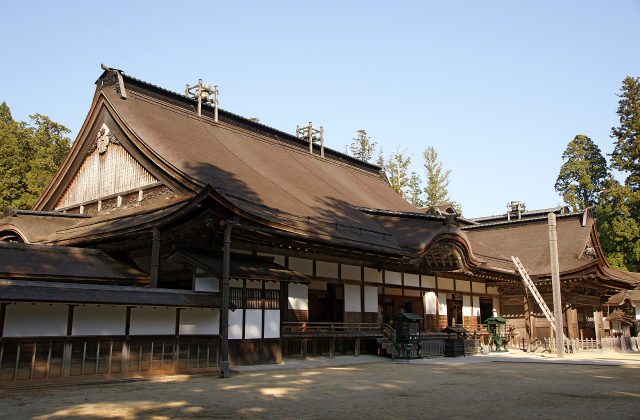
Kinpusen-ji
29 km away
Kinpusen-ji does not sell tickets online. The temple precinct on the Yoshino ridge is open to walk through for free,…
1 ticket or tour
Buddhist Temple · Koyasan · Japan

Photo: Dokudami, CC BY-SA 4.0
Okunoin is free to enter at any time, and no ticket for the cemetery alone is sold online. What visitors do book is the trip to Mount Koya itself, which lies high in the mountains of Wakayama prefecture, about two hours from Osaka by the Nankai railway and a cable car up the final slope, then a bus across town to the cemetery. Many people go independently, using a combined rail, cable car and bus pass sold by the railway company, which also gives discounts at several temples. Others join a guided day trip from Osaka or Kyoto, which usually includes return transport, an English-speaking guide, entry to the main temples of Koyasan and sometimes a vegetarian temple lunch;
the day is long and the time at Okunoin can be short, so check the itinerary. The most rewarding option is an overnight stay in one of the temple lodgings on the mountain. A night at a temple normally includes a room with futons, a vegetarian Buddhist dinner and breakfast, and the chance to join the monks' early morning prayers; meditation, sutra copying and fire ceremonies are offered at some temples, occasionally at extra cost. Several lodgings also run guided night walks through the cemetery led by a monk, which are worth booking ahead. The page lists any GetYourGuide tours whose route passes Okunoin.
Live prices from GetYourGuide for tickets and tours that include this temple. Free cancellation on most of them.
Okunoin is the inner sanctuary of Mount Koya and the resting place of Kukai, also known as Kobo Daishi, who founded the Shingon school of esoteric Buddhism here in the early ninth century. He was laid in his mausoleum in 835, and the faithful believe that he did not die but sits in eternal meditation, awaiting the Buddha of the future. Monks still carry meals to him twice a day. The classic approach starts at Ichinohashi, the first bridge, where you bow before entering. From here a stone path runs for about 2 km through a forest of giant cedars, past more than 200,000 graves and memorials: moss-covered stupas of feudal lords, samurai clans, monks and ordinary pilgrims who wished to lie near the saint.
Look out for the five-tiered stone stupas, each tier standing for one of the elements, and the memorials to rival warlords such as Oda Nobunaga and the Takeda and Uesugi families. Before the Gobyobashi bridge, people pour water over a row of bronze Jizo statues in memory of their dead. Beyond the bridge you are in the sacred area: photography, eating and loud talk are not allowed. At the end stands the Torodo, the Hall of Lanterns, glowing with thousands of donated lamps, two of which are said to have burned for over 900 years. The mausoleum behind it is closed to the public, but pilgrims pray at its fence. Near the Okunoin-mae bus stop, a modern section holds striking company memorials, including one shaped like a rocket. Allow time to walk back the way you came.
The cemetery path is open around the clock, while the Torodo hall keeps daytime hours, roughly from early morning to late afternoon, and the temple offices close earlier in winter. Early morning is the best time: mist hangs between the cedars and you can watch the monks carry Kukai's morning meal across the bridge to the mausoleum at about 6 am. Late afternoon and dusk are equally atmospheric once the day-trippers have left, and a night walk by lantern light is unforgettable. Spring and autumn are the most comfortable seasons, with autumn colour peaking from late October to early November.
Summer is cooler than the lowlands, and winter brings snow, bitter cold and very few visitors. On 13 August, the candle festival lines the path with some 100,000 candles, and 15 June marks the birthday of Kukai. Allow two hours for the walk to the hall and back. Stay overnight to combine it with Kongobuji, the Danjo Garan complex and the great Daimon gate.
29 km away
Kinpusen-ji does not sell tickets online. The temple precinct on the Yoshino ridge is open to walk through for free,…
1 ticket or tour
45 km away
There is no online ticket for Hase-dera alone. You pay the entrance fee at the gate at the foot of the long staircase,…
1 ticket or tour
45 km away
Sumiyoshi Taisha is a working Shinto shrine and costs nothing to enter: the grounds open at dawn, and there is no…
4 tickets & tours
Yes. GetYourGuide sells tickets and guided tours whose route includes Okunoin, Mount Koya; live prices are shown on this page.
The cemetery path is open around the clock, while the Torodo hall keeps daytime hours, roughly from early morning to late afternoon, and the temple offices close earlier in winter.
Allow time to walk back the way you came.
Early morning is the best time: mist hangs between the cedars and you can watch the monks carry Kukai's morning meal across the bridge to the mausoleum at about 6 am.
Entry to Okunoin, Mount Koya: Free
No dress code; remove hats and stay silent beyond the Gobyobashi bridge.
Okunoin, Mount Koya was established in 835.
Okunoin, Mount Koya is in Koyasan, Japan. The map on this page shows the exact spot.
How to visit a Buddhist temple: shoes, dress and manners — Shoes, dress, feet, photos and offerings in Buddhist temples, from the wats of Thailand and Sri Lanka to the Zen temples of Japan.
Koyasan, Japan
There is nothing to book in advance for Kongobu-ji itself.
No online ticket