Mosque of Ibn Tulun
Cairo, Egypt
No ticket is needed to enter the Mosque of Ibn Tulun. It is an active mosque, open to visitors outside prayer times,…
1 ticket or tour

Photo: Mohamed abdelzaher, CC BY-SA 4.0
There is nothing to buy in order to enter the Al-Hakim Mosque: it is a working mosque, run by the Dawoodi Bohra community, and visitors walk in free of charge outside prayer times. The only cost at the door is a small tip for the man who looks after shoes, and perhaps a few pounds if someone lends you a scarf or offers to show you up to the roof. What is sold online is a guided walk through Islamic Cairo in which this mosque is the anchor. On that kind of outing a local guide meets you near Bab al-Futuh or at your hotel, explains the Fatimid city as you walk south along al-Muizz Street, and takes you inside the mosque with some context on the caliph who finished it and the community that rebuilt it.
Transport, entry to paid monuments along the street and drinks are usually extra, so read the inclusions before booking. The sensible choice depends on how much you already know. Independent travellers can see the mosque perfectly well on their own and spend the money on a ticket for the nearby Bayt al-Suhaymi house or the gates. A guide earns his fee if you want the layers of Fatimid, Mamluk and Bohra history unpicked, or if this is your first time navigating the crowded lanes north of Khan el-Khalili.
Live dates and prices from GetYourGuide. Free cancellation on most tickets.
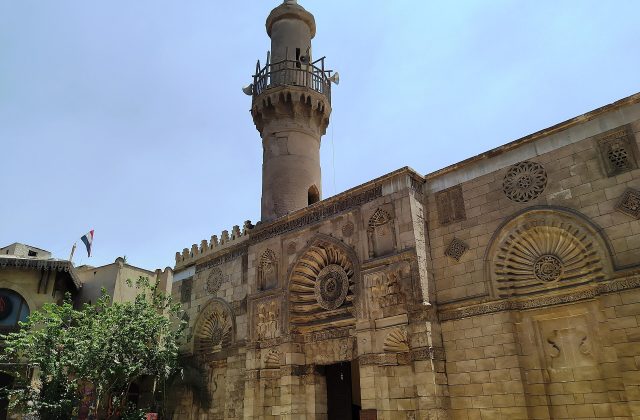
The mosque sits on the east side of al-Muizz Street, just inside the northern walls, and its outer wall actually runs into the fortifications between Bab al-Futuh and Bab al-Nasr. Caliph al-Aziz began it in 990 and his son al-Hakim, the sixth Fatimid caliph, finished it in 1013, when it was more than twice the size of al-Azhar. You enter through a projecting stone portal, an unusual feature for a Cairo mosque of that age, into a vast open courtyard paved in white marble. Three things reward a careful look. First, the two minarets at the corners: the slender original towers were wrapped only a few years after construction in massive square bastions, and you can still make out the older carved shafts rising above them.
Second, the prayer hall on the qibla side, a forest of arches on piers, now gleaming with the marble, gilded inscriptions and chandeliers added during the restoration of 1980. Third, the view along the northern wall, where the mosque and the medieval gates meet. The building had a long and unhappy afterlife. An earthquake in 1303 damaged it badly, and over the centuries it served as a prison, a stable and a store before falling into ruin. The Bohras, an Ismaili community who revere al-Hakim, rebuilt it in a polished style that purists criticise but that brought it back into daily use. Remove your shoes at the entrance, keep voices low, and do not walk in front of people at prayer. Women should bring a scarf. A taxi or ride-hail car to Bab al-Futuh is the easiest way in; from Khan el-Khalili it is a ten-minute walk north along al-Muizz Street.
The mosque is open from early morning until the evening, but visitors are asked to step aside during the five daily prayers, and the Friday noon prayer is the one time to avoid altogether. There are no published visiting hours, so treat mid-morning and mid-afternoon as the safe windows. The best moment is late afternoon, when the low sun turns the white marble courtyard gold and the light falls on the minaret bastions. Mornings are quieter along al-Muizz Street before the shops open fully.
Cairo is most comfortable between October and April; in summer the bare courtyard is punishing at midday. During Ramadan the mosque is busier in the evenings and the street comes alive after iftar, which is a memorable time to be there if you dress modestly and keep a respectful distance. Allow 30 to 45 minutes inside. Most people combine it with a walk along the gates and the northern walls, Bayt al-Suhaymi, the Mamluk madrasas further south and an evening at Khan el-Khalili.
Yes. GetYourGuide lists one ticket or tour for Al-Hakim Mosque, with live dates and prices and free cancellation on most of them.
There is nothing to buy in order to enter the Al-Hakim Mosque: it is a working mosque, run by the Dawoodi Bohra community, and visitors walk in free of charge outside prayer times.
Allow 30 to 45 minutes inside.
Shoulders and knees covered, women cover their hair; shoes off before the courtyard.
Entry to Al-Hakim Mosque: Free; tip the shoe attendant
Al-Hakim Mosque was established in 990.
Al-Hakim Mosque is in Cairo, Egypt. The map on this page shows the exact spot.
How to visit a mosque: dress, timing and manners — What to wear, when to go and how to behave in a mosque as a non-Muslim, and which mosques do not admit visitors at all.
Cairo, Egypt
No ticket is needed to enter the Mosque of Ibn Tulun. It is an active mosque, open to visitors outside prayer times,…
1 ticket or tour
Cairo, Egypt
No ticket for al-Aqmar is sold online, and entry to the mosque itself is free.
No online ticket
Cairo, Egypt
No ticket for al-Azhar is sold online, and none is needed: entry to the mosque is free for visitors of any faith…
No online ticket
Cairo, Egypt
Entry to the Ben Ezra Synagogue is free, and there is no ticket, timed slot or skip-the-line option to buy;
No online ticket
Cairo, Egypt
Nothing needs to be booked for the Mosque of Amr ibn al-As, and no ticket for it alone is sold online.
No online ticket
Cairo, Egypt
The Mosque of Muhammad Ali stands inside the Citadel of Cairo, so there is no separate ticket for it: entry is covered…
No online ticket