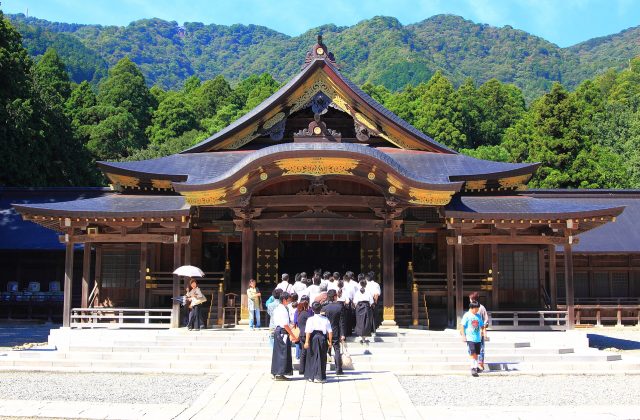
Zenko-ji
13 km away
The temple grounds and the outer part of the main hall are open to everyone free of charge.
16 tickets & tours
Shinto Shrine · Nagano · Japan

Photo: 663highland, CC BY 2.5
There is no admission charge at Togakushi Shrine, and no ticket for the Okusha or any of the other four shrines is sold online. Visitors simply walk in; the only things paid for on the spot are offerings, amulets and the goshuin stamps that pilgrims collect at each of the five sites. Getting there is what needs planning. Togakushi lies on a high plateau north-west of Nagano city, and most people come by the local bus from Nagano Station, a scenic ride of roughly an hour along a winding mountain road; the stop at the Okusha entrance is near the end of the line.
Buses also link the five shrines, which are spread over several kilometres, so many visitors ride to the Okusha first and then walk or take the bus down to the Middle and Lower shrines. A car gives more freedom, but the parking at the Okusha entrance fills quickly on autumn weekends. Some travellers join a guided day trip from Nagano or a private tour that adds Zenko-ji temple in the city, a soba lunch in the village and sometimes the snow monkeys at Jigokudani; these include transport and a guide, with meals usually paid separately. For a walker who can read a bus timetable, going independently works well and leaves time to linger on the cedar avenue.
Live prices from GetYourGuide for tickets and tours that include this temple. Free cancellation on most of them.
The Okusha is the innermost and highest of the five shrines that make up Togakushi Shrine, set at the foot of the jagged ridge of Mount Togakushi, which rises to about 1,904 m inside a national park. Tradition places its founding in legendary antiquity, and for centuries the mountain was a great centre of mountain asceticism where Buddhist monks and Shinto priests worshipped side by side, until the separation of the two faiths in 1868 turned the temple complex into a purely Shinto shrine. The approach is the highlight. From the entrance a gravel path runs about 2 km uphill, first through open forest and then, after the red thatched Zuishinmon gate at the halfway point, along a straight avenue of giant cedars around 400 years old, protected as a natural monument.
The last stretch climbs steep, uneven stone steps to the small shrine buildings tucked against the cliff, where the deity Ame-no-Tachikarao is enshrined; he is the god who, in the myth, pulled open the cave in which the sun goddess had hidden. Beside it stands the Kuzuryu-sha, dedicated to a nine-headed dragon deity of water, said to be the original local god of the mountain, worshipped before the other deities arrived. Bow once before passing under each torii, purify your hands and mouth at the water basin, and keep to the sides of the path, as the centre belongs to the gods. Photography is fine on the approach but avoid photographing inside the worship halls. Allow about 40 minutes each way on foot from the bus stop.
The approach is open in daylight, and the shrine office at the top keeps shorter hours, roughly from morning to mid-afternoon. In practice the Okusha is a spring-to-autumn visit: from late November until about April the upper path lies under deep snow, the buildings at the top are closed and only experienced snowshoers attempt the walk. Mid to late October brings the best colour, when the maples around the plateau and the nearby Kagami-ike pond turn red and gold against the dark cedars;
expect long queues for buses and soba at weekends. Early summer is fresh and green, and an early start, before 9 am, gives you the cedar avenue almost to yourself in any season. Allow two hours for the Okusha alone and a full day if you want to visit all five shrines, walking the forest trails between them. Combine the trip with a bowl of the local buckwheat noodles near the Middle Shrine, a stop at the small ninja museum close to the Okusha entrance, and Zenko-ji temple in Nagano on the way back.
13 km away
The temple grounds and the outer part of the main hall are open to everyone free of charge.
16 tickets & tours
126 km away
There is nothing to pay at Yahiko Shrine: the grounds are open, and you walk through the torii gates and up to the main…
1 ticket or tour
135 km away
Nikko lies about two hours north of Tokyo by train, and the Toshogu shrine is its centrepiece.
40 tickets & tours
Yes. GetYourGuide sells tickets and guided tours whose route includes Togakushi Shrine Okusha (Upper Shrine); live prices are shown on this page.
The approach is open in daylight, and the shrine office at the top keeps shorter hours, roughly from morning to mid-afternoon.
Allow about 40 minutes each way on foot from the bus stop.
Entry to Togakushi Shrine Okusha (Upper Shrine): Free
No dress code; wear walking shoes for the gravel avenue and the stone steps.
Togakushi Shrine Okusha (Upper Shrine) is in Nagano, Japan. The map on this page shows the exact spot.
How to visit a Shinto shrine: torii, water and prayer — How to pass the torii, purify at the water basin, pray, take photos and buy charms at a Shinto shrine in Japan.
Nagano, Japan
The temple grounds and the outer part of the main hall are open to everyone free of charge.
16 tickets & tours