Cao Dai Temple, Ho Chi Minh City
2 km away
This city temple of the Cao Dai faith is a working place of worship rather than a ticketed attraction, so entry is free…
16 tickets & tours
Chinese Temple · Ho Chi Minh City · Vietnam

Photo: Christopher from Shanghai, China, CC BY 2.0
There is nothing to buy in advance for the Thien Hau Temple: the gate on Nguyen Trai Street is open to anyone during the day and no ticket is sold online or at the door. A donation box stands near the altar, and many visitors buy a bundle of incense sticks or one of the large spiral incense coils from the attendants, which is the usual way of contributing to the upkeep of the hall. Most travellers arrive in one of three ways. Independent visitors take a taxi or ride-hailing car from District 1, a ride of roughly 20 to 30 minutes depending on traffic, and combine the temple with a walk through the surrounding streets of Cholon.
Others join a half-day Chinatown or city tour from the centre, which typically links this temple with Binh Tay Market, a second Chinese assembly hall and a church or herbal-medicine street; transport and a guide are included, while drinks and food tastings vary. A third option is an evening food tour by scooter or on foot through District 5, which sometimes passes the temple facade but rarely goes inside. If you want time to look at the roof figurines and watch worshippers, going on your own is the better choice; a guided tour is worth it mainly for the background on the Cantonese community and the festivals.
Live prices from GetYourGuide for tickets and tours that include this temple. Free cancellation on most of them.
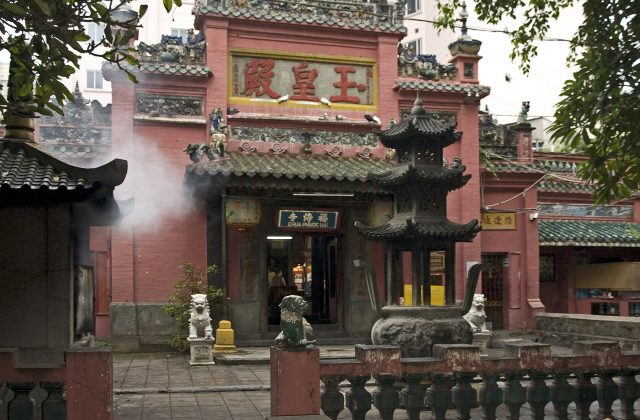
The temple was founded around 1760 by Cantonese merchants who had settled in Cholon, and it served both as a place of worship and as the meeting hall of their trading association, which is why its official name refers to an assembly hall rather than a pagoda. It was repaired and enlarged several times in the 19th century and again in 1916, so what you see today is a late Qing-style building rather than the 18th-century original. You pass through an iron gate and a small forecourt before reaching the facade, where carved wooden panels showing miniature Chinese theatre scenes hang above the doors. Look up at the roof ridges: they are crowded with glazed ceramic figurines arranged in small dioramas of a 19th-century Chinese town, with actors, warriors, animals and even foreign sailors and merchants.
One scene shows the general Guan Yu in combat on horseback; another shows the three star gods of longevity, fertility and prosperity. Inside, the building is really a partly roofed courtyard filled with smoke from bronze burners and from the big incense coils hanging overhead, each with a red paper tag carrying the names and wishes of the family who paid for it. At the far end, three statues of Thien Hau, the sea goddess known in China as Mazu, sit on the main altar with bronze-coloured faces and brightly painted robes and crowns. This is an active place of worship. Walk quietly round people who are praying, do not step over offerings, and ask before photographing anyone at the altar; photographing the building itself is fine.
The temple opens early in the morning and closes in the late afternoon, with no midday break; check locally if you plan to arrive near closing time, as hours can shift on holy days. Early morning, before about 9 am, is the calmest and most atmospheric time, when local worshippers come to light incense and the light falls into the courtyard. The busiest days are the Lunar New Year period, the full moon of the first lunar month (the Lantern Festival) and the goddess's birthday on the 23rd day of the third lunar month, when the hall is packed and processions and lion dances take place outside.
These are exciting days to witness, but expect crowds and heavy smoke. The 1st and 15th of each lunar month also bring more worshippers. Allow 30 to 45 minutes inside. The temple sits within easy reach of Binh Tay Market, Cha Tam Church and several other Chinese assembly halls along Nguyen Trai and Tran Hung Dao streets, so a half day in Cholon is a natural plan. The dry season from December to April is the most comfortable time for walking the district.
2 km away
This city temple of the Cao Dai faith is a working place of worship rather than a ticketed attraction, so entry is free…
16 tickets & tours
54 km away
Vinh Trang is a working Buddhist pagoda on the edge of My Tho, the gateway town of the Mekong Delta, and there is no…
2 tickets & tours
206 km away
Phnom Chisor has no ticket to book online. Foreign visitors pay a small fee at the foot of the hill or at the top, and…
2 tickets & tours
Yes. GetYourGuide sells tickets and guided tours whose route includes Thien Hau Temple (Cholon); live prices are shown on this page.
There is nothing to buy in advance for the Thien Hau Temple: the gate on Nguyen Trai Street is open to anyone during the day and no ticket is sold online or at the door.
Allow 30 to 45 minutes inside.
Entry to Thien Hau Temple (Cholon): Free; donations welcome
Modest clothing is appreciated; shoulders covered and no beachwear inside the shrine.
Thien Hau Temple (Cholon) was established in 1760.
Thien Hau Temple (Cholon) is in Ho Chi Minh City, Vietnam. The map on this page shows the exact spot.
How to visit a Chinese temple: incense, gods and manners — How to behave in Taoist, Confucian and folk temples in China, Taiwan, Hong Kong and South-East Asia: incense, thresholds and fortunes.
Ho Chi Minh City, Vietnam
This city temple of the Cao Dai faith is a working place of worship rather than a ticketed attraction, so entry is free…
16 tickets & tours
Ho Chi Minh City, Vietnam
The memorial temple stands inside the Ben Duoc section of the Cu Chi tunnels, about 70 km north-west of central Ho Chi…
No online ticket
Ho Chi Minh City, Vietnam
There is nothing to book for the Jade Emperor Pagoda itself.
No online ticket