
Wat Arun (Temple of Dawn)
Bangkok, Thailand
Wat Arun stands on the Thonburi bank of the Chao Phraya, opposite Wat Pho, and most people simply take the cross-river…
46 tickets & tours
Hindu Temple · Bangkok · Thailand
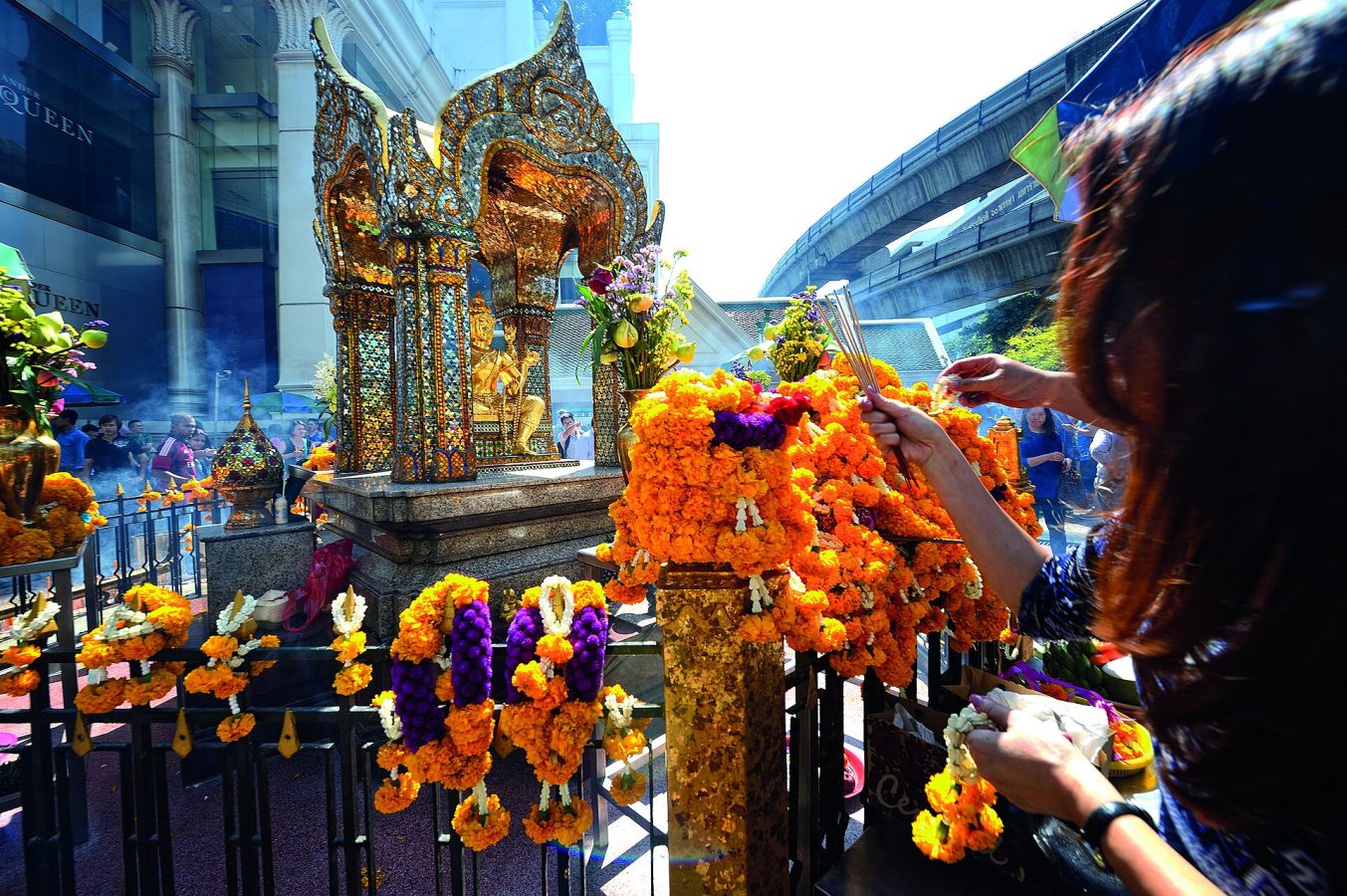
Photo: Mr.Peerapong Prasutr, CC BY-SA 4.0
There is nothing to book for the Erawan Shrine itself. It is an open-air shrine on a busy street corner, with no ticket, no gate and no timed slots, and anyone may walk in, watch the worshippers and leave an offering. What you can pay for are the offerings: stalls inside the compound sell bundles of incense, candles, marigold garlands and small carved elephants, and these are the usual way visitors take part rather than simply look on. You can also hire the resident troupe of classical dancers to perform on your behalf, which is how many Thais give thanks when a wish has come true;
the price depends on the number of dancers and the length of the dance and is posted at the booth beside the stage. The only organised product tied to the shrine is a short guided talk that uses it as a starting point for the Hindu gods and legends that run through Thai religion, which is worth considering if you want the symbolism explained rather than just the spectacle. Otherwise the shrine turns up as a brief stop on general Bangkok city and shopping walks around Ratchaprasong. Most visitors simply arrive on their own by Skytrain, spend twenty minutes, and carry on to the malls next door; for that, a guide adds little beyond the stories.
Live dates and prices from GetYourGuide. Free cancellation on most tickets.
The shrine is small: a raised platform behind a low railing on the corner of the Grand Hyatt Erawan, with a gilded four-faced figure of Phra Phrom, the Thai form of Brahma, sitting under an ornate canopy at the centre. Worshippers queue to walk around the statue, pausing at each of the four faces to offer incense and flowers, and the constant smoke, garlands and murmured prayers are the real sight. Along one side, a small stage is where the dancers, in gold costumes and tall crowns, perform to recorded or live music for those who have paid for a performance. Look too for the rows of wooden elephants left by the faithful, since the three-headed elephant Erawan is the mount associated with the god. The shrine dates from 1956.
It was built during the construction of the old state-run Erawan Hotel, which was plagued by accidents and delays until an astrologer advised placating the spirits of the site; the statue, made by the Fine Arts Department, was installed that November and work went smoothly afterwards. The hotel was later replaced by the Grand Hyatt, but the shrine stayed. The original statue was smashed by a man with a hammer in 2006 and a new one was cast, and the shrine was repaired again after the bomb attack nearby in August 2015. Behave as you would in any place of worship: keep your voice down, do not climb on the railings, and step aside for people praying. Photography is fine. The shrine sits at the Ratchaprasong intersection, and the covered walkway from Chit Lom BTS station runs right above it.
The shrine is open every day from early morning until late in the evening, and it is busy from opening to closing; Bangkok office workers stop by on the way to work, at lunchtime and after hours. Early morning is the calmest time and the light is softer, while the evening, when the surrounding malls and billboards are lit up and the dancers are often in action, has the most atmosphere. Any season works, though the months from November to February are the most comfortable for standing in the open.
The shrine marks its own anniversary on 9 November, when the crowds and offerings are especially heavy, and Chinese New Year also brings large numbers of worshippers. There are no closing days for religious holidays. Twenty to thirty minutes is enough for most visitors, perhaps longer if you want to make an offering or watch several dances. Combine it with the other small Hindu shrines around Ratchaprasong, including those to Ganesha and Trimurti outside CentralWorld, and with the shopping centres that surround the junction, or take the Skytrain a few stops to Jim Thompson House or Lumphini Park.
Yes. GetYourGuide lists one ticket or tour for Erawan Shrine, with live dates and prices and free cancellation on most of them.
The shrine is open every day from early morning until late in the evening, and it is busy from opening to closing; Bangkok office workers stop by on the way to work, at lunchtime and after hours.
Entry to Erawan Shrine: Free; donations welcome
No formal dress code; tidy clothes are appreciated by the many worshippers.
Erawan Shrine was established in 1956.
Erawan Shrine is in Bangkok, Thailand. The map on this page shows the exact spot.
How to visit a Hindu temple: dress, shoes and access — What to wear, what to leave at the gate and where non-Hindus may go in Hindu temples in India, Nepal, Bali and South-East Asia.
Bangkok, Thailand
Wat Arun stands on the Thonburi bank of the Chao Phraya, opposite Wat Pho, and most people simply take the cross-river…
46 tickets & tours
Bangkok, Thailand
Wat Phra Kaew stands inside the walls of the Grand Palace, so there is no separate ticket: one Grand Palace ticket,…
45 tickets & tours
Bangkok, Thailand
Wat Pho is one of the easiest of Bangkok's great temples to visit on your own: the ticket is sold at the gate,…
42 tickets & tours
Bangkok, Thailand
Wat Traimit stands at the eastern gateway of Bangkok's Chinatown, close to Hua Lamphong station, and its single…
2 tickets & tours
Bangkok, Thailand
Admission to Wat Benchamabophit is a modest fee paid at the ticket desk inside the gate;
1 ticket or tour
Bangkok, Thailand
Wat Hong Rattanaram is a royal temple in Thonburi that receives few foreign visitors, and there is no entry fee or…
1 ticket or tour


