Angkor Wat
Siem Reap, Cambodia
Angkor Wat is not ticketed on its own. Every visitor needs an Angkor pass, which covers the whole archaeological park…
532 tickets & tours
Ancient Temple · Siem Reap · Cambodia
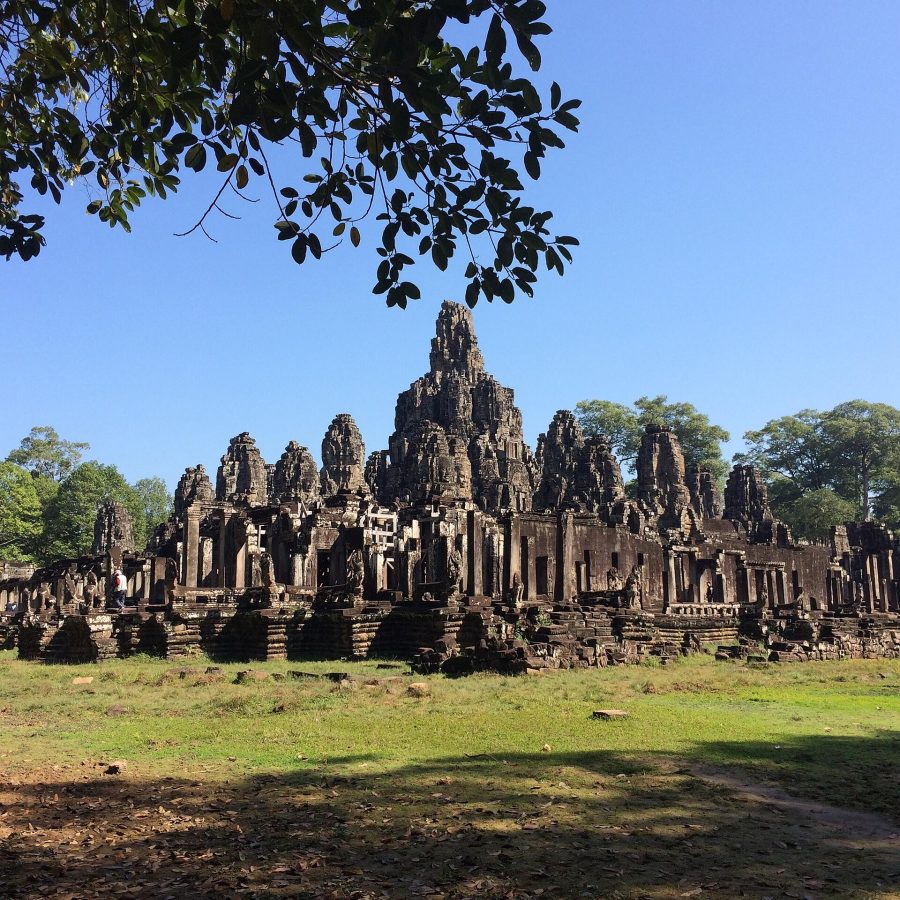
Photo: Trusty Tuk Tuk, CC BY-SA 4.0
The Bayon has no separate ticket: it is covered by the Angkor pass, which is sold for one, three or seven days at the official ticket centre outside Siem Reap or online. The one-day pass costs USD 37, the three-day pass is better value for anyone wanting more than a quick look, and children under 12 enter free with a passport. The pass carries your photo and is checked at the gates of each major temple. Almost every organised day in Angkor passes through the Bayon, since it stands at the centre of Angkor Thom between Angkor Wat and Ta Prohm. The most popular option is a sunrise tour that watches dawn over Angkor Wat and then moves on to the Bayon and the jungle-wrapped Ta Prohm before the heat builds;
full-day group tours cover the same core temples at a steadier pace with lunch in between, and some are run in languages other than English. A private tuk-tuk with a driver for the day is the cheapest flexible choice and lets you return to the Bayon at the hour you want. What is included is usually transport, a licensed guide on guided tours and bottled water; the Angkor pass and lunch are generally extra, so check. A guide pays off here more than at most temples, because the bas-reliefs are dense with stories that are hard to read unaided.
Live dates and prices from GetYourGuide. Free cancellation on most tickets.
The Bayon was the state temple of Jayavarman VII, the Buddhist king who rebuilt the Khmer capital in the late twelfth and early thirteenth centuries after a Cham invasion. It stands at the exact centre of his walled city, Angkor Thom, and was the last great state temple raised at Angkor. Later kings altered it to suit Hindu worship, and in time it returned to Buddhism, which is why some images were recarved and others removed. Seen from a distance the temple looks like a jumble of rock; up close it resolves into a crowd of towers, each carved on its four sides with large serene faces, smiling slightly, with lowered eyes. There are over two hundred of them, and many scholars read them as the bodhisattva of compassion merged with the king himself.
Start with the outer gallery on the east side and walk clockwise: the bas-reliefs show the war against the Cham, including a naval battle on the great lake, along with markets, cockfights, cooking, a woman in childbirth and fishermen at work, an unusually intimate record of daily life in the Khmer empire. Then climb to the upper terrace, where the faces loom at eye level from every angle. Dress is checked at the stairs, the steps are steep and worn, and monks and worshippers still leave offerings at small shrines inside, so give them room. The Bayon is about 3 km north of Angkor Wat; tuk-tuks run from Siem Reap in about 25 minutes.
The Angkor temples are open from early morning until 5.30 pm. At the Bayon, the best plan is to avoid the mid-morning rush, when most sunrise groups arrive from Angkor Wat. Come straight after opening if you can skip the Angkor Wat sunrise, or come late in the afternoon, when the light from the west makes the faces glow and the terraces empty out before closing. November to March is the dry, comfortable and busiest season.
April and May are very hot, so the morning and late afternoon slots matter even more. The rainy season from June to October brings fewer visitors, green moss on the stone and dramatic skies, with short downpours usually in the afternoon. Khmer New Year in mid-April and the water festival in autumn bring Cambodian families to Angkor in large numbers. Allow an hour and a half to two hours. Combine it with the Baphuon and the royal terraces just to the north, Ta Prohm to the east, and Angkor Wat.
Yes. GetYourGuide lists 6 tickets and tours for Bayon, with live dates and prices and free cancellation on most of them.
The Angkor temples are open from early morning until 5.30 pm.
Allow an hour and a half to two hours.
Entry to Bayon: USD 37 one-day Angkor pass
Shoulders and knees covered; the rule is enforced at the steps to the upper terrace.
Bayon was established in 1190.
Bayon is in Siem Reap, Cambodia. The map on this page shows the exact spot.
How to visit an ancient temple: tickets, heat and rules — Tickets, hours, heat, guides, climbing rules and conservation at the ancient temples of Egypt, Greece, Italy, Angkor and the Maya world.
Siem Reap, Cambodia
Angkor Wat is not ticketed on its own. Every visitor needs an Angkor pass, which covers the whole archaeological park…
532 tickets & tours
Siem Reap, Cambodia
Banteay Samre has no ticket of its own. It lies inside the protected Angkor zone, so entry is covered by the standard…
6 tickets & tours
Siem Reap, Cambodia
Ta Prohm lies inside the Angkor Archaeological Park, so there is no separate ticket for it: you need an Angkor pass,…
5 tickets & tours
Siem Reap, Cambodia
The Roluos temples lie inside the Angkor Archaeological Park, so entry is covered by the standard Angkor pass, which is…
4 tickets & tours
Siem Reap, Cambodia
There is no separate ticket for Banteay Kdei. Like every temple in the Angkor Archaeological Park, it is covered by the…
1 ticket or tour
Siem Reap, Cambodia
There is no ticket for Wat Bo. It is an active monastery on the east bank of the Siem Reap River, and visitors can walk…
1 ticket or tour