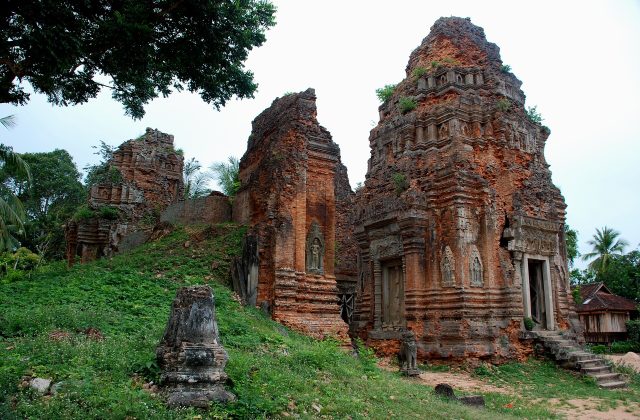
Angkor Wat
Siem Reap, Cambodia
Angkor Wat is not ticketed on its own. Every visitor needs an Angkor pass, which covers the whole archaeological park…
532 tickets & tours
Hindu Temple · Siem Reap · Cambodia

Photo: The original uploader was RichardSocher at English Wikipedia, CC BY 2.5
Banteay Samre has no ticket of its own. It lies inside the protected Angkor zone, so entry is covered by the standard Angkor pass, sold for one, three or seven days at the official ticket centre on the road from Siem Reap or online, and checked at the temple gate; the one-day pass costs USD 37. Keep it with you, because inspectors check it at each major site. Because the temple sits about 30 km out of town, east of the great reservoir known as the East Baray, most people see it on a day out that strings together several outlying sites rather than on its own.
The usual pairings are with Banteay Srei, the small pink temple famous for its carving, and the riverbed carvings of Kbal Spean, sometimes with the sacred mountain of Phnom Kulen and its waterfalls, which needs a separate permit. Other tours take a wider loop to the overgrown ruins of Beng Mealea, or combine Banteay Samre with Pre Rup and the early temples of the Roluos group. Options range from a private tuk-tuk with driver, the cheapest and most flexible, to a car with an air-conditioned cabin and a licensed guide; the pass, lunch and the Kulen permit are normally extra. If you already have a guide for Angkor, simply ask to add Banteay Samre on the way back from Banteay Srei.
Live dates and prices from GetYourGuide. Free cancellation on most tickets.
The temple was built in the first half of the twelfth century, in the reign of Suryavarman II, the king of Angkor Wat, and it shares that monument's style: a single central tower with a pointed, lotus-bud profile, linked by a vestibule to a hall in front, two libraries and two enclosing galleries. No inscription records who founded it, and it was probably the work of a senior court official. Its name refers to the Samre, a people of the hills who once lived in the region. In the 1930s and 1940s the French architect Maurice Glaize rebuilt it stone by stone using the method of anastylosis, and it remains one of the most complete temples in the Angkor area. Approach from the east along the raised causeway, about 200 m long and lined with naga balustrades, then climb to the terrace in front of the outer gate.
Inside, the first enclosure is set lower than the galleries, giving the inner court a sunken, enclosed feel unlike most Khmer temples. Look up at the pediments and lintels, carved with scenes of Vishnu and episodes from the Ramayana in crisp grey and pink sandstone, and at the windows with turned stone balusters. The inner court is compact enough to walk round several times, each time spotting new details. Do not climb on carvings, sit on the balusters or touch the reliefs. Tuk-tuks from Siem Reap take about 40 minutes, passing Pre Rup on the way.
Like the other Angkor monuments, Banteay Samre is open from early morning until 5.30 pm; the main pass is checked at the entrance. Because it lies off the classic small and grand circuits, it is quieter than the central temples at almost any hour, but the best times are the first hour after opening and the late afternoon, when the low sun warms the sandstone and brings out the depth of the carving. The dry season, from November to March, is the most comfortable;
this is also peak season, though crowds here stay modest. April and May bring intense heat, so start early and carry water. The rainy months from June to October turn the surrounding fields bright green and keep the stone a deeper colour, with storms usually in the afternoon. Khmer New Year in mid-April is lively around Siem Reap. Allow 45 minutes to an hour. Combine it with Banteay Srei, about 30 minutes to the north, and Pre Rup or East Mebon on the way back into town.
Yes. GetYourGuide lists 6 tickets and tours for Banteay Samre, with live dates and prices and free cancellation on most of them.
Like the other Angkor monuments, Banteay Samre is open from early morning until 5.30 pm; the main pass is checked at the entrance.
Allow 45 minutes to an hour.
Entry to Banteay Samre: Included in the Angkor pass
Shoulders and knees covered, as at all Angkor temples; hats off in the inner sanctuary.
Banteay Samre was established in 1100.
Banteay Samre is in Siem Reap, Cambodia. The map on this page shows the exact spot.
How to visit a Hindu temple: dress, shoes and access — What to wear, what to leave at the gate and where non-Hindus may go in Hindu temples in India, Nepal, Bali and South-East Asia.
Siem Reap, Cambodia
Angkor Wat is not ticketed on its own. Every visitor needs an Angkor pass, which covers the whole archaeological park…
532 tickets & tours
Siem Reap, Cambodia
The Bayon has no separate ticket: it is covered by the Angkor pass, which is sold for one, three or seven days at the…
6 tickets & tours
Siem Reap, Cambodia
Ta Prohm lies inside the Angkor Archaeological Park, so there is no separate ticket for it: you need an Angkor pass,…
5 tickets & tours
Siem Reap, Cambodia
The Roluos temples lie inside the Angkor Archaeological Park, so entry is covered by the standard Angkor pass, which is…
4 tickets & tours
Siem Reap, Cambodia
There is no separate ticket for Banteay Kdei. Like every temple in the Angkor Archaeological Park, it is covered by the…
1 ticket or tour
Siem Reap, Cambodia
There is no ticket for Wat Bo. It is an active monastery on the east bank of the Siem Reap River, and visitors can walk…
1 ticket or tour