Angkor Wat
Siem Reap, Cambodia
Angkor Wat is not ticketed on its own. Every visitor needs an Angkor pass, which covers the whole archaeological park…
532 tickets & tours
Ancient Temple · Siem Reap · Cambodia
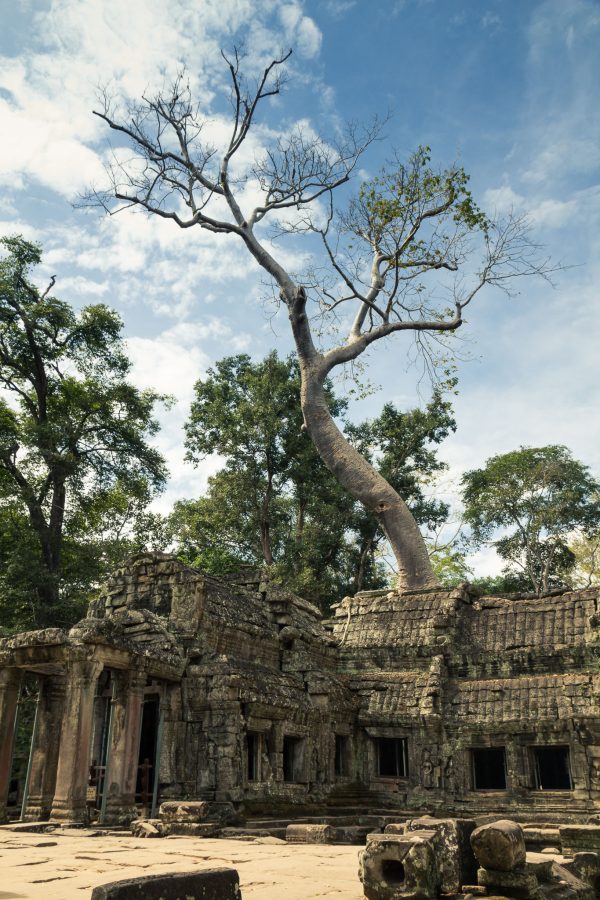
Photo: Dmitry A. Mottl, CC BY-SA 4.0
Ta Prohm lies inside the Angkor Archaeological Park, so there is no separate ticket for it: you need an Angkor pass, sold for one, three or seven days at the official ticket centre on the road from Siem Reap or online, and it is checked at the temple entrance. A one-day pass costs USD 37. Tours almost never include the pass, so budget for it on top. What is sold online is transport and guiding. The most common format is a full-day temple circuit from Siem Reap that combines Angkor Wat, the Bayon and the other gates of Angkor Thom with Ta Prohm, either with a guide in an air-conditioned minivan or with a licensed guide and a tuk-tuk.
Sunrise versions start before 5 am at Angkor Wat and reach Ta Prohm mid-morning. Shorter half-day tours focus on the tree-covered ruins and the stone faces of the Bayon. Private tuk-tuk hire by the day is a cheap and flexible alternative if you are comfortable reading up yourself, and there are guided tours in several languages, German among them. A guide earns his fee here: the reliefs and the history of Jayavarman VII are hard to read without help, and a good one will steer you round the worst of the crowds at the famous trees.
Live dates and prices from GetYourGuide. Free cancellation on most tickets.
Ta Prohm was founded in 1186 by King Jayavarman VII as a Buddhist monastery and seat of learning, dedicated to his mother, and was first called Rajavihara, the royal monastery. Its foundation stele lists more than 12,000 people living within the walls and tens of thousands more in the villages that supplied it. After the Khmer capital was abandoned in the 15th century the jungle moved in, and when French archaeologists began clearing Angkor they deliberately left Ta Prohm much as they found it. That decision is the reason to come. Silk-cotton and strangler fig trees grow straight out of the galleries, their roots poured over walls and gateways like wax, and the half-collapsed corridors are lit by green light filtering through the canopy.
The best-known tree, framing a doorway near the east side, became famous after the 2001 Tomb Raider film and usually has a queue for photographs. Look also for the carved apsaras and devatas that survive on the walls, and for the inner courtyards that are quieter than the tree spots. The temple is laid out on one level inside a series of concentric enclosures, and you walk through it from west to east or the reverse. Wooden walkways and platforms now guide the route and protect the stones; restoration has been a joint project of the Archaeological Survey of India and the Cambodian heritage authority, so expect scaffolding and roped-off sections. Stay on the walkways, do not climb on fallen blocks or roots, and dress modestly with shoulders and knees covered. Ta Prohm is about 1 km east of Angkor Thom and roughly 30 minutes by tuk-tuk from central Siem Reap.
Ta Prohm keeps the same daytime hours as most Angkor temples, from early morning to late afternoon; the pass is valid only within those hours, so check the current times when you buy it. The best moment is the first hour after opening, when the light is soft, the air is cool and the tour coaches are still at Angkor Wat for sunrise. Arriving straight from sunrise at Angkor Wat is a good plan; late morning is the busiest time, when the famous trees are crowded.
The dry season from November to March is the most comfortable, with December and January the peak months. The rains from June to October keep the jungle lush and the crowds thinner, though paths can be muddy. Allow one to one and a half hours. Ta Prohm sits on the so-called small circuit, so it combines naturally with Angkor Wat, the Bayon and the Terrace of the Elephants in one long day, with Banteay Kdei and the reservoir of Srah Srang a few minutes further east.
Yes. GetYourGuide lists 5 tickets and tours for Ta Prohm, with live dates and prices and free cancellation on most of them.
Allow one to one and a half hours.
Entry to Ta Prohm: USD 37 one-day Angkor pass
Shoulders and knees covered, as at all Angkor temples.
Ta Prohm covers 65 ha.
Ta Prohm was established in 1186.
Ta Prohm is in Siem Reap, Cambodia. The map on this page shows the exact spot.
How to visit an ancient temple: tickets, heat and rules — Tickets, hours, heat, guides, climbing rules and conservation at the ancient temples of Egypt, Greece, Italy, Angkor and the Maya world.
Siem Reap, Cambodia
Angkor Wat is not ticketed on its own. Every visitor needs an Angkor pass, which covers the whole archaeological park…
532 tickets & tours
Siem Reap, Cambodia
Banteay Samre has no ticket of its own. It lies inside the protected Angkor zone, so entry is covered by the standard…
6 tickets & tours
Siem Reap, Cambodia
The Bayon has no separate ticket: it is covered by the Angkor pass, which is sold for one, three or seven days at the…
6 tickets & tours
Siem Reap, Cambodia
The Roluos temples lie inside the Angkor Archaeological Park, so entry is covered by the standard Angkor pass, which is…
4 tickets & tours
Siem Reap, Cambodia
There is no separate ticket for Banteay Kdei. Like every temple in the Angkor Archaeological Park, it is covered by the…
1 ticket or tour
Siem Reap, Cambodia
There is no ticket for Wat Bo. It is an active monastery on the east bank of the Siem Reap River, and visitors can walk…
1 ticket or tour