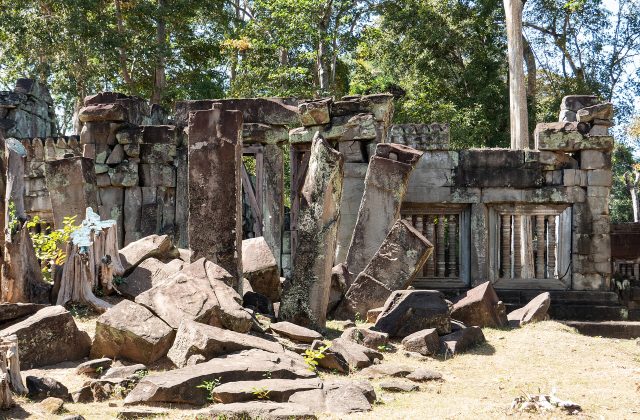
Koh Ker
Preah Vihear, Cambodia
Koh Ker has its own ticket, sold at a checkpoint on the access road and online as a one-day pass;
12 tickets & tours
Ancient Temple · Preah Vihear · Cambodia

Photo: PsamatheM, CC BY-SA 4.0
Preah Vihear is one of the most spectacular Khmer temples and one of the hardest to reach. It sits on a clifftop in the Dangrek Mountains on Cambodia's northern border, roughly 140 km from Angkor as the crow flies and a long drive of three to four hours each way from Siem Reap. Almost everyone visits it as a full-day excursion from Siem Reap, and that is what is sold online. The first type of trip is a private day tour with a car, driver and English-speaking guide, often leaving Siem Reap around dawn and returning after dark. The second is a shared day tour that pairs Preah Vihear with Koh Ker, the tenth-century capital with its seven-tiered pyramid, which lies roughly on the way; it is cheaper but makes for a very long day in a minivan.
Transport and guide are usually included; the temple ticket, the pick-up truck or motorbike ride up the final stretch of mountain road and lunch are often extra, so read the inclusions carefully. Foreigners buy their ticket at the visitor centre at the foot of the mountain, where local drivers also wait to take visitors up the steep access road. Independent travellers can hire a car and driver in Siem Reap or base themselves in the town of Sra Em nearby. The Angkor pass is not valid here. Because the temple lies on a disputed border that has seen armed clashes, as recently as 2025, check that the site is open and that travel to the area is advised before you commit to the trip.
Live dates and prices from GetYourGuide. Free cancellation on most tickets.
Unlike the temples of Angkor, which face east on flat ground, Preah Vihear climbs a ridge along a north-south axis for about 800 m, rising some 120 m from the lowest stairway to the sanctuary perched on the cliff edge. The idea is the same as at Angkor, a stylised Mount Meru, but here it is expressed as a pilgrimage up the mountain itself. The approach is broken by five gateways, or gopuras, each reached by a flight of steps, so that every stage of the temple stays hidden until you pass through the previous gate. Look for traces of red paint on the lowest gopura, and above all for the carved pediment on the south side of the fourth, which shows the Churning of the Sea of Milk and is the finest relief on the site.
The third gopura is the largest, flanked by long halls, and beyond it two courtyards with libraries lead to the central sanctuary, now partly ruined. The temple was begun in the ninth century and enlarged over some three hundred years, mainly under Suryavarman I and Suryavarman II, the builder of Angkor Wat. It was dedicated to Shiva and later used by Buddhists. The International Court of Justice ruled in 1962 that it belongs to Cambodia, and UNESCO listed it in 2008. Walk past the sanctuary to the cliff edge, where the land drops more than 500 m to the Cambodian plain, an enormous view on a clear day. Stay on marked paths, as the surrounding hills were once mined, and respect any soldiers on duty. A small Buddhist shrine near the top is still used for offerings.
The site is open during daylight, roughly from early morning to late afternoon, and the last visitors are usually sent up the mountain well before closing; confirm the hours and the current border situation before you leave Siem Reap. Because the drive is so long, most visitors reach the top around midday. If you can, stay overnight in Sra Em and go up early in the morning, when the air is clear and the view over the plain is at its sharpest;
the cliff edge in the late afternoon light is also memorable. The dry season, from November to February, is the most comfortable time, with clear skies and cooler air. March to May is very hot, and in the rainy season from June to October cloud often covers the clifftop and the access road can be slippery. Allow two to three hours on the site itself, more if you walk the whole length of the causeway slowly. The natural partner is Koh Ker, which can be visited on the same long day or on the way back to Siem Reap the next morning; Beng Mealea is another stop on the same road.
Yes. GetYourGuide lists 2 tickets and tours for Preah Vihear Temple, with live dates and prices and free cancellation on most of them.
Because the temple lies on a disputed border that has seen armed clashes, as recently as 2025, check that the site is open and that travel to the area is advised before you commit to the trip.
Allow two to three hours on the site itself, more if you walk the whole length of the causeway slowly.
Entry to Preah Vihear Temple: Paid foreigners' ticket at the site
Shoulders and knees covered, as at Angkor; good walking shoes for the steps.
Preah Vihear Temple covers 1.5 km².
Preah Vihear Temple was established in 893.
Preah Vihear Temple is in Preah Vihear, Cambodia. The map on this page shows the exact spot.
How to visit an ancient temple: tickets, heat and rules — Tickets, hours, heat, guides, climbing rules and conservation at the ancient temples of Egypt, Greece, Italy, Angkor and the Maya world.
Preah Vihear, Cambodia
Koh Ker has its own ticket, sold at a checkpoint on the access road and online as a one-day pass;
12 tickets & tours