
Tirta Empul
Ubud, Indonesia
Most visitors reach Tirta Empul on a driver-led day out from Ubud, Denpasar or the southern beach resorts, because the…
39 tickets & tours
Hindu Temple · Ubud · Indonesia
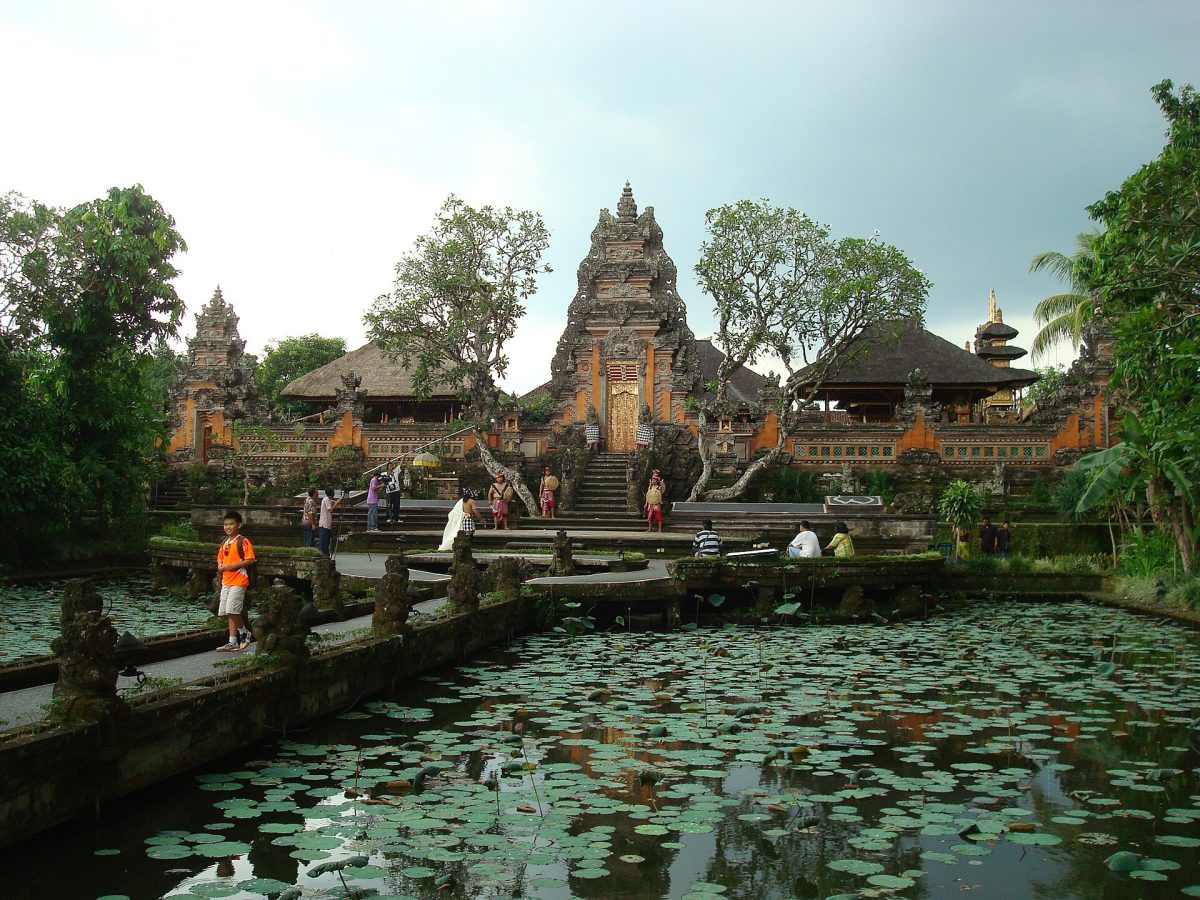
Photo: Arabsalam, CC BY-SA 3.0
There is nothing to buy to see Pura Taman Saraswati. The lotus ponds and the front courtyard are open to anyone walking along the main street of Ubud, and the only payment you may meet is a donation box or a request to rent a sarong if you go further in. The evening dance performances held on the stage in front of the temple are a separate matter: tickets are sold the same day by sellers on the street or at the gate, and you pay in cash. Online, the temple appears inside half-day and full-day tours of the Ubud area rather than on its own.
A typical outing is a private car with an English-speaking driver who picks you up at your hotel anywhere in south or central Bali and links the water temple with the Sacred Monkey Forest, the rice terraces at Tegallalang, a waterfall or two, a coffee plantation and the royal palace across the road. Entry fees at the paid sights, lunch and tips are often extra, so check each listing; the driver and fuel are usually included. Some cultural day trips add a temple blessing or a visit to a craft village. If you are staying in Ubud, you do not need a tour at all: walk here in the morning, then come back after dark for a dance. A driver makes sense only if you are based on the coast and want to see several Ubud sights in one day.
Live dates and prices from GetYourGuide. Free cancellation on most tickets.
The temple stands just off Jalan Raya Ubud, behind a long walkway that runs between two ponds of pink and white lotus. It was built in 1951 and 1952 for the prince of Ubud by I Gusti Nyoman Lempad, the sculptor and temple architect whose work defines much of the town, and it is dedicated to Saraswati, the Hindu goddess of learning, writing and the arts. Many of the soft volcanic stone carvings along the path, of figures from Hindu mythology, are by Lempad himself. At the end of the walkway three red brick gates lead into the inner courtyard. Look for the low wall that blocks the direct route through the central gate: it is the back of a large statue of the demon Jero Gede Mecaling, placed there because in Balinese belief evil spirits can only travel in straight lines.
Inside, in the most sacred north-east corner, a padmasana shrine is topped by an empty golden throne for the supreme deity, its base carved with the cosmic turtle and serpents. A pavilion holds three empty seats for Brahma, Vishnu and Shiva, and another houses the temple's barong figures. Visitors are normally welcome in the outer court and along the ponds, but the inner sanctuary may be closed when ceremonies are under way. Wear a sarong and sash, do not step over offerings on the ground, never stand higher than a priest, and stay out of the temple if you are menstruating, as Balinese custom asks. The temple is in the middle of Ubud, a two-minute walk from the royal palace and the market.
The ponds can be seen from early morning until the evening, and the gates are usually open during daylight hours; there are no fixed tourist hours. Before 9 am is the best time, when the light is soft, the lotus flowers are open and the coach tours from the south have not yet arrived. The evening dance, usually starting around 7.30 pm, transforms the place with lamps and gamelan music. Lotus flowers bloom through much of the year but are fullest in the wet months from roughly November to March;
the dry season from April to October is more comfortable for walking. Temple anniversaries and the festival of Saraswati, held every 210 days in the Balinese calendar when books and learning are blessed, fill the courtyard with offerings and worshippers. On Nyepi, the Day of Silence in March, the whole island shuts down and nobody may go out. Allow half an hour for the temple, longer if you stay for a show. Combine it with the royal palace, the art market, the Monkey Forest and the rice fields north of town.
Yes. GetYourGuide lists 3 tickets and tours for Pura Taman Saraswati, with live dates and prices and free cancellation on most of them.
The lotus ponds and the front courtyard are open to anyone walking along the main street of Ubud, and the only payment you may meet is a donation box or a request to rent a sarong if you go further in.
Allow half an hour for the temple, longer if you stay for a show.
Before 9 am is the best time, when the light is soft, the lotus flowers are open and the coach tours from the south have not yet arrived.
Entry to Pura Taman Saraswati: Free; donations welcome
Shoulders and knees covered; a sarong and sash are needed beyond the outer court.
Pura Taman Saraswati was established in 1951.
Pura Taman Saraswati is in Ubud, Indonesia. The map on this page shows the exact spot.
How to visit a Hindu temple: dress, shoes and access — What to wear, what to leave at the gate and where non-Hindus may go in Hindu temples in India, Nepal, Bali and South-East Asia.
Ubud, Indonesia
Most visitors reach Tirta Empul on a driver-led day out from Ubud, Denpasar or the southern beach resorts, because the…
39 tickets & tours
Ubud, Indonesia
Batuan Temple is a village temple, and visitors simply pay a small entrance donation at the gate, where a sarong and…
9 tickets & tours
Ubud, Indonesia
Gunung Kawi does not need a ticket in advance: you pay the entrance fee at the top of the steps, where a sarong is…
4 tickets & tours

