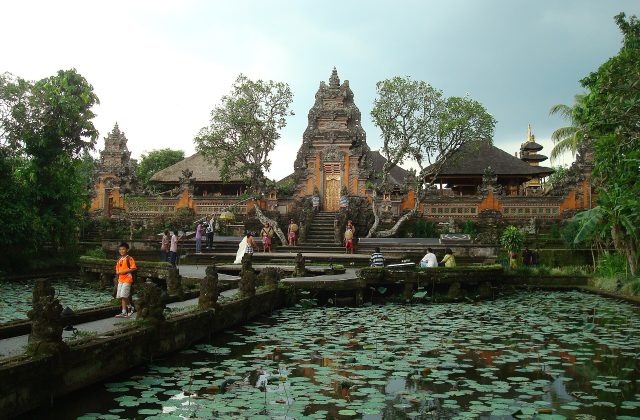
Tirta Empul
Ubud, Indonesia
Most visitors reach Tirta Empul on a driver-led day out from Ubud, Denpasar or the southern beach resorts, because the…
39 tickets & tours
Hindu Temple · Ubud · Indonesia

Photo: Anggabuana, CC BY-SA 4.0
Gunung Kawi does not need a ticket in advance: you pay the entrance fee at the top of the steps, where a sarong is handed over with it, and walk down into the valley. What is worth arranging is the transport, since the site lies in Tampaksiring, a rural area north-east of Ubud with no useful public buses. Most tours from Ubud treat it as one stop on a half day in the Pakerisan valley. The usual partner is the spring temple of Tirta Empul a few minutes up the road, where some tours include a purification bathing ritual, with the sarong and offerings provided and sometimes a local guide to lead you through the fountains.
Other routes add the Tegalalang rice terraces, a waterfall or a coffee plantation. There are also guided visits that focus on the history of the valley, which is part of the UNESCO-listed subak landscape of Bali. Tours normally include pick-up in Ubud, a driver and fuel; entrance fees may or may not be included. One warning: there is a separate water temple called Gunung Kawi Sebatu near Tegalalang, and some itineraries use the same name for it. If you want the rock-cut shrines described here, check that the route goes to Tampaksiring. A private driver for a few hours from Ubud is the most flexible option.
Live dates and prices from GetYourGuide. Free cancellation on most tickets.
Gunung Kawi is a royal memorial of the 11th century, carved directly into the soft rock of the Pakerisan river gorge. It consists of ten candi, shrine facades about 7 m high cut into niches in the cliff, usually linked with King Anak Wungsu of the Udayana dynasty and members of his family. They are not tombs; no remains were ever found, and they are thought to be memorials to deified royalty. You reach them down a long stone staircase, around 300 steps, through a split gate cut in the rock and past terraced rice fields that fall towards the river. At the bottom, a group of four shrines stands on one bank and a row of five on the other, facing each other across the water; you cross a bridge to reach the larger group.
The tenth candi stands apart, further down the valley, on a path past the rice fields. Next to the main group are cells and courtyards cut into the rock where monks or hermits once lived, and a small active temple where local people make offerings. The setting is half the experience: the sound of the river, the moss on the carvings and the rice terraces make the valley one of the most atmospheric places near Ubud. Look closely at the facades to see the outline of false doors and stepped roofs carved in shallow relief. A sarong and sash are required and are lent at the ticket desk. Walk quietly in the active temple area, do not climb the shrines and do not step on offerings. The climb back up is steep, so take water. Tampaksiring is about 30 to 40 minutes by car from Ubud.
The site is open daily from morning until late afternoon; hours are not always posted, so check locally. Come early in the morning, both to avoid the heat on the climb back up and to have the gorge to yourself before the Ubud tours arrive in the late morning. Early light falls on the carved faces across the river. Late afternoon is pleasant too, but leave enough time before closing for the descent and climb. The dry season from April to October is easiest;
in the wet months the steps can be slippery and showers usually arrive in the afternoon, though the valley is at its greenest. The rice terraces change with the planting cycle, flooded and bright after planting and golden before harvest. Local temple ceremonies, the anniversary days of the shrine and island-wide festivals such as Galungan bring worshippers in white and offerings to the small temple; this is a good time to visit if you keep a respectful distance. Allow one and a half hours, and combine the site with Tirta Empul and the Tegalalang terraces on the way back to Ubud.
Yes. GetYourGuide lists 4 tickets and tours for Gunung Kawi, Tampaksiring, with live dates and prices and free cancellation on most of them.
Entry to Gunung Kawi, Tampaksiring: Fee at the gate, sarong included
The site is open daily from morning until late afternoon; hours are not always posted, so check locally.
Allow one and a half hours, and combine the site with Tirta Empul and the Tegalalang terraces on the way back to Ubud.
Sarong and sash required; they are lent free at the entrance.
Gunung Kawi, Tampaksiring was established in 1000.
Gunung Kawi, Tampaksiring is in Ubud, Indonesia. The map on this page shows the exact spot.
How to visit a Hindu temple: dress, shoes and access — What to wear, what to leave at the gate and where non-Hindus may go in Hindu temples in India, Nepal, Bali and South-East Asia.
Ubud, Indonesia
Most visitors reach Tirta Empul on a driver-led day out from Ubud, Denpasar or the southern beach resorts, because the…
39 tickets & tours
Ubud, Indonesia
Batuan Temple is a village temple, and visitors simply pay a small entrance donation at the gate, where a sarong and…
9 tickets & tours
Ubud, Indonesia
There is nothing to buy to see Pura Taman Saraswati. The lotus ponds and the front courtyard are open to anyone walking…
3 tickets & tours