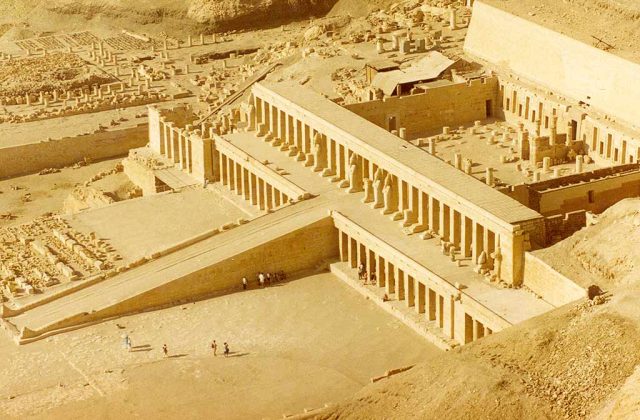
Medinet Habu (Temple of Ramesses III)
1 km away
Medinet Habu has its own entry ticket, bought at the ticket office by the site entrance or online in advance as a dated…
2 tickets & tours
Ancient Temple · Luxor · Egypt

No ticket is sold online for the Mortuary Temple of Amenhotep III on its own. What most visitors actually see is its gateway, the two seated Colossi of Memnon, which stand beside the main road on the West Bank of Luxor and can be visited freely without a ticket. The temple ground behind them, known as Kom el-Hettan, has for years been an active excavation site, and access beyond the fence has been limited; check locally whether any part is open when you go. The usual way to get here is on a guided West Bank tour from Luxor. Half-day and full-day versions are sold by every hotel and online, and they almost always include a short photo stop at the Colossi along with the Valley of the Kings, the Temple of Hatshepsut at Deir el-Bahari and sometimes Medinet Habu or the Ramesseum.
These tours normally include hotel pick-up, an air-conditioned vehicle and an Egyptologist guide; entry tickets to the paid sites are included in some offers and paid on the spot in others, so read the details. Hot-air balloon flights at dawn also drift over this stretch of the West Bank and give the best view of the temple's outline. Independently, a taxi or hired driver from the ferry landing or the bridge takes around 15 minutes, and a bicycle is a pleasant alternative in the cooler months. The page lists any GetYourGuide tours whose route passes the temple.
Live prices from GetYourGuide for tickets and tours that include this temple. Free cancellation on most of them.
In its day this was the largest temple on the West Bank of Thebes, built for Amenhotep III of the 18th Dynasty, around 1350 BC, under the direction of his famous architect Amenhotep, son of Hapu. It was meant to keep the king's cult alive after his death. Very little now stands: the temple sat close to the Nile on low ground, and an earthquake, now dated to around 1200 BC, brought much of it down, after which later pharaohs carried away its stone for their own buildings. The two Colossi of Memnon, each about 18 m high, are seated figures of the king, with smaller figures of his wife Queen Tiye and his mother beside his legs. They once flanked the first gateway of the temple, which faced east towards the river.
In Roman times the northern statue, cracked by an earthquake, was said to make a sound at dawn, and Greek and Roman tourists came to hear it, leaving inscriptions on its legs that you can still pick out. Behind the Colossi, excavation teams have been working since the late 1990s to recover and re-erect what lies in the ground: further colossal statues of the king in red granite and quartzite, rows of statues of the lion-headed goddess Sekhmet, and fragments of the great columned hall and sun court. Even from the fence you can see restored statues standing again on their original bases. There is no special etiquette at an archaeological site, but do not climb on the statues or step over barriers, and expect persistent souvenir sellers in the car park.
The Colossi stand in the open by the road and can be seen at any time of day; the paid West Bank sites nearby generally open around 6 am and close in the late afternoon. Arrive early: by 8 am the coaches from Luxor and Hurghada begin to arrive, and in summer the heat becomes punishing by late morning. The best light falls on the statues soon after sunrise, when the sun rises behind them over the Nile, and again in the late afternoon.
October to April is the most comfortable season; from May to September temperatures in Luxor regularly pass 40 degrees, and an early start is essential. A stop at the Colossi takes 15 to 20 minutes. Combine it with Medinet Habu, a short drive south, the Ramesseum and the tombs of the Nobles nearby, or make it the first stop of a day that continues to Deir el-Bahari and the Valley of the Kings.
1 km away
Medinet Habu has its own entry ticket, bought at the ticket office by the site entrance or online in advance as a dated…
2 tickets & tours
2 km away
The temple at Deir el-Bahari sits on Luxor's West Bank, and almost everyone sees it as part of a wider tour of the…
4 tickets & tours
4 km away
Luxor Temple stands in the middle of the modern city on the east bank of the Nile, so it is the easiest of the great…
20 tickets & tours
Yes. GetYourGuide sells tickets and guided tours whose route includes Mortuary Temple of Amenhotep III (Kom el-Hettan); live prices are shown on this page.
The temple ground behind them, known as Kom el-Hettan, has for years been an active excavation site, and access beyond the fence has been limited; check locally whether any part is open when you go.
Entry to Mortuary Temple of Amenhotep III (Kom el-Hettan): Free to view the Colossi
No dress code; wear a hat and comfortable shoes for the sun and dust.
Mortuary Temple of Amenhotep III (Kom el-Hettan) is in Luxor, Egypt. The map on this page shows the exact spot.
How to visit an ancient temple: tickets, heat and rules — Tickets, hours, heat, guides, climbing rules and conservation at the ancient temples of Egypt, Greece, Italy, Angkor and the Maya world.
Luxor, Egypt
Luxor Temple stands in the middle of the modern city on the east bank of the Nile, so it is the easiest of the great…
20 tickets & tours
Luxor, Egypt
Karnak has its own ticket office at the visitor centre by the entrance, and tickets for foreign visitors are paid by…
8 tickets & tours
Luxor, Egypt
The temple at Deir el-Bahari sits on Luxor's West Bank, and almost everyone sees it as part of a wider tour of the…
4 tickets & tours
Luxor, Egypt
Medinet Habu has its own entry ticket, bought at the ticket office by the site entrance or online in advance as a dated…
2 tickets & tours