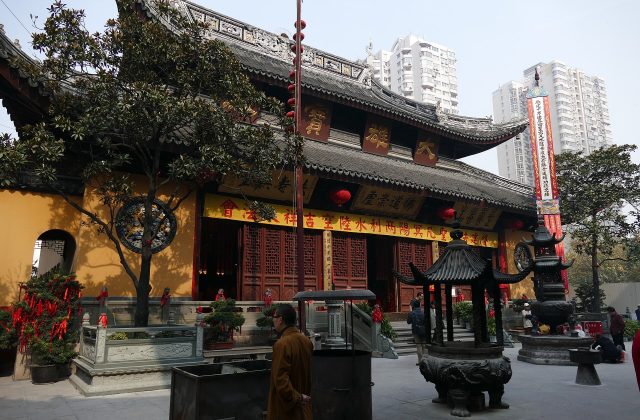
Jing’an Temple
Shanghai, China
Jing'an Temple charges a modest entry fee, paid at the gate on West Nanjing Road or bought in advance as a timed…
7 tickets & tours
Buddhist Temple · Shanghai · China

Photo: Sinopitt, CC BY-SA 4.0
Longhua Temple is entered with a modest ticket bought at the gate, and you do not need to reserve it in advance. Payment by mobile app is now the norm, but small cash amounts are usually accepted; if you are visiting independently, bring a passport just in case. Incense is sold at the entrance for those who want to make an offering. The tours on offer are small-group or private walks led by a local guide who explains Chinese Buddhism as you go: the logic of the halls along the central axis, the roles of the Maitreya Buddha and the four Heavenly Kings, how people pray and what the monks do through the day.
Some include a bowl of noodles at the temple's own vegetarian restaurant, which is a well-known lunch spot in this part of the city, and others add a stroll through the Longhua Martyrs Memorial park next door. They normally include the entry ticket and the guide; transport from your hotel is usually not included, since the metro takes you almost to the gate. A guided visit is worthwhile if you want the iconography and rituals explained, since signage is limited. If you just want to see the temple and the pagoda, going on your own is straightforward and much cheaper, and you can still eat the noodles afterwards.
Live dates and prices from GetYourGuide. Free cancellation on most tickets.
Longhua is the largest and oldest temple complex in Shanghai. Tradition dates it to 242, when Sun Quan of the Kingdom of Wu is said to have built pagodas for relics of the Buddha, but the buildings were destroyed and rebuilt many times. The plan you walk through follows a Song dynasty monastery of the Chan school, while the halls themselves mostly date from rebuilding in the late Qing period and were restored in the 1950s. The complex stretches along a central axis almost 200 m long. You pass in turn through the Maitreya Hall, with the laughing, round-bellied Buddha to whom the temple is dedicated, the Hall of the Heavenly Kings, the Mahavira Hall with its gilded Buddha surrounded by arhats, the Hall of the Three Sages and the abbot's hall.
Side buildings include a bell tower and a drum tower and a hall of 500 arhats, each figure different. Outside the main gate stands Longhua Pagoda, the temple's landmark, a seven-storey octagonal brick and wood tower about 40 m high whose core survives from the Song dynasty. It cannot be climbed, but it is worth walking round. The grounds have a darker past: thousands of suspected communists were executed here in the purge of 1927, remembered in the martyrs' memorial behind the temple, and during the Second World War the Japanese ran a civilian internment camp nearby. Bow or simply stand quietly before the altars, do not step on the raised thresholds, and avoid photographing monks during services. Longhua station on metro lines 11 and 12 is a short walk away.
The temple opens early in the morning and closes in the late afternoon; check current times before you go, as they change on festival days. Morning is the best time, when worshippers bring incense and the monks chant in the main hall, and before the afternoon visitors arrive. Weekdays are calmer than weekends. The biggest occasion is Lunar New Year's Eve, when crowds gather for the ringing of the great bell, struck 108 times at midnight to bring good fortune; tickets for the ceremony are limited and the area is packed.
In spring, around the third lunar month, the traditional Longhua temple fair coincides with the peach blossom season, and the Buddha's birthday and the first and fifteenth days of each lunar month also draw devotees. Spring and autumn are the pleasantest seasons, as Shanghai summers are hot and humid. Allow an hour and a half, including lunch at the vegetarian restaurant. Combine it with the West Bund riverside galleries a short ride away or the old city around Yu Garden.
Yes. GetYourGuide lists 2 tickets and tours for Longhua Temple, with live dates and prices and free cancellation on most of them.
Allow an hour and a half, including lunch at the vegetarian restaurant.
Morning is the best time, when worshippers bring incense and the monks chant in the main hall, and before the afternoon visitors arrive.
Entry to Longhua Temple: Small fee at the gate
No strict dress code; modest clothing is appreciated in the halls.
Longhua Temple covers 2 ha.
Longhua Temple was established in 242.
Longhua Temple is in Shanghai, China. The map on this page shows the exact spot.
How to visit a Buddhist temple: shoes, dress and manners — Shoes, dress, feet, photos and offerings in Buddhist temples, from the wats of Thailand and Sri Lanka to the Zen temples of Japan.
Shanghai, China
Jing'an Temple charges a modest entry fee, paid at the gate on West Nanjing Road or bought in advance as a timed…
7 tickets & tours
Shanghai, China
The Jade Buddha Temple sells its own entry tickets at the gate, for a small fee, and there is no need to book ahead;
5 tickets & tours
Shanghai, China
Entry to the temple itself is paid at a ticket window by the main gate, and the price is modest, so there is little…
3 tickets & tours
Shanghai, China
The Confucius Temple charges a small entrance fee at the gate on Wenmiao Road, and there is nothing to reserve in…
No online ticket