
Jing’an Temple
Shanghai, China
Jing'an Temple charges a modest entry fee, paid at the gate on West Nanjing Road or bought in advance as a timed…
7 tickets & tours
Buddhist Temple · Shanghai · China
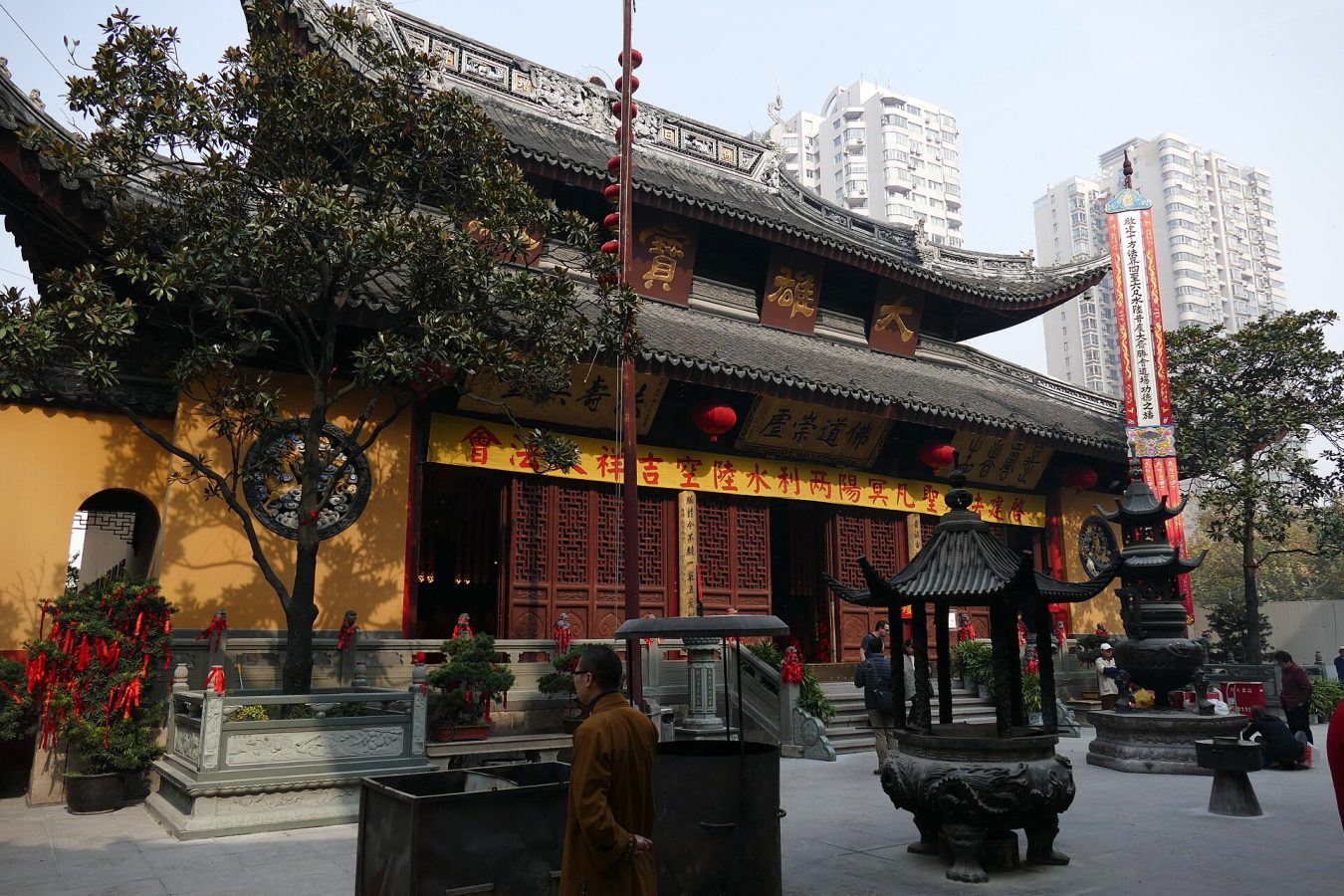
Photo: Hermann Luyken, CC BY-SA 4.0
The Jade Buddha Temple sells its own entry tickets at the gate, for a small fee, and there is no need to book ahead; queues are short except on major Buddhist festivals and at Chinese New Year. The jade statues themselves are in an upper hall within the same compound. If you would like more than a quick look, several kinds of guided experience include the temple. Half-day and full-day city tours often stop here alongside the Bund, Yu Garden and the old town, with a guide, transport and entrance fees covered. Others pair the temple with a walk through local food stalls and neighbourhood restaurants, or with the warehouse galleries of the M50 art district and the lanes of Tian Zi Fang, both a short ride away.
More unusual options set a visit in the context of daily life: a morning tai chi session in a park, a fitting at a traditional tailor, or a quiet session of meditation combined with calligraphy, in which you trace Chinese characters with a brush as a mindful practice. For an independent visit, the temple is on Anyuan Road in the Putuo district, a short walk from Changshou Road metro station, and a taxi from People's Square takes about 15 minutes. Allow money for a bowl of noodles in the temple's vegetarian restaurant, which is part of the experience and popular with local office workers at lunch.
Live dates and prices from GetYourGuide. Free cancellation on most tickets.
The temple owes its name to two white jade statues of the Buddha brought from Burma in 1882 by Huigen, a monk from the sacred island of Putuo, who carried them home after a long pilgrimage. The first temple built for them was damaged in the turmoil of 1911, and the present complex was raised between 1918 and 1928 in the style of the Song dynasty. During the Cultural Revolution the monks are said to have saved it by pasting portraits of Mao over the doors. Today it is one of the busiest active monasteries in Shanghai and houses a Buddhist college. You enter through the Hall of the Heavenly Kings, with the laughing Maitreya facing the gate and the four guardian kings standing on either side.
Across the courtyard, where incense smoke drifts from great bronze burners, is the Grand Hall with three gilded Buddhas, gilded devas along the side walls, and the eighteen arhats. Behind the main altar a large Guanyin stands among sculpted scenes of the pilgrim Sudhana and his teachers. The jade Buddha itself sits in a hall on the upper floor at the back: a seated figure nearly 2 m tall, carved from a single block of pale jade and studded with gems. Photography is not permitted in this room. In a separate hall lies the smaller jade reclining Buddha, showing the Buddha at the moment of his death; nearby is a much larger marble reclining Buddha given from Singapore, which many people mistake for the original. Walk quietly in the halls, do not step on the raised thresholds, and avoid photographing monks during services.
The temple is open every day from early morning until late afternoon, generally closing around 4.30 pm; check the official site for the current hours. The best time is the first hour after opening, when monks chant the morning service and the courtyards are filled with worshippers rather than tour groups. Weekday mornings are quietest; at weekends and lunchtime the vegetarian restaurant is crowded. Shanghai is most pleasant in spring and autumn.
Summers are hot and humid, though the halls offer some shade. Chinese New Year is the busiest moment of the year: on the eve and the first days of the lunar year huge crowds come to pray for good fortune, and lines can stretch along the street. The Buddha's birthday in the fourth lunar month and the Guanyin feast days also draw large numbers. Allow an hour, or an extra half hour for lunch. Combine it with the M50 galleries by Suzhou Creek, then head on to Jing'an Temple or People's Square.
Yes. GetYourGuide lists 5 tickets and tours for Jade Buddha Temple, with live dates and prices and free cancellation on most of them.
The temple is open every day from early morning until late afternoon, generally closing around 4.30 pm; check the official site for the current hours.
Allow money for a bowl of noodles in the temple's vegetarian restaurant, which is part of the experience and popular with local office workers at lunch.
The best time is the first hour after opening, when monks chant the morning service and the courtyards are filled with worshippers rather than tour groups.
Photography is not permitted in this room.
Entry to Jade Buddha Temple: Small entrance fee
No strict dress code; dress modestly and remove hats in the halls.
Jade Buddha Temple was established in 1882.
Jade Buddha Temple is in Shanghai, China. The map on this page shows the exact spot.
How to visit a Buddhist temple: shoes, dress and manners — Shoes, dress, feet, photos and offerings in Buddhist temples, from the wats of Thailand and Sri Lanka to the Zen temples of Japan.
Shanghai, China
Jing'an Temple charges a modest entry fee, paid at the gate on West Nanjing Road or bought in advance as a timed…
7 tickets & tours
Shanghai, China
Entry to the temple itself is paid at a ticket window by the main gate, and the price is modest, so there is little…
3 tickets & tours
Shanghai, China
Longhua Temple is entered with a modest ticket bought at the gate, and you do not need to reserve it in advance.
2 tickets & tours
Shanghai, China
The Confucius Temple charges a small entrance fee at the gate on Wenmiao Road, and there is nothing to reserve in…
No online ticket


