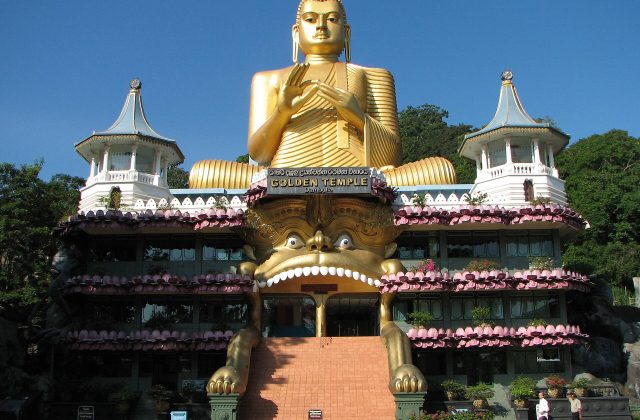
Dambulla Cave Temple
41 km away
Dambulla is easy to visit on your own. Foreign visitors buy a ticket at the office near the Golden Temple at the foot…
192 tickets & tours
Ancient Temple · Polonnaruwa · Sri Lanka

Photo: Singhalawap, CC BY-SA 3.0
Gal Vihara has no ticket of its own: it is part of the ancient city of Polonnaruwa, and entry is covered by the single site ticket for foreign visitors, bought at the ticket office beside the Archaeological Museum near the Parakrama Samudra reservoir. Buy it before heading into the ruins, as it is checked at several points, including at Gal Vihara. The ticket is priced in US dollars and payable in rupees or by card; Sri Lankan visitors pay a much lower rate. Most visitors explore Polonnaruwa by bicycle, hired from guesthouses in the new town, or by tuk-tuk, whose drivers wait at each group of monuments.
Gal Vihara is near the northern end of the site, several kilometres from the museum, so walking the whole circuit is long in the heat. Guided day trips to Polonnaruwa usually start from Sigiriya, Habarana, Dambulla or Kandy, and many combine it with an elephant safari in Minneriya or Kaudulla National Park in the afternoon, or with the Dambulla cave temples. They generally include a private car or minibus with driver, an English-speaking guide and sometimes lunch, while the entrance ticket is often paid separately, so check what is covered. The page lists any GetYourGuide tours whose route passes the site, but hiring a bicycle and a site map is enough to see it on your own.
Live prices from GetYourGuide for tickets and tours that include this temple. Free cancellation on most of them.
Gal Vihara is the rock temple of Polonnaruwa, created in the 12th century by King Parakramabahu I, the greatest of the city's rulers. It was originally called the Uttararama, the northern monastery, and it was here that the king summoned the monks of the island's three rival fraternities, expelled those he judged corrupt and drew up a code of conduct for the order. That code is carved on the smooth rock face between two of the images, and the open terrace in front of them is thought to be where the assembly met. Four images of the Buddha were cut from a single long face of granite gneiss, each sized to the height of the rock. From left to right there is a large seated Buddha in meditation, a smaller seated figure inside a shallow cave, a standing figure about 7 m tall with arms crossed on the chest, and a reclining Buddha about 14 m long.
Look at the reclining figure's pillow, which seems to sink under the weight of the head, and at the natural streaks in the stone that run across the faces. Historians still debate whether the standing figure is the Buddha or his disciple Ananda. Brick foundations show that each statue once had its own image house, decorated with paintings that are now lost. The statues are sacred, and the rules are strictly enforced: remove your shoes and hat before the terrace, cover shoulders and knees, keep quiet, do not touch the carvings, and never pose with your back to a Buddha image. The area is part of the ancient city that UNESCO lists as a World Heritage Site.
The Polonnaruwa site opens at about 7 am and closes at about 6 pm. Gal Vihara is best seen early in the morning, when the low light brings out the texture of the stone and before day-trip groups and the midday heat arrive, or in the last hour before closing. Polonnaruwa lies in the dry zone of Sri Lanka, and the most reliable weather is from January to September, while the northeast monsoon brings most rain from October to December.
It is hot all year, and the stone terrace burns bare feet by midday, so carry socks. On full-moon Poya days, especially Vesak in May and Poson in June, Sri Lankan pilgrims dressed in white come in large numbers to make offerings, which is moving to see but busier. Allow 30 to 45 minutes at Gal Vihara and four hours or more for the whole ancient city. Combine it with the nearby Lankatilaka and Kiri Vehera, the Quadrangle, and a safari in Minneriya in the afternoon.
41 km away
Dambulla is easy to visit on your own. Foreign visitors buy a ticket at the office near the Golden Temple at the foot…
192 tickets & tours
85 km away
Sri Lankans enter the Temple of the Tooth freely to worship, while foreign visitors buy an entry ticket, either at the…
3 tickets & tours
125 km away
There is no ticket for this temple alone, and none is needed: like most village temples in the hill country around…
10 tickets & tours
Yes. GetYourGuide sells tickets and guided tours whose route includes Gal Vihara; live prices are shown on this page.
The Polonnaruwa site opens at about 7 am and closes at about 6 pm.
Allow 30 to 45 minutes at Gal Vihara and four hours or more for the whole ancient city.
Shoulders and knees covered; shoes and hats off near the statues.
Entry to Gal Vihara: Polonnaruwa ancient city ticket
Gal Vihara is in Polonnaruwa, Sri Lanka. The map on this page shows the exact spot.
How to visit an ancient temple: tickets, heat and rules — Tickets, hours, heat, guides, climbing rules and conservation at the ancient temples of Egypt, Greece, Italy, Angkor and the Maya world.

