Wat Rong Khun (White Temple)
14 km away
Thai visitors enter free, while foreign visitors pay a modest fee at the ticket office;
17 tickets & tours
Buddhist Temple · Chiang Rai · Thailand

Photo: Chainwit., CC BY-SA 4.0
There is no ticket for the Blue Temple and nothing to book for it alone: entry is free, the grounds have no gate fee and no timed slots, and a donation box stands inside the hall. Small stalls near the car park sell drinks, snacks and souvenirs, and wraps are available for anyone who arrives in shorts. The temple sits in the Rong Suea Ten neighbourhood on the northern edge of Chiang Rai, about 3 km from the clock tower, so a tuk-tuk, a ride-hailing car or a rented scooter gets you there in ten minutes; cyclists can manage it easily on the flat roads. The most common way for international visitors to see it, though, is on a long day trip from Chiang Mai, about three hours' drive each way.
These trips usually pair the Blue Temple with the White Temple, Wat Rong Khun, and the Black House museum, and some continue to the Golden Triangle on the Mekong; they include hotel pick-up, an air-conditioned minivan, a guide and often lunch, while the small fee at the White Temple may or may not be included. If you are staying in Chiang Rai, a private driver for half a day is the more relaxed choice and lets you avoid the midday rush. The page lists any GetYourGuide tours whose route passes the temple. For this site a guide is not essential, but the symbolism of the decoration is easier to read with one.
Live prices from GetYourGuide for tickets and tours that include this temple. Free cancellation on most of them.
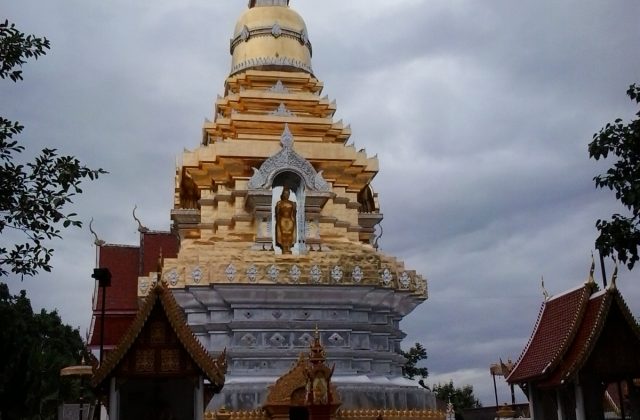
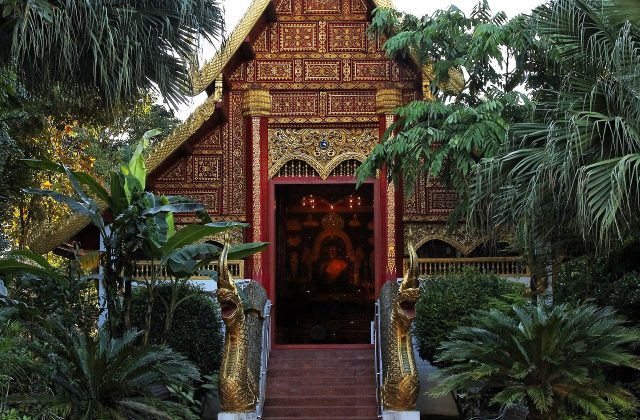
Wat Rong Suea Ten, the temple of the dancing tiger, takes its name from a legend that tigers once leapt across the nearby river. An old temple stood here and fell into ruin; the local community began its rebuilding in 1996, construction started in 2005 and the main assembly hall was finished in 2016. Its designer, the Chiang Rai artist Phuttha Kabkaew, known locally as Salanok, had trained with Chalermchai Kositpipat on the White Temple, and the family resemblance is clear: this is the same flamboyant modern take on northern Thai temple art, but in sapphire blue and gold. Two great naga serpents with curling crests guard the steps up to the hall, and every gable, eave and window frame is covered in fine carved and painted ornament.
Inside, the walls are painted in deep blues with swirling scenes of the Buddha's life and of the cosmos, and the hall is dominated by a seated Buddha 6.5 m high in a luminous pearl white, set against the blue. Relics are kept in the image, and thousands of small votive tablets were placed beneath it. Behind the hall rises a white and blue stupa, and around the grounds stand further guardian figures and a white Buddha statue on a pedestal. This is an active temple. Take your shoes off at the foot of the stairs, cover shoulders and knees, sit with your feet pointing away from the Buddha and keep your voice down; photography is generally permitted inside, but avoid flash during prayers.
The temple is open daily from early morning to the evening; hours are not posted online in detail, so plan to visit in daylight. The best time is early, between 7 am and 9 am, when the blue and gold shine in the low sun, the grounds are quiet and the day-trip minivans from Chiang Mai, which usually arrive in the late morning, are still on the road. Late afternoon is the second choice. The cool season from November to February is the most pleasant time in northern Thailand, with clear skies and fresh mornings.
March and April are hot and often hazy with smoke from field burning, and the rains from June to October bring green landscapes and short storms. Thai families visit on weekends and Buddhist holy days. Allow 30 to 45 minutes. Combine it with the White Temple 13 km south of the city, the Black House to the north, and an evening at the Chiang Rai night bazaar.
14 km away
Thai visitors enter free, while foreign visitors pay a modest fee at the ticket office;
17 tickets & tours
138 km away
Wat Phra That Doi Saket is a hilltop temple about 20 km north-east of central Chiang Mai, and there is no admission…
1 ticket or tour
155 km away
Wat Chedi Luang charges foreign visitors a small entry fee at the gate on Phra Pokklao Road;
1 ticket or tour
Yes. GetYourGuide sells tickets and guided tours whose route includes Wat Rong Suea Ten (Blue Temple); live prices are shown on this page.
The temple is open daily from early morning to the evening; hours are not posted online in detail, so plan to visit in daylight.
Allow 30 to 45 minutes.
The best time is early, between 7 am and 9 am, when the blue and gold shine in the low sun, the grounds are quiet and the day-trip minivans from Chiang Mai, which usually arrive in the late morning, are still on the road.
Shoulders and knees covered; shoes off before entering the main hall.
Entry to Wat Rong Suea Ten (Blue Temple): Free; donations welcome
Wat Rong Suea Ten (Blue Temple) is in Chiang Rai, Thailand. The map on this page shows the exact spot.
How to visit a Buddhist temple: shoes, dress and manners — Shoes, dress, feet, photos and offerings in Buddhist temples, from the wats of Thailand and Sri Lanka to the Zen temples of Japan.
Chiang Rai, Thailand
Thai visitors enter free, while foreign visitors pay a modest fee at the ticket office;
17 tickets & tours
Chiang Rai, Thailand
Wat Huay Pla Kang is free to enter and no ticket for it is sold online.
No online ticket
Chiang Rai, Thailand
No ticket for Wat Phra Kaew alone is sold online, and none is needed.
No online ticket