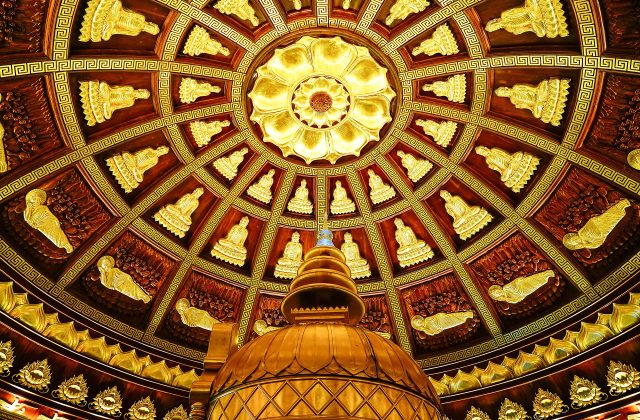
Bich Dong Pagoda
Ninh Binh, Vietnam
Bich Dong costs nothing to enter, so what is sold online is really a way of reaching it and of fitting it into a day…
10 tickets & tours
Chinese Temple · Ninh Binh · Vietnam

Photo: Shyamal, CC BY-SA 4.0
Thai Vi is a village temple honouring the kings of the Tran dynasty, set at the foot of limestone peaks in the Tam Coc area of Ninh Binh province, south of Hanoi. Entry is free and there is no ticket to buy; visitors leave a small donation or offering if they wish. Nobody books a visit to Thai Vi alone. It is a stop on the cycling and boat routes around Tam Coc, and that is how the tours sold online treat it. The first type of trip is a full day out from Hanoi, with a minibus south to Ninh Binh, a rowing-boat ride through the caves of Tam Coc, a bicycle ride along the rice fields to Thai Vi and a short climb or visit to a nearby pagoda.
Transport, guide, boat ticket, bicycle and a buffet lunch are usually included. The second is a local half-day ride from Tam Coc or Ninh Binh town, by bicycle or motorbike, that links the temple with village life, such as a buffalo farm and rice paddies, with a guide who explains what you see. The temple is easy to reach on your own. It lies about 2 km west of the Tam Coc boat pier on a quiet lane, and bicycles can be hired from almost every guesthouse in Tam Coc village. Many of the Tam Coc boat routes also pass close by, and some rowers will stop if asked. For most independent travellers a hired bicycle and an hour in the early morning are all that is needed.
Live dates and prices from GetYourGuide. Free cancellation on most tickets.
The temple stands on a site linked to the early Tran kings, who in the thirteenth century used the hidden valleys of this region as a retreat and a base during the wars against the Mongols. Tradition holds that the first Tran emperor, after handing the throne to his son, withdrew here to live a religious life, and the temple was raised later to honour him and his successors. The present buildings have been rebuilt several times and are largely of later date, but the setting has changed little. You approach across a small bridge over a lotus pond, with a sheer karst cliff behind the roofs. The entrance gate leads into a paved courtyard and then to the worship halls, built of dark wood with heavy tiled roofs and low eaves.
Inside, the altars hold statues and tablets of the Tran kings, with incense burners, carved panels and lacquered decorations in red and gold. Look also for the stone stele and the carved stonework in the courtyard, and for the old trees that shade the precinct. This is an active place of worship visited by local families, especially on the first and fifteenth days of the lunar month. Speak quietly, do not step on the raised thresholds of the halls, and ask before photographing people at prayer. Dress modestly: cyclists in very short shorts are sometimes asked to cover up. There are usually no guides on site, so a little background reading helps. From Tam Coc village follow the road west along the river by bicycle; the ride through the paddies is part of the pleasure.
The temple is open during the day, roughly from early morning until late afternoon, and there are no formal visiting hours posted for foreigners; if the main hall is closed, a caretaker nearby will usually open it. The best time is early morning, when mist still hangs on the limestone peaks and before the day-trip groups from Hanoi arrive in Tam Coc around ten. The late afternoon is also quiet and the light on the cliffs is warm. The countryside is at its most photogenic in late May and early June, when the rice in the Tam Coc valley turns golden before the harvest, and again in September and October.
Winter can be grey and drizzly, and July and August are hot and wet. The temple holds its main festival in spring, in the third month of the lunar calendar, with processions and rituals for the Tran kings; it is lively but crowded, and lunar holidays such as Tet also bring many local worshippers. Half an hour is enough at the temple itself. Combine it with the Tam Coc boat trip, Bich Dong pagoda, the viewpoint at Hang Mua and the old capital of Hoa Lu.
Yes. GetYourGuide lists 2 tickets and tours for Thai Vi Temple, with live dates and prices and free cancellation on most of them.
The temple is open during the day, roughly from early morning until late afternoon, and there are no formal visiting hours posted for foreigners; if the main hall is closed, a caretaker nearby will usually open it.
The best time is early morning, when mist still hangs on the limestone peaks and before the day-trip groups from Hanoi arrive in Tam Coc around ten.
Entry to Thai Vi Temple: Free; donations welcome
Shoulders and knees covered; remove hats inside the shrine.
Thai Vi Temple is in Ninh Binh, Vietnam. The map on this page shows the exact spot.
How to visit a Chinese temple: incense, gods and manners — How to behave in Taoist, Confucian and folk temples in China, Taiwan, Hong Kong and South-East Asia: incense, thresholds and fortunes.
Ninh Binh, Vietnam
Bich Dong costs nothing to enter, so what is sold online is really a way of reaching it and of fitting it into a day…
10 tickets & tours
Ninh Binh, Vietnam
Bai Dinh is a huge pilgrimage complex rather than a single building, and entry to the temple grounds is free.
3 tickets & tours