Buddhist Temple · Guangzhou · China
Temple of the Six Banyan Trees (Liurong)
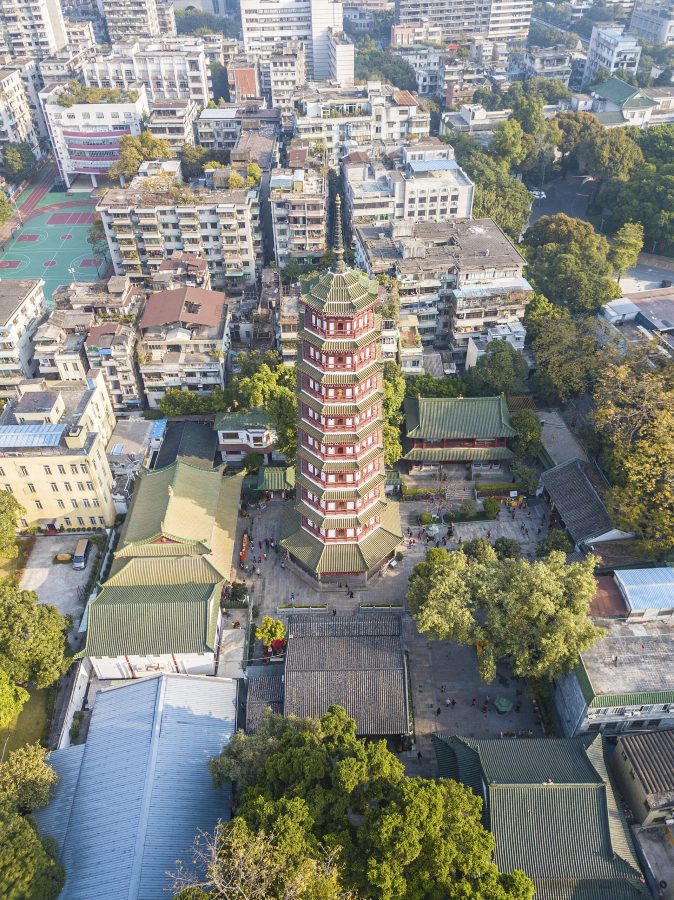
Photo: Legolas1024, CC BY-SA 4.0
- Type
- Buddhist Temple
- Religion
- Chinese Buddhism
- Area
- 8 500 m²
- Founded
- 537 (founded 537; Flower Pagoda 1097, rebuilt 1373)
- Height
- 58 m
- Entry
- Small fee at the gate
- Dress code
- Modest clothing; no shorts or bare shoulders in the halls is the polite norm.
- Tickets
- 1 ticket or tour
Temple of the Six Banyan Trees (Liurong) tickets and tours: which one to book
Liurong, the Temple of the Six Banyan Trees, is a working monastery in the old centre of Guangzhou, and you simply pay a small admission fee at the gate; climbing the pagoda, when it is open to visitors, has carried a separate small charge. There is no need to book anything in advance, and the temple is a short walk from Ximenkou metro station or from the shopping streets around Beijing Road. For a first visit, a guided walk of the old city is the option worth considering. The temple is available as a private or small-group guided visit, usually lasting a couple of hours, in which a local guide meets you at your hotel or a metro station, pays the entry for you and explains the Chan Buddhist background, the Sixth Patriarch and the pagoda's history.
Many guides extend the walk to the Guangxiao Temple, where the Sixth Patriarch was ordained, and to the Huaisheng Mosque, one of the oldest in China, all within walking distance. Check whether entrance fees and transport are included and whether the guide speaks good English; that is the main thing you are paying for. Independent travellers manage easily on their own, since the temple is compact and well signposted, although very little information is posted in English, so reading up beforehand will make the visit far more rewarding.
Tickets and tours for Temple of the Six Banyan Trees (Liurong)
Live dates and prices from GetYourGuide. Free cancellation on most tickets.
Visiting Temple of the Six Banyan Trees (Liurong): what to see and how to behave
The temple was founded in 537, under the Liang dynasty, to house relics of Buddhist saints brought from Cambodia, and it has been burnt and rebuilt several times since. Its present name comes from the Song-dynasty poet Su Shi, who visited around 1100, admired the six banyan trees growing in the courtyard and wrote the two characters for Six Banyans that still hang over the gate. The banyans he saw are long gone, but younger ones shade the courtyards today. The centrepiece is the Flower Pagoda, named for the colourful decoration it once had. First built in an octagonal form in 1097 and rebuilt after a fire in the early Ming period, it rises about 57 m in nine outer tiers, with green-glazed eaves and red columns, and it is one of the landmarks of old Guangzhou.
Inside, the structure is divided into more levels than the facade suggests, with narrow stairs climbing to the top. The Mahavira Hall holds three large seated bronze Buddhas cast in the seventeenth century, among the biggest in southern China. Look also for the hall of the Sixth Patriarch, Huineng, the founder of the southern school of Chan, whose bronze image is venerated here. The temple is the seat of the Guangzhou Buddhist association, so services and monks are part of daily life. Speak quietly, walk round the altars rather than in front of worshippers, and avoid photographing monks during services. The courtyard incense burners are for devotees; visitors are welcome to buy and light incense too.
Temple of the Six Banyan Trees (Liurong): opening hours, ceremonies and the best time to go
The temple opens daily from early morning to late afternoon; check locally whether the pagoda itself is open to climbers, as access has been restricted at times. Morning is the best time, when worshippers come to burn incense and monks hold their services, and the courtyards are calm before the afternoon visitors.
The first and fifteenth days of each lunar month bring many more devotees, as do Chinese New Year and the festival of the Buddha's birthday in late spring, when the temple is full of smoke, chanting and colour but also crowded. Guangzhou is hot and humid from May to September, with heavy summer storms, so October to December is the most comfortable season, and early spring is mild though often damp. Allow 45 minutes to an hour. Combine the visit with Guangxiao Temple, ten minutes' walk away, the Huaisheng Mosque, Yuexiu Park and the Chen Clan Academy, or with Shamian Island and the riverside in the evening.
More tours and activities in Guangzhou
Before you go
Can I book a temple tour or ticket in Temple of the Six Banyan Trees (Liurong) online?
Yes. GetYourGuide lists one ticket or tour for Temple of the Six Banyan Trees (Liurong), with live dates and prices and free cancellation on most of them.
How much is the entrance fee for Temple of the Six Banyan Trees (Liurong)?
Entry to Temple of the Six Banyan Trees (Liurong): Small fee at the gate
When is Temple of the Six Banyan Trees (Liurong) open?
Liurong, the Temple of the Six Banyan Trees, is a working monastery in the old centre of Guangzhou, and you simply pay a small admission fee at the gate; climbing the pagoda, when it is open to visitors, has carried a separate small charge.
How many days do you need in Temple of the Six Banyan Trees (Liurong)?
Allow 45 minutes to an hour.
When is the best time to visit Temple of the Six Banyan Trees (Liurong)?
Morning is the best time, when worshippers come to burn incense and monks hold their services, and the courtyards are calm before the afternoon visitors.
What should I wear to visit Temple of the Six Banyan Trees (Liurong)?
Modest clothing; no shorts or bare shoulders in the halls is the polite norm.
How big is Temple of the Six Banyan Trees (Liurong)?
Temple of the Six Banyan Trees (Liurong) covers 8 500 m².
When was Temple of the Six Banyan Trees (Liurong) founded?
Temple of the Six Banyan Trees (Liurong) was established in 537.
Where is Temple of the Six Banyan Trees (Liurong)?
Temple of the Six Banyan Trees (Liurong) is in Guangzhou, China. The map on this page shows the exact spot.
How to visit a Buddhist temple: shoes, dress and manners — Shoes, dress, feet, photos and offerings in Buddhist temples, from the wats of Thailand and Sri Lanka to the Zen temples of Japan.