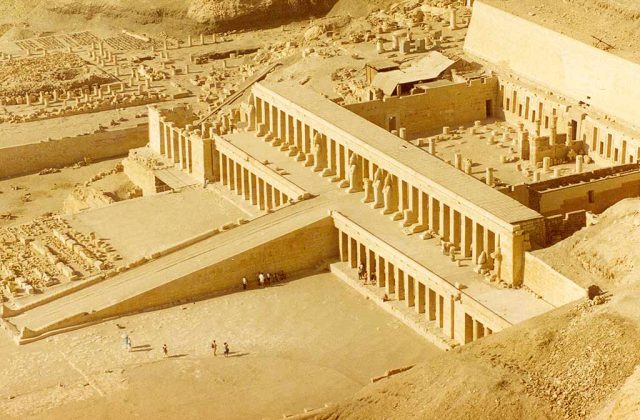
Dendera Temple Complex (Temple of Hathor)
75 km away
Tickets for Dendera are sold at the entrance to the site, and since visitor numbers are modest there is no need to buy…
5 tickets & tours
Ancient Temple · Abydos · Egypt
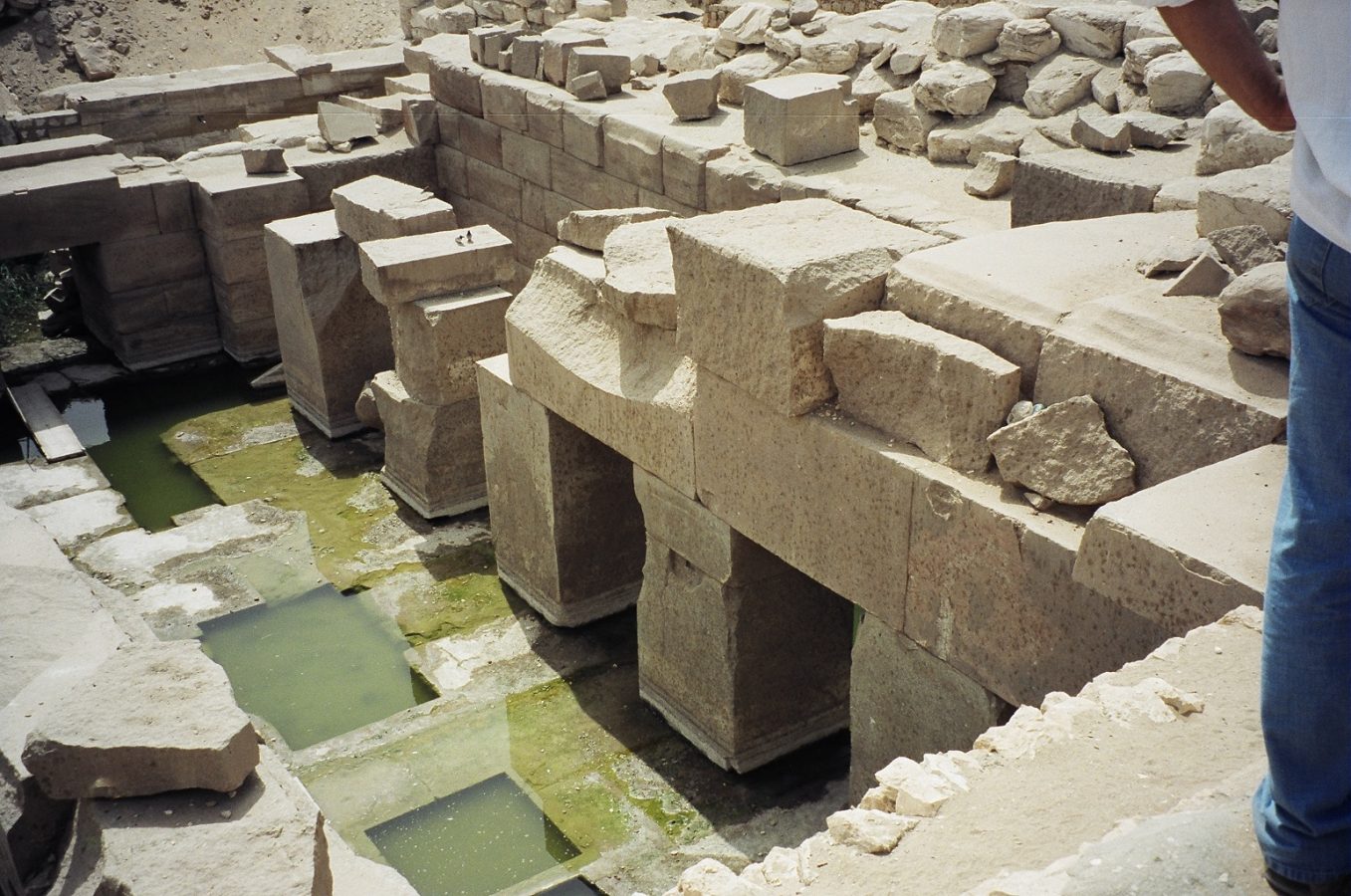
Photo: No machine-readable author provided. RsAzevedo assumed (base, CC BY-SA 3.0
The Osireion is not ticketed on its own. It lies directly behind the Temple of Seti I at Abydos, and the ticket sold at the temple gate covers both; you pay in Egyptian pounds at the booth, and card payment is increasingly accepted at major sites but cash is a sensible backup. No ticket for the Osireion alone is sold online. Getting there is the real decision. Abydos lies on the west bank of the Nile in Upper Egypt, roughly three hours by road north of Luxor, so most visitors come on a full-day trip from Luxor in a private car or minibus. The usual pairing is Abydos with the Temple of Hathor at Dendera, which sits on the same route;
such day trips normally include air-conditioned transport, an Egyptologist guide and sometimes lunch, while entry tickets are often paid separately, so read the inclusions. Some Nile cruises between Luxor and Aswan also offer an optional excursion to both temples. Independent travellers can hire a car and driver in Luxor, which gives you control over the timing and lets you arrive early, or stay overnight near Abydos itself or in the city of Sohag, about an hour to the north. A guide is worth having here: the reliefs of the Seti temple are among the finest in Egypt, and the Osireion's purpose is easy to misunderstand without context. The page lists any GetYourGuide tours whose route passes the site.
Live prices from GetYourGuide for tickets and tours that include this temple. Free cancellation on most of them.
Abydos was one of the holiest places in ancient Egypt, the cult centre of Osiris, god of the dead, whose head was believed to be buried here. Pharaoh Seti I, who reigned around 1294 to 1279 BC, built his great temple at the site, and behind it, on the same east-west axis but far below its floor, he placed the Osireion, a symbolic tomb for himself in the guise of Osiris. Walk through the Seti temple first, with its seven chapels and the famous list of earlier kings carved in a side corridor, then follow the path round to the back. From the edge of a deep pit you look down on the central hall of the Osireion, built of enormous blocks, with two rows of massive red granite pillars standing on a raised platform surrounded by a channel.
The roof has long gone, and groundwater now floods much of the structure, so the pillars often rise from a still green pool. A long stone-lined corridor, decorated with texts from the Egyptian books of the underworld, leads to the hall from the north. Its stark, undecorated granite looks so different from the delicate temple reliefs that some writers have claimed it is far older; excavators, however, found inscriptions naming Seti I, and archaeologists date it to his reign. The Greek geographer Strabo described it in the first century BC as a spring reached through vaulted galleries. Flinders Petrie and Margaret Murray uncovered it in 1902 and 1903. Access to the lower level is normally closed; visitors view it from above. Do not climb on the walls, and keep to the marked paths.
The Abydos site is open daily during daytime hours, typically from early morning until late afternoon; check locally for the current closing time, which shifts slightly with the season. Arriving at opening time pays off twice: the light inside the Seti temple is softer and the heat is bearable. Coming from Luxor, that means leaving around 6 or 7 am. The water in the Osireion reflects the pillars best when the sun is fairly high and the pit is not in deep shadow, so late morning is good for photographs. The best season is October to April, when daytime temperatures in Upper Egypt are moderate.
From May to September the heat is intense by midday, and the long drive becomes tiring. Abydos remains quiet even in high season, as it lies off the main tourist circuit. Allow 30 minutes for the Osireion and at least two hours for the Seti temple and the smaller Temple of Ramesses II nearby. The obvious combination is Dendera's Temple of Hathor on the same day.
75 km away
Tickets for Dendera are sold at the entrance to the site, and since visitor numbers are modest there is no need to buy…
5 tickets & tours
85 km away
The temple at Deir el-Bahari sits on Luxor's West Bank, and almost everyone sees it as part of a wider tour of the…
4 tickets & tours
86 km away
Medinet Habu has its own entry ticket, bought at the ticket office by the site entrance or online in advance as a dated…
2 tickets & tours
Yes. GetYourGuide sells tickets and guided tours whose route includes Osireion, Abydos; live prices are shown on this page.
The Abydos site is open daily during daytime hours, typically from early morning until late afternoon; check locally for the current closing time, which shifts slightly with the season.
Allow 30 minutes for the Osireion and at least two hours for the Seti temple and the smaller Temple of Ramesses II nearby.
The best season is October to April, when daytime temperatures in Upper Egypt are moderate.
Entry to Osireion, Abydos: Included in the Abydos temple ticket
No dress code; light, modest clothing and a hat for the sun.
Osireion, Abydos is in Abydos, Egypt. The map on this page shows the exact spot.
How to visit an ancient temple: tickets, heat and rules — Tickets, hours, heat, guides, climbing rules and conservation at the ancient temples of Egypt, Greece, Italy, Angkor and the Maya world.