Dilwara Temples
175 km away
There is nothing to book for the Dilwara Temples themselves.
2 tickets & tours
Sacred Site · Ahmedabad · India

Photo: Kalyan Shah, CC BY-SA 3.0
There is no ticket to buy for the Hutheesing Jain Temple, and no product sells entry to it on its own. Entry is free, and visitors of any faith are welcome in the courtyard and the main halls outside the hours of private ritual. Leave your shoes at the stand by the gate, and anything made of leather with them. Independent visitors usually come by auto-rickshaw, since the temple stands on the busy road just north of the old walled city, outside the Delhi Gate. Most Ahmedabad city tours, whether half-day drives or full-day private tours with a car and guide, include it as one of the main stops alongside the Sidi Saiyyed Mosque, the Jama Masjid and the Sabarmati Ashram;
these normally include transport and a guide, with any paid entries elsewhere sometimes extra. The early-morning heritage walk through the old city's pols is a separate outing that ends inside the walls, so combine the two by taking a rickshaw out to the temple afterwards. For most people a guided city tour gives the best value, because the Jain iconography and the story of the founding family are not explained on site. If you prefer to go alone, the temple is easy to reach and quick to understand from the outside. The page lists any GetYourGuide tours whose route passes the temple.
Live prices from GetYourGuide for tickets and tours that include this temple. Free cancellation on most of them.
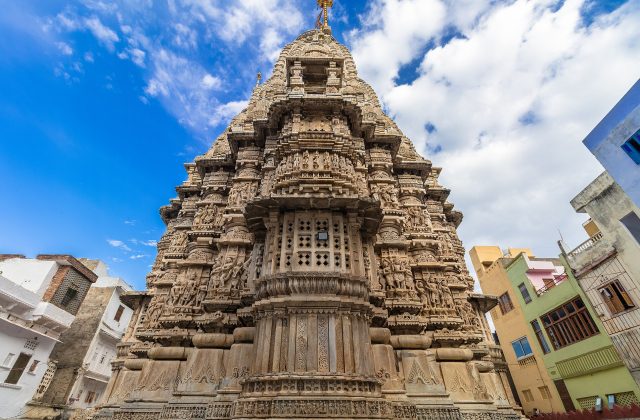
The temple was begun by Sheth Hutheesing Kesarisinh, a wealthy Ahmedabad trader, and after his early death it was completed in 1848 by his widow Harkunwar, who supervised the work herself. It was raised during a severe famine, and the project kept hundreds of craftsmen employed for two years. The chief architect, Premchand Salat, combined the classical Maru-Gurjara temple style of western India with features of the carved wooden mansions, or havelis, of Gujarat, and the family trust still manages it today. Built of white marble, the temple faces west and stands on a raised platform inside a courtyard. Pass through the ornate entrance porch, with its balconies and screens borrowed from haveli design, into a series of halls leading to the sanctum, each crowned with its own spire.
The central image is of Dharmanatha, the fifteenth Jain Tirthankara. Look up at the domed ceiling of the closed hall, carried on twelve carved pillars, and look for the bracket figures on the porches, the only places where sculpted figures appear among the dense geometric and floral ornament. Around the courtyard a colonnaded cloister holds 52 small shrines, each with its own image. In the outer court stands a tall column of honour, about 24 m high, added for the 2,500th anniversary of the birth of Mahavira and inspired by the tower at Chittorgarh. Observe Jain etiquette: no leather, no food, quiet voices, and no photography of the images in the sanctum. Women are traditionally asked not to enter during menstruation. The temple is a short rickshaw ride from Kalupur railway station.
The temple opens in the morning and again in the late afternoon and evening, usually with a closure in the middle of the day; check locally for the current hours. The morning is the best time, when worshippers perform the daily rites, the marble is still cool underfoot and the light on the white facade is soft. Evenings bring the lamp ritual and a gentler crowd. The best season in Ahmedabad is November to February, when the days are warm and dry. From April to June the heat is intense and walking barefoot across the courtyard at midday is uncomfortable;
the monsoon follows from July to September. Paryushan, the most important Jain festival, usually falls in August or September and fills the temple with worshippers; Mahavir Jayanti in March or April is another busy day. In mid-January the city celebrates Uttarayan, the kite festival, when rooftops across Ahmedabad fill with kite flyers. Allow 45 minutes to an hour. Combine it with the heritage walk of the old city, the Sidi Saiyyed Mosque, the Calico Museum of Textiles and the Sabarmati Ashram.
175 km away
There is nothing to book for the Dilwara Temples themselves.
2 tickets & tours
204 km away
Jagdish Temple is a working Hindu temple in the middle of old Udaipur and there is no ticket for it: you leave your…
1 ticket or tour
222 km away
Eklingji is a living royal shrine, not a monument, so there is no ticket to buy and no online booking.
2 tickets & tours
Yes. GetYourGuide sells tickets and guided tours whose route includes Hutheesing Jain Temple; live prices are shown on this page.
Allow 45 minutes to an hour.
The morning is the best time, when worshippers perform the daily rites, the marble is still cool underfoot and the light on the white facade is soft.
Observe Jain etiquette: no leather, no food, quiet voices, and no photography of the images in the sanctum.
Entry to Hutheesing Jain Temple: Free
Shoulders and knees covered; shoes off; no leather belts, bags or wallets inside.
Hutheesing Jain Temple was established in 1848.
Hutheesing Jain Temple is in Ahmedabad, India. The map on this page shows the exact spot.
How to visit a gurdwara: head cover, feet and langar — How to visit a Sikh gurdwara, with notes on Jain temples, Baha'i houses of worship and Cao Dai temples: dress, timing and conduct.
Ahmedabad, India
There is nothing to book for the Sidi Saiyyed Mosque. Entry is free, there is no ticket office, and the mosque is open…
No online ticket