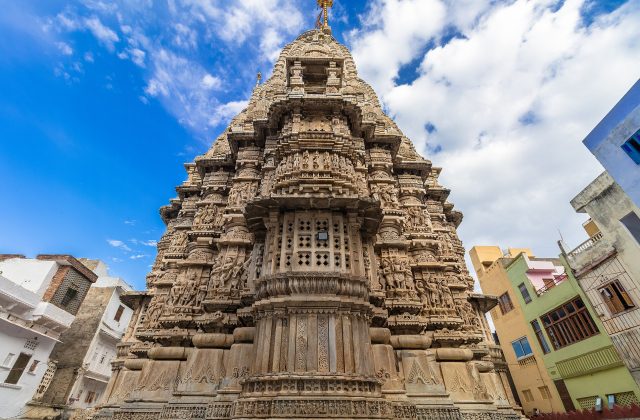
Jagdish Temple, Udaipur
Udaipur, India
Jagdish Temple is a working Hindu temple in the middle of old Udaipur and there is no ticket for it: you leave your…
1 ticket or tour
Hindu Temple · Udaipur · India

Photo: LBM1948, CC BY-SA 4.0
Eklingji is a living royal shrine, not a monument, so there is no ticket to buy and no online booking. Entry is free during the darshan hours, when the doors of the sanctum are open to worshippers; outside those slots the gates are shut. Phones, cameras and bags are deposited at the counter by the entrance for a small charge. The way most travellers reach it is a half-day or full-day car trip from Udaipur, about 22 km away. The usual circuit heads north along the Nathdwara road, stops at Eklingji, continues to the Krishna temple of Shrinathji at Nathdwara and then swings west to the Haldighati pass, scene of the 1576 battle between Maharana Pratap and the Mughal army.
Such tours are normally private, with an air-conditioned car and driver, sometimes with a guide; the temples themselves are free, while the Haldighati museum and meals are paid on the spot. The key thing to check is timing. Both Eklingji and Nathdwara open only for set darshan windows, so a good driver plans the day around them; a cheap tour that arrives at midday may leave you looking at closed doors. Travellers on a budget can take a local bus or shared jeep along the Nathdwara road from Udaipur, or hire an auto-rickshaw for a few hours and add the ruined temples of Nagda nearby.
Live dates and prices from GetYourGuide. Free cancellation on most tickets.
The temple stands in the village of Kailashpuri, in a narrow valley among the Aravalli hills north of Udaipur, close to Nagda, the early capital of Mewar. It is dedicated to Shiva as Eklingji, the tutelary deity of the Mewar dynasty: the Maharanas traditionally ruled as his diwan, or minister, rather than in their own name. Tradition credits the founding to Bappa Rawal in the eighth century, but the shrine was attacked several times; the present main temple and its image date largely from rebuildings under Rana Kumbha and his son Rana Raimal in the fifteenth century. A high fortified wall encloses a crowded courtyard of shrines, often said to number more than a hundred, built in the grey and white stone typical of Mewar.
The main temple has a tall, ribbed spire over the sanctum and a pillared hall guarded by a silver Nandi, Shiva's bull. Inside, the image is a four-faced form of Shiva carved in black stone, each face looking in a different direction. Look also at the smaller shrines around the edges, including a Vishnu temple from Kumbha's time, and at the carved figures on the outer walls. Eklingji is strict about conduct. Photography is not allowed anywhere inside the walls, leather belts and wallets should be left in the car, and visitors stand in a queue to glimpse the image rather than enter the sanctum. Dress conservatively, remove shoes at the gate and avoid touching offerings. Non-Hindus are generally admitted, but behave as you would at any active place of prayer.
The temple opens in three short darshan windows: very early in the morning, in late morning until early afternoon, and again in the late afternoon and early evening. Exact times shift with the season and festivals, so confirm them locally before setting out from Udaipur. October to March is the comfortable season in Mewar; April to June is very hot, and the monsoon in July and August turns the Aravalli hills green but makes driving slower.
Mondays, the day sacred to Shiva, bring more worshippers, and Maha Shivaratri, in February or March, fills the village with pilgrims and long queues. The evening session is the most atmospheric, with lamps, bells and chanting. The visit itself takes 30 to 45 minutes once you are through the queue. Pair it with the Sas-Bahu temples at Nagda, a few minutes away, and with Nathdwara and Haldighati for a full day.
Yes. GetYourGuide lists 2 tickets and tours for Eklingji Temple, with live dates and prices and free cancellation on most of them.
Entry is free during the darshan hours, when the doors of the sanctum are open to worshippers; outside those slots the gates are shut.
Modest dress with shoulders and knees covered; shoes, phones and leather left outside.
Photography is not allowed anywhere inside the walls, leather belts and wallets should be left in the car, and visitors stand in a queue to glimpse the image rather than enter the sanctum.
Entry to Eklingji Temple: Free
Eklingji Temple was established in 700.
Eklingji Temple is in Udaipur, India. The map on this page shows the exact spot.
How to visit a Hindu temple: dress, shoes and access — What to wear, what to leave at the gate and where non-Hindus may go in Hindu temples in India, Nepal, Bali and South-East Asia.
Udaipur, India
Jagdish Temple is a working Hindu temple in the middle of old Udaipur and there is no ticket for it: you leave your…
1 ticket or tour