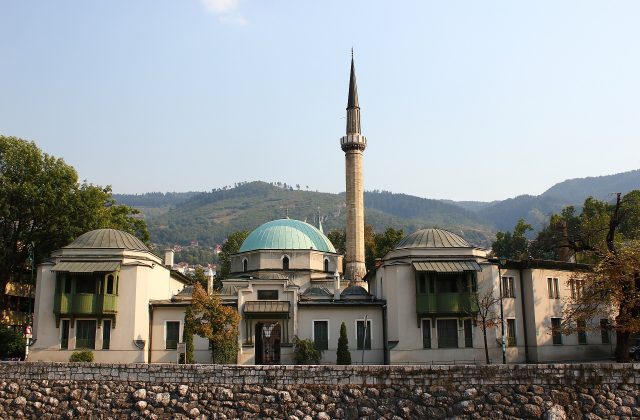
Emperor’s Mosque (Careva Dzamija)
Sarajevo, Bosnia and Herzegovina
No ticket for the Emperor's Mosque is sold online. It is the main working mosque on the south bank of the Miljacka…
No online ticket
Mosque · Sarajevo · Bosnia and Herzegovina

Photo: Bjoertvedt, CC BY-SA 3.0
There is nothing to book in advance for the Gazi Husrev-beg Mosque. No ticket for the mosque alone is sold online, and none is needed: visitors simply walk in from the Bascarsija lanes, and outside prayer times a modest fee is collected from non-Muslim visitors at the courtyard, which goes to the upkeep of the foundation. Worshippers enter free at any time. The sensible way to see it is on foot, on your own or as part of a walking tour of Sarajevo's old town. The standard city walks start near the Sebilj fountain or the Latin Bridge and almost always pause here, because the mosque is the centrepiece of the Ottoman quarter and sits beside the covered market and the old madrasa built by the same founder.
A guided walk is worth it if you want the wider story of the city, from the Ottoman centuries through the Austro-Hungarian period to the siege of the 1990s, which a local guide tells far better than any panel. Full-day tours from Sarajevo to Mostar or the tunnel museum usually do not stop at the mosque, so plan the old town as a separate half day. The page lists any GetYourGuide tours whose route passes the mosque; none of them includes more than a short stop inside.
Live prices from GetYourGuide for tickets and tours that include this temple. Free cancellation on most of them.
The mosque was founded in 1531 by Gazi Husrev-beg, the Ottoman governor of Bosnia, as the heart of a large charitable endowment that also paid for a school, a madrasa, a covered market and a bathhouse, many of which still stand around it. The design is often linked with Mimar Sinan, though most scholars credit another court architect of Persian origin; masons from Dubrovnik worked on the building. It remains the main congregational mosque of Bosnia and Herzegovina, so you are visiting a living place of prayer rather than a monument. You enter through a walled courtyard shaded by trees, with a domed sadirvan fountain where worshippers wash before prayer. A portico of four broad columns, roofed with small domes, leads to a portal carved with muqarnas.
Inside, the main dome rises over a single tall space, extended on the qibla side by a half-dome that frames the mihrab and the marble minbar; look for the honeycomb vaulting under that half-dome and the painted decoration, restored after heavy war damage in the 1990s. In the courtyard stand the domed mausoleums of the founder and of his freedman Murat-beg, and across the lane is the Kursumli madrasa, which houses a small museum. The mosque is also remembered as the first in the world to be lit by electricity, in 1898. Take off your shoes at the door, keep your voice low, and do not walk in front of anyone praying. Women should bring a scarf. Photography is generally fine without flash outside prayer. The mosque stands in the middle of Bascarsija, a short walk from the tram stops along the river.
The mosque is open to visitors through the day but closes to them during the five daily prayers, and the midday Friday prayer is the busiest time of the week, so avoid Friday from late morning until early afternoon. Opening hours shift with the season and the prayer timetable; check at the gate or ask at your hotel for the current visiting times. Early to mid morning is the calmest time, before the walking groups fill Bascarsija. In the evening the courtyard is lit and pleasant to look into, even if the hall itself is closed.
Spring and early autumn are the best seasons for walking the old town; summer is hot and crowded, while winter is quiet and often snowy. During Ramadan the evenings around the mosque are lively, but visiting hours inside can be shorter, and the two Eid holidays bring large crowds of worshippers. Allow 30 to 45 minutes for the mosque, courtyard and mausoleums, and another half hour for the madrasa museum. Combine it with the covered market, the Old Orthodox Church, the Cathedral of the Sacred Heart and the Latin Bridge, all within a few minutes on foot.
Yes. GetYourGuide sells tickets and guided tours whose route includes Gazi Husrev-beg Mosque; live prices are shown on this page.
No ticket for the mosque alone is sold online, and none is needed: visitors simply walk in from the Bascarsija lanes, and outside prayer times a modest fee is collected from non-Muslim visitors at the courtyard, which goes to the upkeep of the foundation.
Allow 30 to 45 minutes for the mosque, courtyard and mausoleums, and another half hour for the madrasa museum.
Shoulders and knees covered, women cover their hair; shoes off in the prayer hall.
Entry to Gazi Husrev-beg Mosque: Small fee for visitors
Gazi Husrev-beg Mosque was established in 1531.
Gazi Husrev-beg Mosque is in Sarajevo, Bosnia and Herzegovina. The map on this page shows the exact spot.
How to visit a mosque: dress, timing and manners — What to wear, when to go and how to behave in a mosque as a non-Muslim, and which mosques do not admit visitors at all.
Sarajevo, Bosnia and Herzegovina
No ticket for the Emperor's Mosque is sold online. It is the main working mosque on the south bank of the Miljacka…
No online ticket