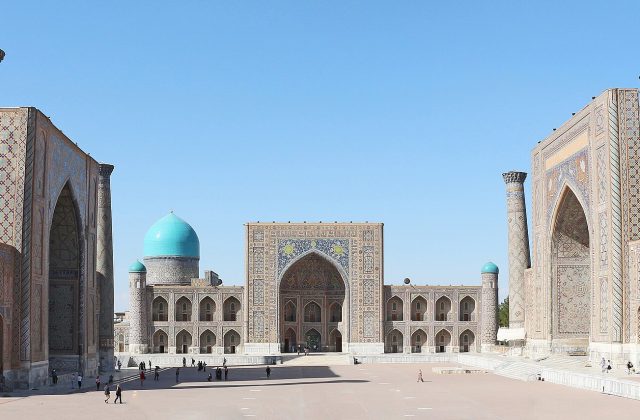
Registan, Samarkand
1 km away
The Registan is an open public square framed by three madrasas, and you can see the facades from the edge of the square…
4 tickets & tours
Mosque · Samarkand · Uzbekistan

Photo: David Stanley from Nanaimo, Canada, CC BY 2.0
No online ticket is sold for Bibi-Khanym Mosque on its own. Entry works the simple way: you pay a modest fee at the gate on Tashkent Street, where foreign visitors are charged more than Uzbek citizens, and you can walk in whenever the site is open. A small extra charge is sometimes asked for photography or for a guide who waits at the entrance; settle the price before he starts talking. Most visitors see the mosque as one stop on a walking tour of central Samarkand. The usual route starts at the Registan, follows the pedestrian street north-east for about ten minutes to Bibi-Khanym, crosses to the Siab Bazaar for dried fruit and bread, and continues uphill to the Shah-i-Zinda necropolis.
Group and private city tours from Samarkand include the entry fee and a licensed guide; day trips from Tashkent by the fast train do the same circuit in a long day, usually with Gur-e-Amir, Timur's mausoleum, added. Tours of several Silk Road cities, combining Samarkand with Bukhara and Khiva, also stop here. A guide is worth paying for if you want the story of Timur and his builders; on your own, a printed plan and the panels at the site are enough. The page lists any GetYourGuide tours whose route passes the mosque.
Live prices from GetYourGuide for tickets and tours that include this temple. Free cancellation on most of them.
Bibi-Khanym was Timur's attempt to build the greatest mosque of his age. He ordered it after his Indian campaign of 1399, using wealth and craftsmen brought back from conquered lands, and when he returned in 1404 he found it nearly finished but not grand enough, and had the main dome rebuilt larger. The ambition outran the engineering: bricks were falling from the vaults within a few years, and after the sixteenth century the building was left to decay. An earthquake in 1897 brought down the inner arch of the entrance portal, and much of what you see today is the result of Soviet and Uzbek reconstruction since 1974, with work still continuing. The plan is a classic courtyard mosque. A huge portal on the east opens into a rectangular courtyard about 167 m long and 109 m wide, once enclosed by galleries on marble columns.
Facing the portal across the yard is the main sanctuary, with the largest dome and a towering arched front; two smaller domed mosques stand on the north and south sides of the courtyard. Look for the surviving original tilework on the side buildings, which is subtler than the restored surfaces, and for the giant carved marble Quran stand in the centre of the courtyard, linked to a local tradition about women who wish to have children. Across the street stands the small domed mausoleum attributed to Saray Mulk Khanum, Timur's senior wife, after whom the mosque is named. The site is chiefly a monument, so etiquette is light: dress modestly and keep your voice down. It is a ten-minute walk from the Registan.
The mosque is open daily from morning until early evening, with longer hours in summer; check locally for the exact closing time, which changes with the season. The best light is in the late afternoon, when the sun falls on the main sanctuary and the courtyard is cooler, and the first hour after opening is the quietest, before city tours arrive from the Registan. The portal is also attractive after dark, lit from below, when you can see it from the street. Spring, from April to early June, and autumn, from September to October, are the ideal seasons in Samarkand.
July and August are hot and dry, with afternoons above 35 degrees, and winter can be cold and grey though rarely crowded. The Siab Bazaar next door is liveliest in the morning, so an early visit lets you combine both. Allow about an hour for the mosque and the mausoleum opposite. Combine it with the Registan, the bazaar and Shah-i-Zinda in one walking morning, then Gur-e-Amir in the late afternoon.
1 km away
The Registan is an open public square framed by three madrasas, and you can see the facades from the edge of the square…
4 tickets & tours
Yes. GetYourGuide sells tickets and guided tours whose route includes Bibi-Khanym Mosque; live prices are shown on this page.
Entry to Bibi-Khanym Mosque: Modest fee for foreigners at the gate
Entry works the simple way: you pay a modest fee at the gate on Tashkent Street, where foreign visitors are charged more than Uzbek citizens, and you can walk in whenever the site is open.
Allow about an hour for the mosque and the mausoleum opposite.
No strict code; shoulders and knees covered is respectful, women may wish to carry a scarf.
Bibi-Khanym Mosque was established in 1399.
Bibi-Khanym Mosque is in Samarkand, Uzbekistan. The map on this page shows the exact spot.
How to visit a mosque: dress, timing and manners — What to wear, when to go and how to behave in a mosque as a non-Muslim, and which mosques do not admit visitors at all.
Samarkand, Uzbekistan
The Registan is an open public square framed by three madrasas, and you can see the facades from the edge of the square…
4 tickets & tours