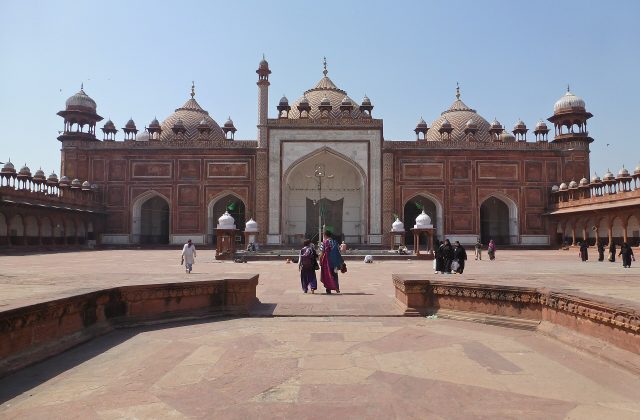
Jama Masjid, Agra
55 km away
Agra's Jama Masjid is an active congregational mosque and charges no entry: you walk up the steps, leave your…
1 ticket or tour
Hindu Temple · Vrindavan · India
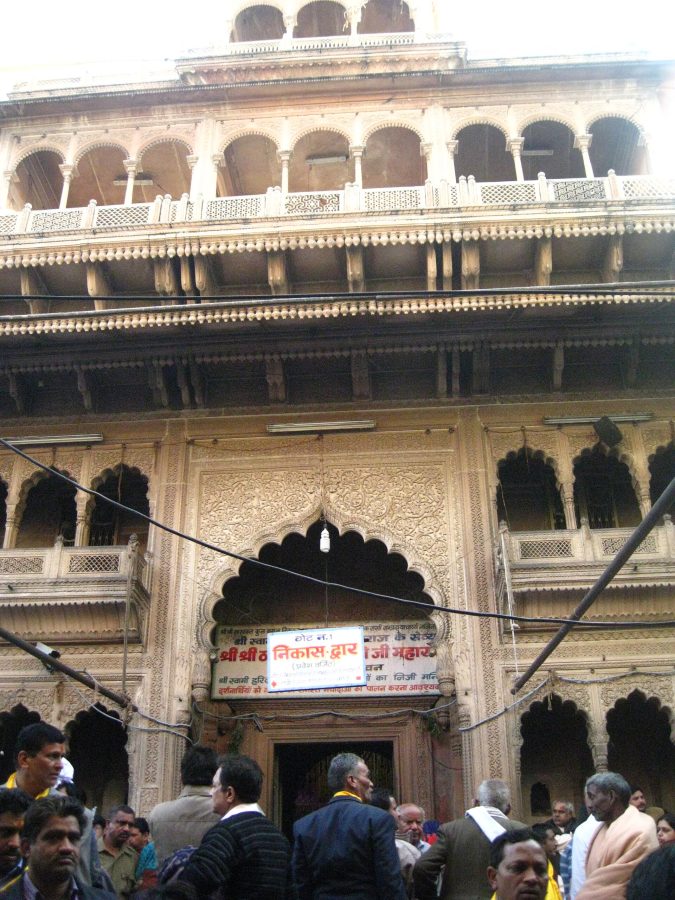
Photo: आशीष भटनागर, CC BY-SA 3.0
Entry to the Banke Bihari Temple is free, and there is no ticket, timed slot or official queue pass to buy online; anyone offering paid fast-track darshan at the gate is a tout, not the temple. No tour of this temple alone is sold online. The usual way to visit from outside the region is a day trip to Mathura and Vrindavan, the twin towns of the Krishna legend on the Yamuna. Tours leave from Delhi, about three hours away by the Yamuna Expressway, or from Agra, roughly an hour and a half away, and often run alongside a visit to the Taj Mahal on an overnight trip.
They normally include a private car with driver and a local guide, and visit the Krishna Janmabhoomi complex in Mathura, the ISKCON temple, Prem Mandir and Banke Bihari in Vrindavan; meals and donations are extra. A guide is genuinely useful here, as the lanes are confusing and the crowd management takes local knowledge. Independent travellers can reach Vrindavan by train to Mathura Junction and then an auto-rickshaw for the last 12 km or so. The final stretch to the temple is on foot or by cycle rickshaw through narrow lanes, as cars cannot get close. Leave valuables, large bags and anything you do not need in the car or hotel. The page lists any GetYourGuide tours whose route passes the temple.
Live prices from GetYourGuide for tickets and tours that include this temple. Free cancellation on most of them.
Banke Bihari is the most loved and most crowded temple in Vrindavan, dedicated to Krishna in a form understood as the united presence of Radha and Krishna. The image is said to have been revealed to the 16th-century saint and musician Swami Haridas in the groves of Nidhivan, where he worshipped it as Kunj Bihari, the one who delights in the groves. His followers later called it Banke Bihari, 'bent' after the graceful threefold-bent posture in which Krishna plays the flute. The present temple, in a Rajasthani style with carved stone arches, was built in the 1860s by the goswami priests, whose families still serve the deity and live behind it. The temple is worshipped as if the deity were a small child, and this shapes the whole visit.
There are no bells and no early morning aarti for fear of disturbing him, and the curtain in front of the image is drawn closed every few minutes, a custom based on the belief that an unbroken gaze would charm Krishna into following a devotee home. Each brief opening is greeted with a surge of the crowd and shouts of devotion. Expect a single courtyard packed with pilgrims, hands raised towards the shrine, and a pressing, joyful noise. Hold on to belongings, keep children close, and follow the flow rather than pushing forward. Photography of the deity is not allowed. Monkeys in Vrindavan snatch glasses and phones, so keep them out of sight in the lanes.
The temple opens for darshan in two sessions, in the morning until around midday and again from late afternoon until about 9 pm, with the times shifting between summer and winter; check the official site before going. Weekday mornings soon after opening are the least crowded; weekends, holidays and evenings can be overwhelming. October to March has the most comfortable weather in Uttar Pradesh. April to June is very hot, and July to September brings the monsoon. Festivals transform Vrindavan.
Holi in February or March is celebrated here for days, with flowers and coloured powder thrown in the temple; it is exhilarating but extremely crowded, and colour will ruin your clothes. Janmashtami, Krishna's birthday in August or September, is the one night of the year the early morning aarti is performed. During the monsoon month of Shravan the image is placed on a swing, at Sharad Purnima in autumn he holds a flute, and on Akshaya Tritiya in spring his feet are shown. Allow an hour for the temple itself. Combine it with Nidhivan, Prem Mandir, the ISKCON temple and the ghats on the Yamuna.
55 km away
Agra's Jama Masjid is an active congregational mosque and charges no entry: you walk up the steps, leave your…
1 ticket or tour
116 km away
Entry to the Lotus Temple is free and no ticket is needed.
8 tickets & tours
122 km away
Entry to the Akshardham complex and the temple itself is free, and there is nothing to book in advance for a simple…
41 tickets & tours
Yes. GetYourGuide sells tickets and guided tours whose route includes Banke Bihari Temple; live prices are shown on this page.
Allow an hour for the temple itself.
Entry to Banke Bihari Temple: Free
Modest Indian or long clothing; shoes are left outside before entering.
Banke Bihari Temple was established in 1864.
Banke Bihari Temple is in Vrindavan, India. The map on this page shows the exact spot.
How to visit a Hindu temple: dress, shoes and access — What to wear, what to leave at the gate and where non-Hindus may go in Hindu temples in India, Nepal, Bali and South-East Asia.

