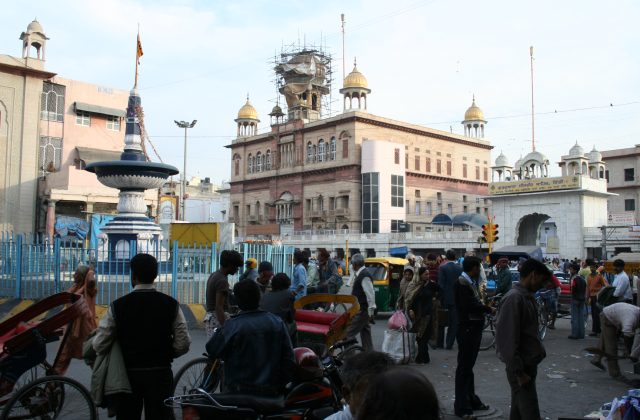
Lotus Temple (Bahai House of Worship)
8 km away
Entry to the Lotus Temple is free and no ticket is needed.
8 tickets & tours
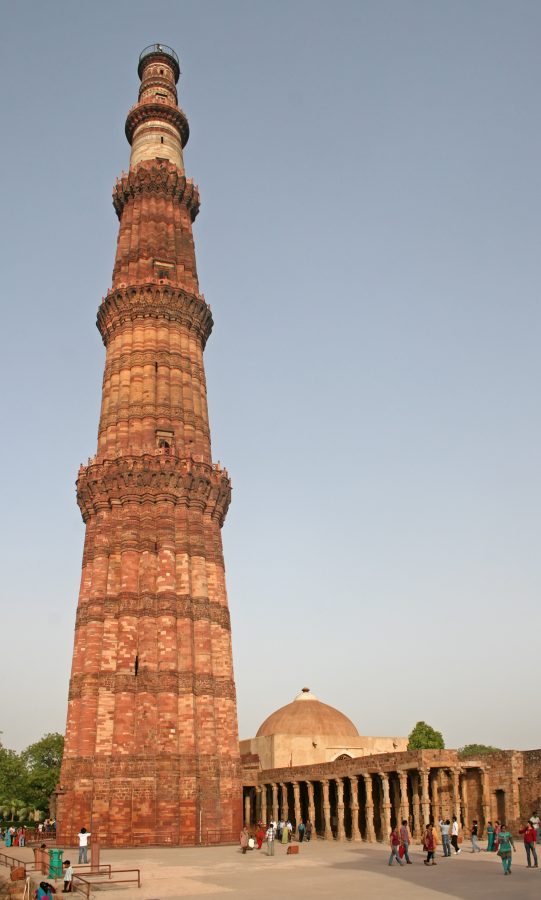
Photo: Muhammad Mahdi Karim, GFDL 1.2
The Qutb Minar complex is run by the Archaeological Survey of India, and admission is by a single ticket that covers everything inside the walls: the minar, the ruined Quwwat-ul-Islam Mosque, the Iron Pillar, the Alai Darwaza gate and the tombs. Foreign visitors pay considerably more than Indian citizens, and there is a small discount for buying online through the official ASI portal, which lets you skip the cash queue and scan a QR code at the gate. Children under 15 enter free. The complex lies in Mehrauli, in the south of Delhi, about 15 km from Connaught Place.
The Qutab Minar station on the Yellow Line of the Delhi Metro is about 1.5 km away, with auto-rickshaws waiting outside to cover the last stretch. Taxis and ride-hailing cars drop you at the entrance. Most organised visits come as part of a full-day or half-day sightseeing tour of New and Old Delhi, which typically pairs Qutb Minar with Humayun's Tomb, India Gate and the Lotus Temple, and includes a car, driver and an English-speaking guide, with monument tickets sometimes extra. Licensed guides also wait at the ticket office and charge a fixed fee for a tour of about an hour; their explanation of the carvings and inscriptions is worth having.
Live prices from GetYourGuide for tickets and tours that include this temple. Free cancellation on most of them.
The tower is the tallest brick minaret in the world, 72.5 m high, with five storeys separated by projecting balconies. Qutb-ud-din Aibak, the first sultan of Delhi, began it around 1199, his successor Iltutmish completed the next three storeys, and after lightning damaged the top in the 14th century Firoz Shah Tughlaq rebuilt the upper levels, finishing in 1368. The change is easy to see: the lower three storeys are red sandstone with alternating rounded and angular flutes, while the top two use white marble. Look closely at the bands of carved Arabic inscriptions and the honeycomb brackets that support each balcony. The staircase inside has been closed to visitors since 1981. Around the tower lie several buildings worth time of their own.
The Alai Darwaza of 1311, a domed gateway of red sandstone with white marble inlay and pierced stone screens, is counted as the first building in India with true arches and a true dome. To the north rises the Alai Minar, the massive rubble stump of a second tower that Alauddin Khalji intended to be twice the height of the Qutb but left unfinished at his death. The tomb of Iltutmish, with its richly carved interior, is one of the earliest surviving royal tombs in India. The whole complex is a UNESCO World Heritage Site. Walk round slowly, stay off fenced areas, and step out into Mehrauli Archaeological Park next door, where paths lead to dozens of tombs and step-wells.
The complex is open daily from sunrise to sunset, and on some evenings the minar is lit and the gates stay open later; check the ASI notices for current night hours. Arrive at opening time, around 7 am, to see the tower in soft light with few people about; school groups and coach tours arrive from mid-morning, and weekends are busiest. The best months are October to March, when Delhi days are dry and mild, though December and January mornings can be foggy and the winter smog sometimes hides the top of the tower.
From April to June temperatures pass 40 degrees, and the monsoon from July to September brings heavy showers. The Qutub Festival of music and dance, held over three evenings in November or December with the floodlit minar as backdrop, is worth planning around. Allow one and a half to two hours for the complex, more if you add the archaeological park. Combine it with the Mehrauli village lanes and a drive to Hauz Khas or the Lotus Temple.
8 km away
Entry to the Lotus Temple is free and no ticket is needed.
8 tickets & tours
12 km away
Gurdwara Bangla Sahib is free and open to all, whatever their faith, and there is nothing to book.
2 tickets & tours
13 km away
Entry to the Akshardham complex and the temple itself is free, and there is nothing to book in advance for a simple…
41 tickets & tours
Yes. GetYourGuide sells tickets and guided tours whose route includes Qutb Minar Complex; live prices are shown on this page.
The staircase inside has been closed to visitors since 1981.
Allow one and a half to two hours for the complex, more if you add the archaeological park.
The best months are October to March, when Delhi days are dry and mild, though December and January mornings can be foggy and the winter smog sometimes hides the top of the tower.
Entry to Qutb Minar Complex: INR 600 foreigners; INR 40 Indians
No dress code for the monuments; modest clothing is respectful.
Qutb Minar Complex was established in 1193.
Qutb Minar Complex is in Delhi, India. The map on this page shows the exact spot.
How to visit a mosque: dress, timing and manners — What to wear, when to go and how to behave in a mosque as a non-Muslim, and which mosques do not admit visitors at all.
Delhi, India
Entry to the Akshardham complex and the temple itself is free, and there is nothing to book in advance for a simple…
41 tickets & tours
Delhi, India
Entry to the Jama Masjid is free, and no ticket is needed for the mosque itself.
12 tickets & tours
Delhi, India
Entry to the Lotus Temple is free and no ticket is needed.
8 tickets & tours
Delhi, India
Gurdwara Bangla Sahib is free and open to all, whatever their faith, and there is nothing to book.
2 tickets & tours
Delhi, India
There is nothing to buy for Gurdwara Sis Ganj Sahib. Like every Sikh gurdwara it is open to anyone, of any faith,…
No online ticket
Delhi, India
Entry to the ISKCON Temple in Delhi is free, and no ticket for it alone is sold online.
No online ticket