Kek Lok Si Temple
6 km away
Kek Lok Si is an active monastery, and walking into the grounds and the main shrine halls costs nothing.
4 tickets & tours
Buddhist Temple · George Town · Malaysia

Photo: CEphoto, Uwe Aranas, CC BY-SA 3.0
No ticket for Dhammikarama is sold online, and none is needed. The temple is a working Theravada monastery that keeps its gates open to anyone who walks in, and entry costs nothing. Donation boxes stand in the shrine hall and beside the main images, and a small offering is appreciated if you have taken time over the murals and statues, but nobody asks for one at the door. The temple stands on Lorong Burma in Pulau Tikus, a residential district roughly 3 km north-west of the heritage core of George Town. Most independent visitors come by ride-hailing car or taxi from the old town, which takes ten to fifteen minutes outside rush hour, or on one of the Rapid Penang buses that run along Jalan Burma.
Walking from the colonial centre is possible but long and hot, and the route follows busy roads. Organised visits usually take in the temple as one stop on a half-day or full-day island tour, where it is paired with Wat Chayamangkalaram, the Thai temple directly across the lane, and often with Kek Lok Si, Penang Hill or the clan houses of George Town. Such trips include transport and a guide; the temple visit itself is free. The page lists any GetYourGuide tours whose route passes the temple, but the place is easy to see on your own and combines naturally with its Thai neighbour.
Live prices from GetYourGuide for tickets and tours that include this temple. Free cancellation on most of them.
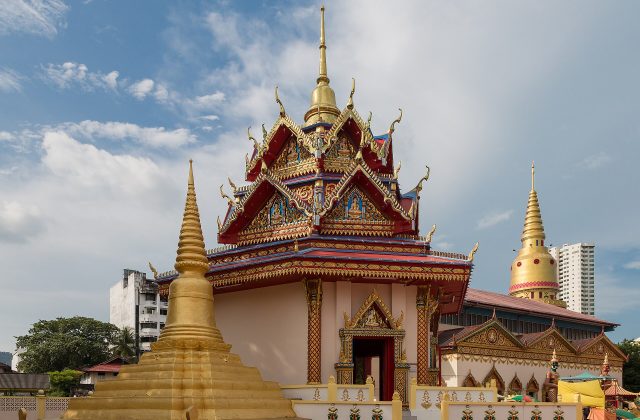
Dhammikarama is the only Burmese temple in Penang and one of the oldest Buddhist foundations on the island. The Burmese community that settled in Pulau Tikus built a modest shrine here in 1803 on land bought and donated by a local woman, Nyonya Betong, and women remained the backbone of the temple for decades, serving as its first trustees. In 1845 the colonial government granted further land so the temple and its burial ground could expand. The oldest structure is the stupa, consecrated in 1805 and later encased within a larger outer stupa in 1838. The ordination hall built at the same time is guarded by two stone elephants; inside, a standing Buddha is set against a gilded, carved backdrop under a ceiling of brown lacquered woodwork.
Elsewhere in the compound look for the pair of winged chimeras that guard the world, a long mural of the Buddha leaving his palace to seek enlightenment, the shrine of the monk Upagutta, believed to ward off danger, and the Golden Pagoda Bell Tower completed in 2011 by craftsmen brought in from Myanmar. Chinthe, the lion-like guardians of Burmese temples, appear at gateways and stairs, and statues of elephants, fish and the garuda stand among the gardens to represent land, sea and sky. This is a monastery with resident monks, a library and lodgings for novices, so keep voices low and dress modestly. Remove your shoes before stepping into the shrine halls and do not point your feet towards the Buddha images or the monks. Women should not touch a monk or hand anything to him directly. Photography is generally accepted in the courtyards; be more discreet inside the halls when people are praying.
The temple is open daily from early morning until late afternoon or early evening; check locally for exact hours, as they are not published widely. Mornings are the most pleasant time, with gentler light on the gilded pagoda and fewer coach groups, who tend to arrive mid-morning on the island tours. Penang is hot and humid all year. December to February is usually the driest stretch, while heavy afternoon showers are common from September to November.
The temple is busiest and most festive during the Burmese New Year water festival in mid-April, when devotees splash water and bathe the Buddha images, and it also draws crowds during the Buddhist Lent and at Wesak in May, when processions and offerings fill the courtyards. Allow 30 to 45 minutes here, then cross the lane to Wat Chayamangkalaram and its large reclining Buddha. Together the two temples make a comfortable hour, and the cafes and hawker stalls of Pulau Tikus are a short walk away.
6 km away
Kek Lok Si is an active monastery, and walking into the grounds and the main shrine halls costs nothing.
4 tickets & tours
287 km away
The main sight at Batu Caves, the Temple Cave at the top of the great staircase, is free to enter, so you do not need a…
4 tickets & tours
299 km away
Thean Hou Temple is free to enter and needs no ticket. It stands on Robson Heights, a hill just south of central Kuala…
1 ticket or tour
Yes. GetYourGuide sells tickets and guided tours whose route includes Dhammikarama Burmese Temple; live prices are shown on this page.
The temple is open daily from early morning until late afternoon or early evening; check locally for exact hours, as they are not published widely.
Allow 30 to 45 minutes here, then cross the lane to Wat Chayamangkalaram and its large reclining Buddha.
Shoulders and knees covered; shoes off before entering the shrine halls.
Entry to Dhammikarama Burmese Temple: Free; donations welcome
Dhammikarama Burmese Temple was established in 1803.
Dhammikarama Burmese Temple is in George Town, Malaysia. The map on this page shows the exact spot.
How to visit a Buddhist temple: shoes, dress and manners — Shoes, dress, feet, photos and offerings in Buddhist temples, from the wats of Thailand and Sri Lanka to the Zen temples of Japan.
George Town, Malaysia
Kek Lok Si is an active monastery, and walking into the grounds and the main shrine halls costs nothing.
4 tickets & tours
George Town, Malaysia
There is nothing to book for Wat Chayamangkalaram itself.
No online ticket