
Garni Temple
20 km away
Garni is about 30 km east of Yerevan and almost every visit is made by road, either by taxi or private driver or on an…
31 tickets & tours
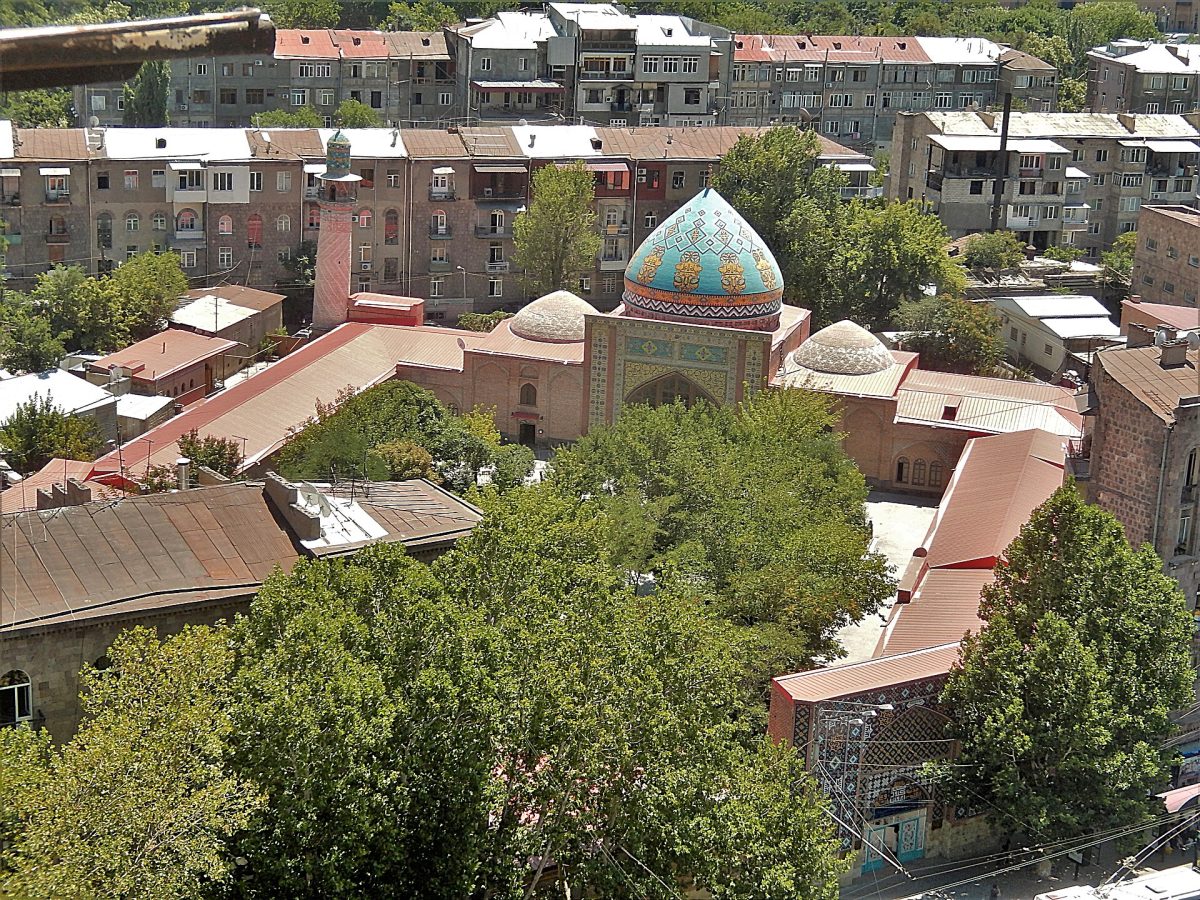
Photo: Armineaghayan, CC BY-SA 4.0
There is nothing to book for the Blue Mosque. Entry to the courtyard and the prayer hall is free, there is no ticket office and no tour for the mosque alone sold online. Visitors simply walk in from Mashtots Avenue through the main gate, and a donation is welcome but not expected. Most travellers come on foot, since the mosque lies in the centre of Yerevan, about fifteen minutes' walk from Republic Square and directly across the avenue from the old covered market.
It fits naturally into a self-guided walk up Mashtots Avenue to the Matenadaran manuscript museum at its northern end, with the Cascade and the Opera House a few minutes beyond. Some guided walking tours of central Yerevan include a stop in the courtyard, usually as a short look at the city's Persian past between the Soviet buildings and the churches, and private city tours by car sometimes add it on request. Day trips from Yerevan to Garni, Geghard or Echmiadzin do not normally come here, so if you want time inside, plan your own visit. A guide adds little beyond the history, which the information boards and the staff of the Iranian cultural centre on site can explain. The page lists any GetYourGuide tours whose route passes the mosque.
Live prices from GetYourGuide for tickets and tours that include this temple. Free cancellation on most of them.
The Blue Mosque is a reminder that Yerevan was for centuries a provincial capital of Iran. Hoseyn Ali Khan, ruler of the Erivan Khanate, built it in 1765 and 1766 as the city's main Friday mosque, and when Russian troops took the city in 1827 it was the largest of eight mosques here. It was retiled under Russian rule in the late nineteenth century, closed in the 1920s, and served for more than fifty years as the city's history museum. After Armenian independence it was restored with Iranian support and reopened for worship; it is now the only working mosque in the country, used mainly by Iranian residents and visitors. The complex covers about 0.7 hectares. Behind a plain street wall lies a long courtyard planted with mulberry and other shade trees around a pool, lined with rows of small cells that once housed the students of the madrasa.
On one side stands the prayer hall under its turquoise-tiled dome, and above it rises the minaret, 24 m tall, which in the nineteenth century was the highest structure in Yerevan. Look closely at the tilework on the portals and the dome, much of it renewed by Iranian craftsmen, and at the painted ceilings in the smaller hall on the north side of the court, which earlier travellers singled out for praise. The courtyard is a peaceful retreat from the traffic of Mashtots Avenue. Dress modestly; women should bring a scarf for the prayer hall, and everyone removes shoes before entering. Avoid walking in front of people at prayer, and ask before photographing worshippers.
The mosque is generally open to visitors during the day, from mid-morning until early evening; the exact hours are not published, and the prayer hall may be closed to non-worshippers during prayer times. Avoid Friday around midday, when the congregational prayer takes priority. A weekday morning or afternoon is quietest, and late afternoon light is kind to the tiles of the dome and the minaret. Yerevan's best seasons are spring, from late April to early June, and autumn, from September to October.
Summers are hot and dry, which makes the shaded courtyard particularly welcome in July and August, while winters are cold. Around Nowruz, the Persian New Year in late March, many Iranian visitors come to Yerevan and the mosque is at its busiest and most festive; during Ramadan the evening gatherings are lively, though visitor access may be restricted. Allow 30 to 45 minutes. Combine it with the covered market across the road, the Matenadaran, the Cascade and Republic Square in a single walk.
20 km away
Garni is about 30 km east of Yerevan and almost every visit is made by road, either by taxi or private driver or on an…
31 tickets & tours
Yes. GetYourGuide sells tickets and guided tours whose route includes Blue Mosque, Yerevan; live prices are shown on this page.
The mosque is generally open to visitors during the day, from mid-morning until early evening; the exact hours are not published, and the prayer hall may be closed to non-worshippers during prayer times.
Allow 30 to 45 minutes.
Entry to Blue Mosque, Yerevan: Free
Shoulders and knees covered; women cover their hair in the prayer hall.
Blue Mosque, Yerevan covers 7 000 m².
Blue Mosque, Yerevan was established in 1765.
Blue Mosque, Yerevan is in Yerevan, Armenia. The map on this page shows the exact spot.
How to visit a mosque: dress, timing and manners — What to wear, when to go and how to behave in a mosque as a non-Muslim, and which mosques do not admit visitors at all.