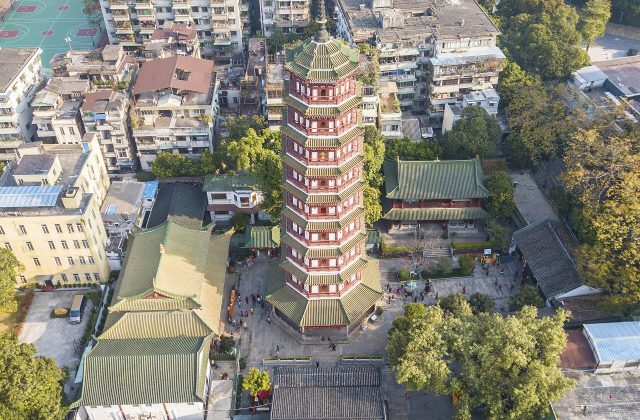
Temple of the Six Banyan Trees (Liurong)
109 km away
Liurong, the Temple of the Six Banyan Trees, is a working monastery in the old centre of Guangzhou, and you simply pay…
1 ticket or tour
Chinese Temple · Macau · China

There is no ticket to buy for A-Ma Temple and none of the online booking platforms sells entry to it on its own. The temple is an active place of worship, open to everyone without charge, and visitors simply walk in from Barra Square at the southern tip of the Macau peninsula. Incense sticks and offerings are sold at stalls near the entrance if you would like to make one, and donation boxes stand inside the halls. Most travellers reach the temple in one of three ways. Many come on foot as the final stop of a walk through the Historic Centre of Macau, heading south from Senado Square past St Lawrence's Church, the Mandarin's House and Lilau Square;
the walk takes around half an hour at an easy pace. Others arrive on a guided city tour, often a full-day trip from Hong Kong by ferry or across the long bridge to Zhuhai and Macau, in which the temple is paired with the Ruins of St Paul's, Senado Square and a casino district. Such trips usually include transport, a guide and sometimes lunch, while the temple itself costs nothing. Several public bus routes stop at Barra, and taxis can drop you at the square. The page lists any GetYourGuide tours whose itinerary passes the temple, but the place is easy to see independently, and it rewards a slower, unguided visit.
Live prices from GetYourGuide for tickets and tours that include this temple. Free cancellation on most of them.
A-Ma Temple honours Mazu, the Fujianese goddess of the sea who protects fishermen and sailors, and it is among the oldest buildings in Macau. Tradition dates the first shrine to 1488, decades before the Portuguese arrived, and the city is widely believed to take its name from it: Portuguese sailors landing on the shore below were told the place was A-Ma-Gao, the bay of A-Ma, and their versions of that phrase eventually became Macau. Since 2005 the temple has formed part of the Historic Centre of Macau World Heritage Site. Rather than a single building, the complex is a group of small pavilions climbing the wooded slope of Barra Hill, linked by stone steps, terraces and moon gates.
You enter through the granite gate pavilion and pass a memorial arch before reaching the prayer hall, then continue upwards to the Hall of Benevolence, the oldest and smallest shrine, the Hall of Guanyin, and a Buddhist pavilion near the top. Look for the large spiral incense coils hanging from the ceilings, each burning for days on behalf of a family, and for the boulders around the paths carved with inscriptions and a relief of a junk, recalling the legend of the goddess calming a storm. This is a place where people pray in earnest, often in thick smoke, so step aside for worshippers, do not walk between them and the altars, and keep photography discreet inside the shrines. Shoes may be worn. Across the road the Macau Maritime Museum explains the fishing and trading history that the temple grew out of.
The temple opens early in the morning and closes in the early evening, roughly from 7 am to 6 pm, though hours can be longer at festival times. The best time is the first hour after opening, when local worshippers come before work and the tour groups from Hong Kong have not yet arrived; by late morning the narrow paths become crowded. Autumn, from October to December, brings the clearest and most comfortable weather. Summers are hot, humid and wet, with typhoons possible.
The temple is at its busiest and most atmospheric over Chinese New Year, when queues form to offer the first incense of the year, and on the goddess's birthday on the 23rd day of the third lunar month, usually in April or May, when Chinese opera and lion dances are staged nearby. Allow 45 minutes to an hour. Combine it with the Maritime Museum, the Moorish Barracks, the Mandarin's House and the walk north to Senado Square.
109 km away
Liurong, the Temple of the Six Banyan Trees, is a working monastery in the old centre of Guangzhou, and you simply pay…
1 ticket or tour
Yes. GetYourGuide sells tickets and guided tours whose route includes A-Ma Temple; live prices are shown on this page.
Allow 45 minutes to an hour.
The best time is the first hour after opening, when local worshippers come before work and the tour groups from Hong Kong have not yet arrived; by late morning the narrow paths become crowded.
Entry to A-Ma Temple: Free
No strict dress code; modest clothing is respectful inside the shrines.
A-Ma Temple was established in 1488.
A-Ma Temple is in Macau, China. The map on this page shows the exact spot.
How to visit a Chinese temple: incense, gods and manners — How to behave in Taoist, Confucian and folk temples in China, Taiwan, Hong Kong and South-East Asia: incense, thresholds and fortunes.