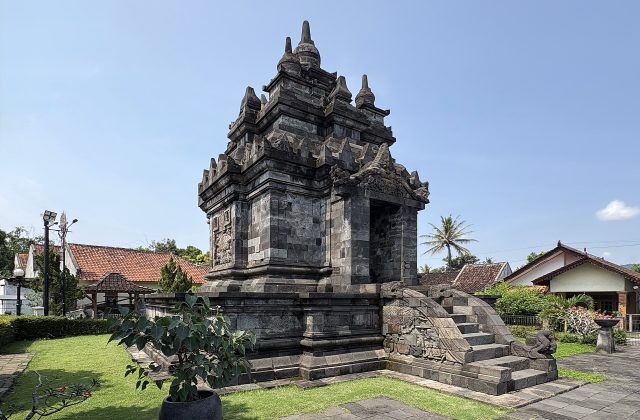
Prambanan Temple
2 km away
Prambanan is easy to visit independently: you buy an entry ticket at the gate or online, and the ticket covers the main…
297 tickets & tours
Ancient Temple · Yogyakarta · Indonesia

Photo: Victoria Lara Labaila, CC BY-SA 4.0
No ticket for Plaosan is sold online, and there is no need for one. You pay a modest entry fee at the small ticket booth beside the car park, foreigners at a higher rate than Indonesians, and walk straight in. Plaosan Lor, the northern complex with the twin main temples, is the part most people mean; Plaosan Kidul, across the road to the south, is a smaller field of restored shrines that you can see on the same visit. The temple lies about 1 km north-east of Prambanan, roughly 17 km east of central Yogyakarta, and it is easy to add to a Prambanan day.
Many visitors hire a car and driver for the day from Yogyakarta, or a ride-hailing car or motorbike, and work through the Buddhist and Hindu temples of the Prambanan plain at their own pace: Plaosan, Sewu, Sojiwan and Kalasan, with Ratu Boko on the hill above. Day trips from the city that focus on Borobudur and Prambanan sometimes stop here briefly; ask in advance if you want time at Plaosan, as it is often skipped. Cyclists like the area too: guided bicycle rides through the villages and rice fields around Prambanan regularly include Plaosan, with the bike, a guide and drinks usually included and the temple fees paid on the day. There is no guide service at the gate, so read up beforehand or bring an independent guide from Yogyakarta.
Live prices from GetYourGuide for tickets and tours that include this temple. Free cancellation on most of them.
Plaosan was built in the mid-9th century, in the years when the Buddhist Sailendra dynasty and the Hindu Sanjaya line were joined by the marriage of Pramodhawardhani, daughter of King Samaratungga, and Rakai Pikatan. Inscriptions on the small shrines record gifts by the king and by court officials, and the complex is often read as a monument to that union of two faiths a short walk from Hindu Prambanan. At Plaosan Lor two large twin temples stand side by side within a walled court, each guarded at the gate by a pair of fierce Dwarapala statues with clubs. Around them run rows of smaller shrines and stupas, 174 buildings in all across the complex, many still lying as heaps of numbered stones waiting for reassembly.
Each main temple is a two-storey structure divided into three rooms; holes in the walls once held the beams of a wooden upper floor. Inside, stone Bodhisattvas still sit on either side of empty pedestals where bronze Buddhas once stood, and the outer walls carry fine reliefs of standing male and female figures. Look in the rooms for the carving of a prince wearing a crown often identified as Khmer. The 2006 earthquake damaged the complex, and restoration continues, so some areas may be fenced. Walk round the main temples clockwise, do not climb on loose stones or stupas, and keep drones in the bag unless you have a permit. The site is small and quiet, a welcome contrast to the crowds at Prambanan.
Plaosan opens early in the morning and closes in the late afternoon every day; check locally for the exact times, which have changed in recent years. Sunrise is the favourite moment for photographers, when mist lies over the rice fields and, on clear mornings, Mount Merapi rises behind the twin temples; arrive by 6 am. Late afternoon, from about 4 pm, also gives warm light on the stone. The dry season from May to September brings the most reliable skies and the best chance of seeing Merapi.
During the wet months, from November to March, mornings are usually clear and storms tend to arrive in the afternoon, and the surrounding paddies are at their greenest. Indonesian school holidays and the days after Idul Fitri fill the Prambanan area, though Plaosan rarely feels crowded. The Buddhist Vesak procession in May or June focuses on Borobudur rather than here. Allow 45 minutes to an hour for Plaosan Lor and Kidul together. Combine it with Prambanan and Sewu in the morning and sunset at Ratu Boko.
2 km away
Prambanan is easy to visit independently: you buy an entry ticket at the gate or online, and the ticket covers the main…
297 tickets & tours
5 km away
Candi Ijo does not sell its own tickets online. Entry is paid at a small booth by the car park, the fee is modest, and…
6 tickets & tours
34 km away
Mendut has its own small ticket office and the entry fee is modest, paid on the day;
2 tickets & tours
Yes. GetYourGuide sells tickets and guided tours whose route includes Plaosan Lor Temple; live prices are shown on this page.
Entry to Plaosan Lor Temple: Small fee at the gate
Allow 45 minutes to an hour for Plaosan Lor and Kidul together.
Shoulders and knees covered; no other special rules for visitors.
Plaosan Lor Temple is in Yogyakarta, Indonesia. The map on this page shows the exact spot.
How to visit an ancient temple: tickets, heat and rules — Tickets, hours, heat, guides, climbing rules and conservation at the ancient temples of Egypt, Greece, Italy, Angkor and the Maya world.
Yogyakarta, Indonesia
Visiting Borobudur now involves two decisions rather than one.
370 tickets & tours
Yogyakarta, Indonesia
Prambanan is easy to visit independently: you buy an entry ticket at the gate or online, and the ticket covers the main…
297 tickets & tours
Yogyakarta, Indonesia
Candi Ijo does not sell its own tickets online. Entry is paid at a small booth by the car park, the fee is modest, and…
6 tickets & tours
Yogyakarta, Indonesia
Mendut has its own small ticket office and the entry fee is modest, paid on the day;
2 tickets & tours
Yogyakarta, Indonesia
Candi Pawon is a small Buddhist shrine standing in a village garden between Mendut and Borobudur, about 40 km…
1 ticket or tour