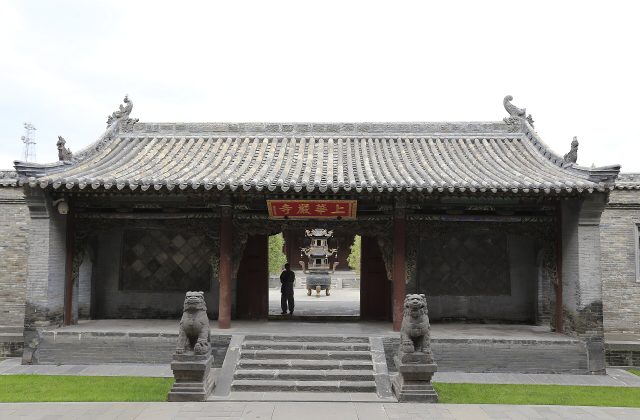
Huayan Temple, Datong
Datong, China
Huayan Temple charges an entry fee at the gate in Datong's old city, and tickets can also be bought in advance as…
6 tickets & tours
Chinese Temple · Datong · China

The Hanging Temple sits in a gorge about 65 km south-east of Datong, so the real question is transport rather than tickets. At the site there are two charges: a small one for the scenic area at the foot of the cliff and a considerably higher one to climb up into the temple itself, which is limited by a daily quota and sometimes sold in time slots at busy periods. Without the second ticket you can only admire the building from below. Almost every tour sold online starts in Datong and uses a private car or a small shared bus. The standard day pairs the temple with the Yungang Grottoes on the western edge of the city;
other routes swap the grottoes for the great wooden pagoda at Yingxian or for a walk on Hengshan, the Taoist holy mountain whose slope rises above the gorge. Private versions include a driver and sometimes an English-speaking guide, while the self-guided car options give you only the driver and leave the explanations to you. Check whether the climbing ticket is included, since many prices cover only the transfer. An early-entry option gets you onto the walkways before the coaches arrive, which makes a real difference here because the galleries are narrow. From Beijing there is a long day trip by high-speed train and car, but an overnight stay in Datong is far more relaxed.
Live dates and prices from GetYourGuide. Free cancellation on most tickets.
Tradition says a monk called Liaoran began the temple around 491, under the Northern Wei, and it has been rebuilt and repaired many times since; most of what stands today dates from the Ming and Qing periods. Some forty small halls and pavilions cling to the west wall of the Jinxia Gorge, linked by plank walkways, stairways and short bridges, and appear to rest on thin wooden poles. In reality the weight is carried by oak beams driven deep into sockets cut in the rock, and the overhanging cliff shelters the buildings from rain and the strongest sun. The climb runs one way along a fixed circuit.
The highlight is the Hall of the Three Religions near the top, where statues of the Buddha, Laozi and Confucius sit side by side, a rare reminder that Buddhism, Taoism and Confucianism were once worshipped together. Along the way look for the bronze, iron, clay and stone figures in the tiny shrines, the painted ceilings and the view straight down to the riverbed. The walkways are only wide enough for one person in places, and staff keep the queue moving, so take photographs from the viewpoints below rather than on the stairs. Visitors with a fear of heights should think twice before climbing. Photography is allowed, but incense is not lit inside the wooden halls. Without a car, the site can be reached by bus from Datong to Hunyuan town and a taxi for the last few kilometres.
The site is open daily from morning until early evening in summer, with shorter hours in winter, and the climb closes before the scenic area does. Arrive at opening: by mid-morning tour groups queue for the walkways, and on Chinese holidays the wait can be long. May to October is the best period, with green slopes in early summer and clear air in September and October. Winter is bitterly cold and the stairs can be icy, though the temple under snow is spectacular and almost empty.
Avoid the first week of May and the first week of October, when domestic travel peaks. Allow about an hour and a half on site, plus roughly 90 minutes by road each way from Datong. The usual pairing is the Yungang Grottoes in the afternoon, or Yingxian's wooden pagoda on the way back; with an extra half day, the old walled city of Datong itself rewards an evening stroll.
Yes. GetYourGuide lists 12 tickets and tours for Hanging Temple (Xuankong Si), with live dates and prices and free cancellation on most of them.
The site is open daily from morning until early evening in summer, with shorter hours in winter, and the climb closes before the scenic area does.
Allow about an hour and a half on site, plus roughly 90 minutes by road each way from Datong.
May to October is the best period, with green slopes in early summer and clear air in September and October.
Photography is allowed, but incense is not lit inside the wooden halls.
No dress code; flat shoes with grip for the narrow wooden walkways and steep stairs.
Hanging Temple (Xuankong Si) was established in 491.
Hanging Temple (Xuankong Si) is in Datong, China. The map on this page shows the exact spot.
How to visit a Chinese temple: incense, gods and manners — How to behave in Taoist, Confucian and folk temples in China, Taiwan, Hong Kong and South-East Asia: incense, thresholds and fortunes.
Datong, China
Huayan Temple charges an entry fee at the gate in Datong's old city, and tickets can also be bought in advance as…
6 tickets & tours